
TL;DR

Get cleaning gear delivered free with Prime
- Fast, free delivery on millions of items
- Prime Video, Amazon Music and more included
- Member-only deals all year
Moving your rig into another room or closet drastically cuts noise—not just with foam but by creating distance and proper ventilation. Proper placement, treatment, and airflow are key to a quiet, effective workspace, especially for small rooms or closets.
Ever notice how loud your gaming or AI rig sounds? Or how tiny your closet sounds like a cavern when you record vocals? Here’s the truth: the most effective way to quiet your setup isn’t just stuffing foam panels everywhere. It’s about where your rig sits, how you treat the space around it, and especially—how you move it out of your main workspace. Learn more about acoustic treatment and setup.
If you want a workspace that’s silent, cool, and professional, you need to think beyond just dampening sound. You need smart placement. And that’s what this guide is about: how to make your rig whisper-quiet and cool, even if it’s tucked in a small closet or corner. Ready to turn that noisy mess into a peaceful sanctuary? Let’s go.
Acoustic dampening
& the rig in the closet.
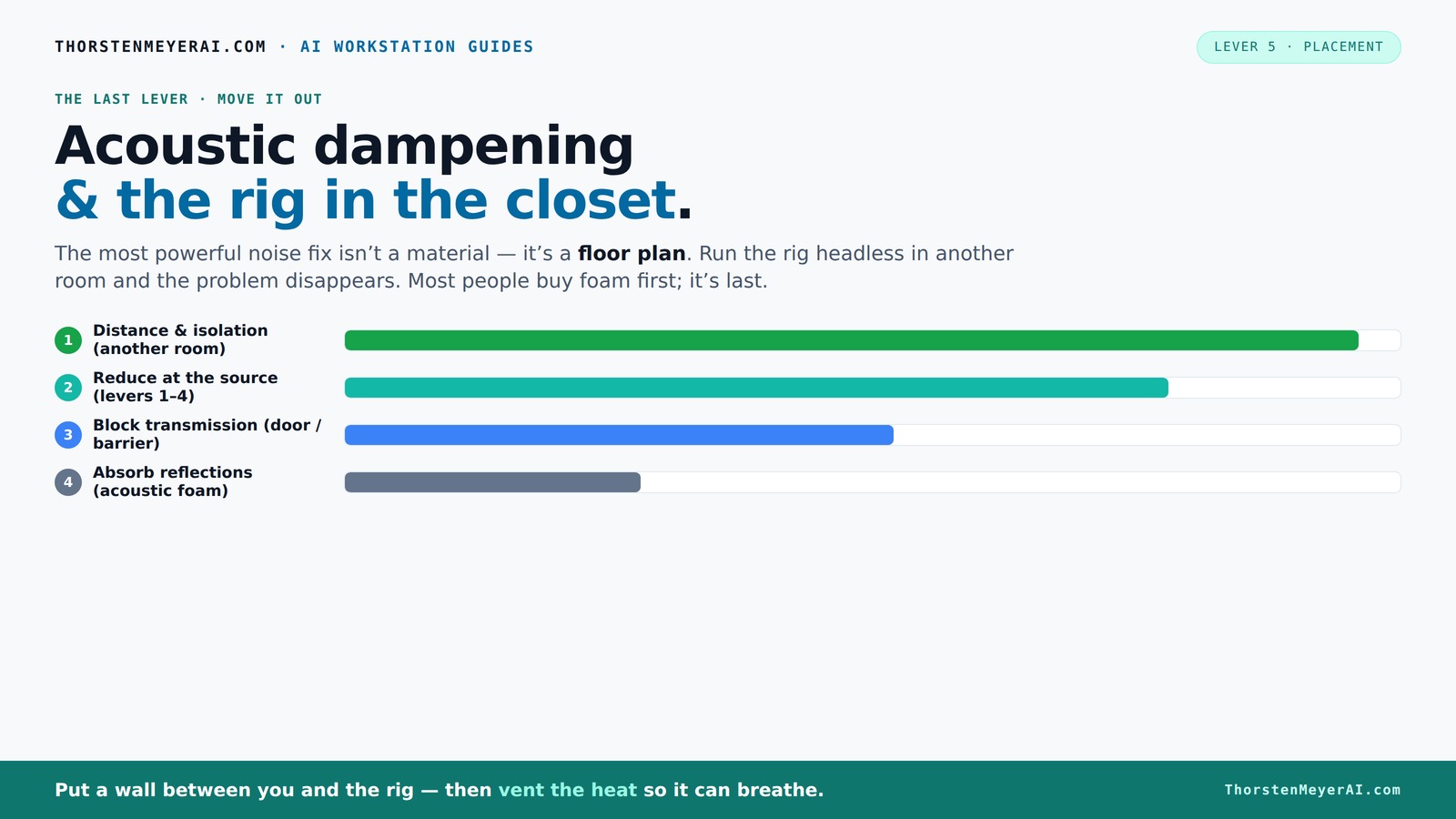
The most powerful noise fix isn’t a material — it’s a floor plan. A rig you can’t hear because it’s in another room beats any amount of foam. Tap the approaches in Part 1 to see what actually works.
(another room)
(levers 1–4)
(door / barrier)
(acoustic foam)
Contain the noise, not the heat
Key Takeaways
- Distance is king. Moving your rig into another room or closet cuts noise more than foam ever will.
- Ventilation isn’t optional—hot, sealed closets trap heat and throttle performance. Use active airflow solutions.
- Treat reflection points behind the mic and on side walls for the biggest sound quality boost in small spaces.
- Seal gaps around doors and vents. Sound leaks undermine your effort, no matter how much foam you add.
- Budget DIY solutions—blankets, rugs, and creative placement—can turn a tiny closet into a surprisingly effective vocal booth.
soundproof acoustic foam panels for studio
As an affiliate, we earn on qualifying purchases.
As an affiliate, we earn on qualifying purchases.
Why Distance and Isolation Are Your Best Noise Fixes
Distance and isolation top the list because they cut the noise at its source—your rig. If you put the machine in another room, a basement, or even a closet with a door, the sound doesn’t reach you. Think about how a loud fan or GPU hum drops off dramatically just by moving it across the hall.
For example, I set up a powerful AI workstation in a spare closet. With a wired connection and proper airflow, I can barely hear it from my desk. No amount of foam or panels beats being far away from the noise. It’s simple, effective, and often overlooked.
This approach works so well because it leverages the physics of sound: the farther you are, the quieter it gets. Plus, network-based workflows mean you don’t need your machine next to you. SSH into the rig, run your models, and forget about noise.
quiet computer case with sound dampening
As an affiliate, we earn on qualifying purchases.
As an affiliate, we earn on qualifying purchases.
The 'Rig in the Closet' Setup — How to Do It Right
Putting your noisy, heat-generating rig inside a closet or cabinet can be a game-changer. But here’s the catch: heat needs to escape, or you risk cooking your hardware. Without airflow, trapped heat makes fans roar and throttles performance.
First, ensure there’s active ventilation—think of a small exhaust fan or vents that allow hot air to escape. For more tips on effective cooling solutions, see this guide on reducing heat and noise in high-power AI workstations.
Plus, consider using a soundproof enclosure if you want both quiet and cool. These units combine acoustic foam with ducted, temperature-controlled airflow. They cost more but are perfect for a 24/7 rig in a tiny space. Check out this detailed guide on [how to reduce heat and noise in a high-power AI workstation](https://thorstenmeyerai.com/reduce-heat-noise-ai-workstation/).
portable soundproof booth for recording
As an affiliate, we earn on qualifying purchases.
As an affiliate, we earn on qualifying purchases.
How to Position Acoustic Treatment for Maximum Effectiveness
Acoustic dampening isn’t about covering every inch with foam; it’s about strategic placement. The first reflection points—behind the mic and on side walls—are the most crucial. In a small closet, treating these points cuts echo and harshness dramatically.
For example, hang a thick blanket about 2 inches off the wall behind your mic to absorb early reflections. Move blankets, foam panels, or acoustic tiles to the ceiling and side walls where sound bounces most. Use dense materials like moving blankets or thick foam for best results.
Remember, soft materials absorb sound, but hard surfaces reflect it. So, softening the walls, ceiling, and nearby surfaces prevents that annoying boxy echo and low-end buildup.
Check out how to treat a small room for vocals for detailed placement tips.
PC noise reduction isolation enclosure
As an affiliate, we earn on qualifying purchases.
As an affiliate, we earn on qualifying purchases.
Common Mistakes That Kill Small-Room Sound Quality
Many people make the mistake of over-treating or treating the wrong surfaces. Covering too much can make your room sound dull, not quieter. Poor placement—like sticking foam on the ceiling or far from reflection points—won’t help much.
Another trap: sealing up the room completely without ventilation. It’s like putting a fire in a sealed box—heat builds up fast. Also, neglecting door gaps and cracks lets sound leak out or in, ruining the effect.
For example, I once sealed my closet door with weatherstripping, only to find that the heat inside soared because of poor airflow. Adding a small passive vent fixed that problem instantly. The lesson: treat the right surfaces, leave some gaps for air, and don’t overdo it.
DIY Budget Closet Booth Ideas That Actually Work
You don’t need expensive construction to create a quiet booth in your closet. Soft blankets, thick rugs, and DIY panels can cut reflections and reduce echo. For instance, hang moving blankets on walls about 2-3 inches away from the surface for better absorption.
Stack old mattress toppers or acoustic foam panels to build a makeshift booth. Use command hooks and duct tape for easy rearranging. Cover the door with a heavy curtain or blankets to seal gaps and add a layer of soundproofing.
In my own setup, I layered blankets and foam on the walls, added a thick rug on the floor, and sealed gaps around the door with weatherstripping. The result: a surprisingly clean vocal sound with minimal cost and effort.
Check out DIY closet booth ideas for more creative, budget-friendly solutions.
When Treatment Isn’t Enough — Going Beyond Absorption
Absorbing internal reflections is one thing, but stopping sound from escaping or entering takes more effort. If sound leaks through gaps or the door, no amount of foam will help. You need sealing, added mass, or decoupling.
For example, sealing gaps with acoustic sealant or weatherstripping drastically reduces sound leaks. Adding mass—like a heavy, dense door—further blocks transmission. Decoupling—using rubber grommets or anti-vibration pads—prevents vibrations from transmitting through walls or floors.
Remember, true soundproofing is a layered approach. It involves sealing gaps, adding mass, and decoupling vibrations, not just stuffing foam in corners. For detailed methods, see soundproofing an enclosed space.
Choosing the Right Microphone and Placement for Small Spaces
Your choice of microphone matters just as much as treatment. In small, treated spaces, microphones that reject off-axis sound or have a tight pickup pattern help reduce room coloration. Learn more about optimizing your home studio setup.ration. Cardioid or hypercardioid mics are often better than omnidirectional ones.
Position the mic so that it faces away from reflective surfaces and toward the sound source. For example, place the mic 6-12 inches from your mouth, angling it slightly downward or upward to avoid capturing reflections from walls or the ceiling.
In a tiny closet, avoid placing the mic directly against the wall or near hard surfaces. Use a shock mount or a boom arm to position it away from reflective surfaces, ensuring a clearer, warmer sound.
Learn more about mic and room interaction in [best mics for small rooms](https://gearspace.com/board/music-for-picture/1258132-soundproofing-isolating-small-room-closet.html).
Conclusion
Shifting your noisy rig into a closet or another room isn’t just about quiet—it's about controlling heat, reflections, and leaks. When you combine smart placement with proper ventilation and targeted acoustic treatment, you create a workspace that’s both serene and powerful.
So, next time your setup feels overwhelming, remember: sometimes, the best fix is simply putting distance between you and the noise. Your ears—and your hardware—will thank you.
Halloween Picks
halloween
As an affiliate, we earn on qualifying purchases.