
Choosing between countertop filters, distillers, and RO systems depends on your priorities. Countertop filters are easy to use, retain beneficial minerals, and improve taste but may not remove all contaminants. Distillers produce pure water but can lack minerals and taste dull. RO systems offer thorough filtration and can include mineralization options but may waste water and strip beneficial minerals. To find the best fit for your needs, explore the details further below.
Key Takeaways
- Countertop filters retain natural minerals, improve taste, and are easy to maintain, but may not remove all contaminants.
- Distillers produce highly purified water, but remove minerals, often resulting in flat taste and acidity.
- RO systems offer comprehensive contaminant removal but can strip beneficial minerals and generate wastewater.
- Distillation and RO processes can lower water pH, making it more acidic; some systems include mineralization features.
- Choice depends on desired purification level, mineral retention, taste preferences, and environmental considerations.
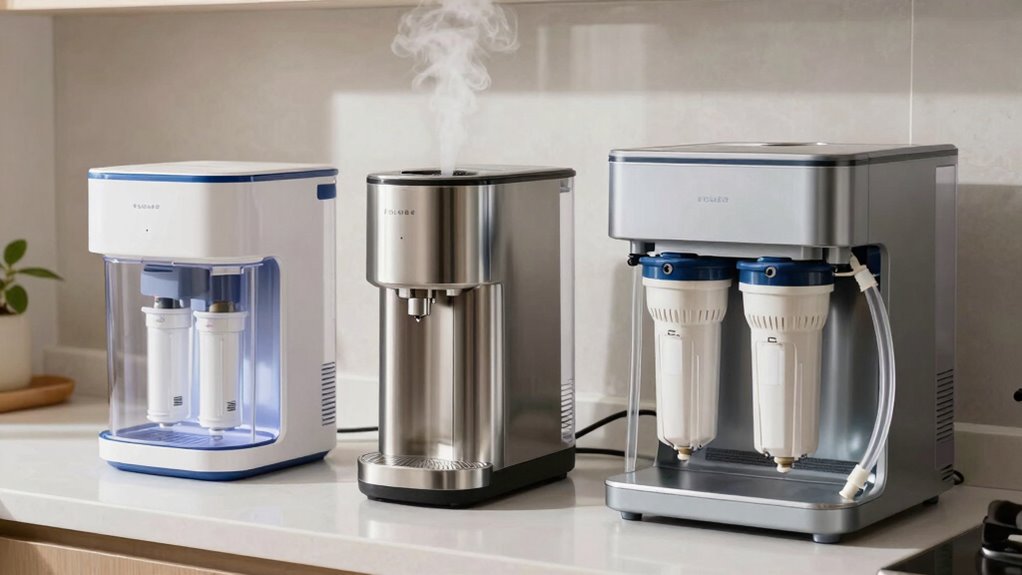
When choosing a water purification system, understanding the differences between countertop water filters, distillers, and reverse osmosis (RO) systems is essential. Each method offers unique benefits and drawbacks, especially when it comes to maintaining pH balance and mineral retention in your water. As you explore your options, keep in mind that your priorities—whether it’s taste, health, or convenience—will influence which system suits you best.
Countertop water filters are popular for their simplicity and ease of use. They typically use activated carbon or other media to remove chlorine, sediment, and some contaminants. While they do a good job of improving taste and odor, they may not remove all dissolved solids or microorganisms. One advantage is that they often preserve the natural mineral content of your water, helping maintain a healthy pH balance. This is important because minerals like calcium and magnesium not only contribute to taste but also support your body’s mineral intake. If you prefer water that retains its natural mineral profile while reducing harmful substances, a countertop filter could be a suitable choice.
Distillers operate differently by boiling water and then condensing the steam back into liquid form. This process effectively eliminates bacteria, viruses, heavy metals, and many chemicals. However, because distillation removes most minerals, the resulting water can become acidic and lacking in essential elements, disrupting the pH balance. Some people find the flat or dull taste of distilled water unappealing, especially if they rely on it as a primary source. On the plus side, distillers produce highly purified water, but the downside is the loss of beneficial minerals, which can be significant if you drink distilled water regularly. Additionally, the mineral content of water plays a crucial role in maintaining its overall health benefits. Without proper mineral retention, the water can also become acidic, which may negatively affect overall health. This loss of minerals can also impact the pH balance, making the water more prone to acidity. Furthermore, understanding the water purification process can help you make more informed decisions based on your health needs.
Reverse osmosis systems use pressure to force water through a semi-permeable membrane that filters out a broad range of contaminants, including salts, chemicals, and microorganisms. RO systems excel at producing clean, safe water with a neutral taste, but they also tend to strip away many minerals. As a result, the water may have a lower pH and lack the mineral content that supports a healthy pH balance. Some systems include mineral cartridges to add back beneficial minerals to help restore both flavor and pH. If mineral retention and pH stability are important to you, look for an RO system that incorporates remineralization features. Moreover, the environmental impact of waste water generated by RO systems is a consideration for sustainable living practices.
In the end, your choice depends on what you prioritize—whether it’s ease of use, purification level, mineral retention, or maintaining pH balance. Each system has its strengths, so consider your water quality needs and personal preferences carefully.
countertop water filter with mineral retention
As an affiliate, we earn on qualifying purchases.
As an affiliate, we earn on qualifying purchases.
Frequently Asked Questions
Which System Is Best for Removing Heavy Metals From Water?
You should choose a distiller for removing heavy metals from water because it provides effective heavy metal absorption, ensuring these toxins are eliminated. Unlike some filters, distillers also retain essential minerals, so you don’t lose beneficial nutrients. Reverse osmosis systems also work well for heavy metal removal, but distillers excel at thorough purification without sacrificing mineral retention. This makes distillation a top choice for safe, clean drinking water.
How Much Maintenance Do Each of These Systems Require?
You’ll find that countertop water filters need minimal maintenance, usually just filter replacement every few months, offering good filter lifespan and cost efficiency. Distillers require regular cleaning and occasional parts replacement but have a longer lifespan, ensuring consistent performance. RO systems demand more upkeep—filter and membrane changes every 6-12 months—but they’re cost-effective over time. Overall, maintenance depends on your water quality and usage, impacting both lifespan and cost efficiency.
Are These Systems Suitable for Well Water?
Yes, these systems can be suitable for well water, but you need to take into account taste improvement and aesthetic considerations. Distillers effectively remove contaminants and improve taste, but they can be bulky. RO systems are versatile and can handle well water with proper pre-treatment, offering good taste and clarity. Countertop filters are convenient, but their effectiveness depends on your water quality. Regular maintenance guarantees peak performance across all systems.
Which Filter Type Preserves Beneficial Minerals in Water?
Ever wonder which filter type preserves beneficial minerals in water? If you want mineral retention and water mineralization, countertop water filters often do the best job. They typically retain essential minerals like calcium and magnesium while removing contaminants. Distillers and RO systems tend to strip away minerals completely, so you’d need to mineralize the water afterward. Choosing a filter that maintains natural mineral levels helps keep your water both healthy and flavorful.
How Do Installation Costs Compare Among the Three Systems?
Installation costs vary among the three systems. Countertop water filters are the most straightforward, with minimal installation required, making their cost the lowest. Distillers typically need less complex setup but may involve more initial investment for equipment. Reverse osmosis (RO) systems usually have higher installation complexity and costs, often needing professional help, especially for under-sink or whole-house models. Overall, expect the cost comparison to reflect these differences in installation complexity.
As an affiliate, we earn on qualifying purchases.
Conclusion
Choosing the right water filtration system depends on what matters most to you—convenience, purity, or cost. Countertop filters offer quick, easy access; distillers provide thorough purification; RO systems deliver all-encompassing filtration for the best taste. Consider your needs, your budget, and your lifestyle. Decide what’s most important—simplicity, safety, or savings—and make an informed choice. Your perfect water solution is out there, waiting to quench your thirst for clean, revitalizing water.
reverse osmosis water filtration system with mineralization
As an affiliate, we earn on qualifying purchases.
As an affiliate, we earn on qualifying purchases.
best countertop water filter for taste and health
As an affiliate, we earn on qualifying purchases.
As an affiliate, we earn on qualifying purchases.