HEPA filters are designed to trap most airborne particles around 0.3 microns, including dust, pollen, and bacteria, effectively removing many common indoor pollutants. They excel at capturing particles via interception, impaction, and diffusion, preventing smaller and larger contaminants from passing through. However, ultrafine particles smaller than 0.1 microns can sometimes slip by due to their tiny size. To understand how these mechanisms work and what might get through, keep exploring further.
Key Takeaways
- HEPA filters efficiently trap 0.3-micron particles, considered the most penetrating size, using multiple filtration mechanisms.
- Particles smaller than 0.3 microns, like ultrafine particles, are also captured mainly through diffusion.
- Larger particles such as dust and pollen are intercepted or impacted directly by fibers in the filter.
- Some very tiny particles, especially those smaller than 0.1 microns, may occasionally slip through due to their movement.
- HEPA filters provide high removal efficiency across a broad range of particle sizes, improving indoor air quality.
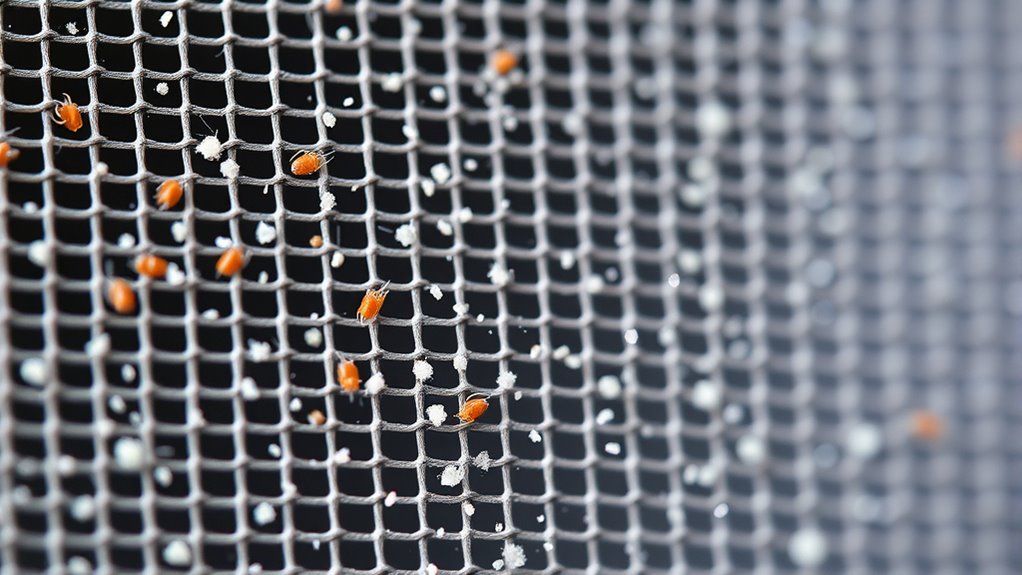
Have you ever wondered what makes HEPA filters so effective at capturing tiny particles? The secret lies in their filtration efficiency and their ability to target specific particle sizes. HEPA filters are designed to trap at least 99.97% of particles that are 0.3 microns in diameter, a size classification that’s surprisingly small. This particle size is often called the most penetrating particle size (MPPS), meaning that particles of this size are the hardest to catch. Yet, HEPA filters are engineered to be highly efficient even at this challenging size, making them incredibly effective at removing airborne contaminants. Their filtration efficiency isn’t just about capturing large debris; it’s about targeting microscopic particles that can cause health problems or compromise air quality.
HEPA filters trap at least 99.97% of 0.3-micron particles, the most challenging size to capture.
Understanding particle size classification is key to grasping how HEPA filters work. Particles in the air vary widely—from dust and pollen to bacteria and smoke. These particles are categorized based on their size, with common classifications including PM10, PM2.5, and ultrafine particles smaller than 0.1 microns. HEPA filters excel at trapping particles in the size range of 0.3 microns, but they also perform well on smaller and larger particles through different mechanisms. For larger debris, the filters use interception and impaction, where particles collide with fibers and are captured. For smaller particles, diffusion plays a significant role—these tiny particles move randomly and bump into fibers more frequently, increasing their chances of being trapped.
Additionally, the filter’s efficiency can be enhanced through electrostatic attraction, which helps in capturing even the smallest particles more effectively. When you look at a HEPA filter, you’re seeing a dense web of fibers designed to maximize this filtration efficiency. The filter’s fiber diameter and packing density are precisely engineered to optimize particle capture across a range of sizes. The filtration process involves multiple mechanisms working simultaneously—interception, impaction, diffusion, and sometimes electrostatic attraction—to ensure that as many particles as possible are removed from the air. This thorough approach is why HEPA filters are so effective at cleaning indoor air and reducing allergens, bacteria, and even some viruses.
In essence, the magic of HEPA filters lies in their ability to classify particles by size and trap them with remarkable efficiency. Despite the tiny scale of these particles, the combination of advanced materials and smart design ensures that most of what you don’t want in your air gets caught before it can reach you. That’s what makes HEPA filtration so reliable in environments where air purity matters most.
Frequently Asked Questions
How Do HEPA Filters Perform Against Viruses?
HEPA filters excel at viral filtration, capturing most airborne viruses effectively. Their high filter efficiency traps tiny particles, including those carrying viruses, preventing them from circulating in the air. You can trust a HEPA filter to reduce viral exposure markedly, especially in enclosed spaces. Just ensure it’s properly maintained and fitted, so it performs at its best and keeps your environment safer from airborne viral threats.
Can HEPA Filters Remove Gases and Odors?
Can HEPA filters remove gases and odors? Not entirely. You might think they do, but their adsorption efficiency for gases is limited. HEPA filters excel at capturing particles, but for odors and chemical fumes, they rely on chemical filtration, usually with activated carbon. This process adsorbs gases more effectively, so if you want to eliminate odors, choose a filter designed with chemical filtration alongside HEPA.
Are All HEPA Filters Equally Effective?
Not all HEPA filters are equally effective. Your filter’s efficiency depends on its quality and design, with higher-rated filters trapping more particles. Over time, filter lifespan decreases as it accumulates debris, reducing effectiveness. To guarantee peak air purification, choose a HEPA filter with a high efficiency rating and replace it regularly. This way, you’ll maximize particle removal and maintain healthy indoor air quality.
How Often Should HEPA Filters Be Replaced?
You should replace your HEPA filter every 6 to 12 months, depending on its filter lifespan and usage. Regular replacement guarantees peak performance and air quality. Check the manufacturer’s recommendations and monitor your filter for signs of dirt or reduced airflow, which indicate it’s time for a replacement. Keep in mind that factors like air pollution levels and household size can influence how often you need to change it.
Do HEPA Filters Work in Humid Environments?
Think of a HEPA filter in a humid environment like a sponge soaking up water; over time, moisture can cause filter degradation, reducing efficiency. While HEPA filters do work in humid conditions, excessive humidity can lead to mold growth and clogging. To guarantee peak performance, consider using a dehumidifier or choosing filters designed for high humidity, which helps maintain their ability to trap particles effectively.
Conclusion
Understanding HEPA particle sizes helps you know what’s truly filtered out. Did you know HEPA filters trap 99.97% of particles as small as 0.3 microns? That’s tiny—about 1/300th the width of a human hair! So, next time you breathe clean air, remember those microscopic particles are being caught, protecting your health. Staying informed about what gets trapped guarantees you’re making the best choices for your indoor air quality.