
TL;DR

Get cleaning gear delivered free with Prime
- Fast, free delivery on millions of items
- Prime Video, Amazon Music and more included
- Member-only deals all year
The best variable speed pool pump 3 HP replacement depends on more than horsepower: confirm voltage, installation type, plumbing, controls, and the flow your pool actually needs. CrestWave, BLACK+DECKER, VEVOR, and Dewenwils offer different combinations of app control, stated flow, and construction, but their published specifications are not perfectly comparable. Before buying, have a pool professional verify the hydraulic and electrical fit, then use low-speed operation for routine circulation where your system allows.
A pump marked 3 HP can still be the wrong pump for your pool. One model’s listing claims 85 GPM; another claims 190 GPM. That gap is a good reminder that horsepower alone won’t tell you how a pump will behave in your plumbing or whether it will fit your existing setup.
If you’re searching for the best variable speed pool pump 3 HP, you may also be replacing a Doheny’s Pool Pro unit described as a 230-volt, hard-wired pump with a programmable timer and a stated maximum flow of 131 GPM. That model may not be easy to find, so this guide compares four listed alternatives without treating any product listing as a promise of fit or availability.
You’ll see how to compare specs, spot mismatches, and decide what to ask an installer before you buy. The goal is simple: choose a pump that circulates your water reliably without paying for speed your pool doesn’t need.
Match the pump’s voltage, pool type, plumbing connections, and controls—not just its 3 HP label.
Treat listed flow figures such as 85 GPM and 190 GPM as claims to verify against pump curves and equipment limits.
Use lower speeds for routine circulation when your filter and connected equipment operate correctly at those settings.
Compare app control, timers, and touchscreens with your actual routine and existing automation system.
Have a licensed professional verify electrical work, bonding, grounding, permits, and installation fit.
Why a 3 HP label does not tell you which pump is right
A 3 HP label describes motor horsepower, not the exact flow your pool will receive or the electrical load your installation can safely support. To choose a replacement, you also need the pump’s performance curve, the resistance in your plumbing, and the equipment the water must pass through. Two pumps with the same horsepower can act very differently once connected.
Think of horsepower as the engine size and plumbing as the road. A wide, straight road behaves differently from a long route with tight turns, a heater, a filter, and several valves. If your old pump pushed water through a complicated system, a new model’s headline flow figure may not predict its real performance. Ask for the pump curve at your system’s estimated total dynamic head, not just the maximum gallons-per-minute number.
The Doheny’s Pool Pro listing in the source brief describes a 3.0 HP, 230-volt pump with a stated maximum of 131 GPM, hard-wired power, and internally threaded 2-inch connections. Those details are useful as a starting checklist, not proof that every replacement with “3 HP” will fit. A listing that says 220 volts or “above ground” deserves special attention if your existing setup is an in-ground pool.
For example, a pool owner replacing a 3 HP pump might see a 190 GPM claim and assume it is an upgrade. But if the filter or plumbing has a lower recommended flow limit, that larger number may be irrelevant or could create a mismatch. Match the complete system, not the boldest figure on a product page.
As an affiliate, we earn on qualifying purchases.
Compare four replacement candidates before you buy
The best variable speed pool pump 3 HP option depends on which published specifications match your current setup, and the alternatives do not line up evenly. Use this table to narrow your questions, not to declare a winner: product titles and specifications can change, and a stated maximum flow is not the same as measured flow in your pool.
| Candidate | Listed voltage and flow | Notable listed feature | Check before choosing |
|---|---|---|---|
| CrestWave Smart Variable Speed | 230V; 11,359 GPH (about 189 GPM by unit conversion) | App control; plastic construction | Confirm pool type and flow units; listing text identifies it as above ground |
| BLACK+DECKER 3 HP Variable Speed In-Ground | 230V; 85 GPM | Wi-Fi enabled; Energy Star certified in the supplied product name | Verify pump curve, connection size, and automation compatibility |
| VEVOR Variable Speed 3 HP | 220–240V; 190 GPM | Programmable timer; self-priming claim; filter basket | Confirm in-ground suitability, safe flow for the filter, and exact electrical requirements |
| Dewenwils Fluxa 3.0 HP | 220V; flow not specified in the brief | Full-color touchscreen; GFPP material listed | Request a pump curve and verify plumbing and controls |
The flow conversion in the table is arithmetic: 11,359 gallons per hour ÷ 60 ≈ 189 gallons per minute. It does not make that claim directly comparable to another manufacturer’s maximum rating; test conditions and pump curves matter. Likewise, the VEVOR’s 190 GPM headline should not be read as the flow your installed system will deliver.
These listings point to different tradeoffs rather than a clear ranking. CrestWave and VEVOR show high headline flow, but that number only helps if the pump curve supports your system’s resistance and your filter can accept the flow. BLACK+DECKER lists a lower maximum, which might be adequate—or not—depending on required circulation and connected equipment. Dewenwils does not provide a flow figure in the supplied brief, so you would need its curve before comparing performance. In every case, a pump curve shows how flow changes as resistance rises; a single maximum-flow figure usually describes a less restrictive condition and can overstate what to expect on your equipment pad.
Picture your equipment pad on a sunny afternoon: a filter, heater, chlorinator, and a row of valves packed beside the pump. In that real setting, a clear match for voltage and connection layout may matter more than a phone app. Compare each candidate against your old pump’s nameplate, plumbing measurements, and pool equipment limits before deciding.
As an affiliate, we earn on qualifying purchases.
Check the five fit details that prevent a costly mismatch
Before you order, verify voltage, pool type, connections, flow requirements, and controls against your existing system. These five checks catch many avoidable problems, especially when a replacement listing mixes terms such as “in-ground,” “above ground,” “220 volts,” and “230 volts.” A close match in horsepower alone is not enough.
- Read the old pump’s nameplate. Note voltage, phase, amperage, model, and any speed or control details. Take a clear photo; a faded label beside the motor can save time later. Voltage and phase identify basic supply requirements, while amperage helps the professional assess whether the existing circuit and protection are appropriate for the replacement.
- Confirm the installation type. Some candidate listings describe an above-ground pump even when the horsepower and electrical specs look similar to an in-ground model. Ask the seller or manufacturer to confirm suitability for your pool configuration. Pump designs can differ in mounting, plumbing arrangement, priming capability, and intended operating conditions, so a similar motor rating does not prove that the unit is suitable for your system.
- Measure the plumbing. Record pipe outside diameter, union style, and available space. The Doheny’s listing specifies 2-inch internal threads, but another pump may use different fittings or require adapters. Adapters can solve a connection mismatch, but they take space and add joints that need to be sealed correctly; tight or misaligned plumbing can also put stress on the pump housing and unions.
- Check system flow limits. Ask your filter and heater manufacturers or installer about their allowable flow ranges. A headline maximum of 190 GPM does not mean your setup should run at that rate. Excessive flow can push water beyond an equipment’s recommended range, while too little flow may prevent a heater, cleaner, or sanitizer from operating properly. The useful target is the flow needed by the entire system, not the largest number the pump can produce.
- Map the controls. Check whether the pump has built-in scheduling, Wi-Fi, a touchscreen, or a connection your existing automation system can use. Control compatibility affects more than convenience: if an external panel cannot command the pump, or two schedules conflict, the system may not run at the right speed when a heater or cleaner needs it.
Consider a homeowner whose old pump is hard-wired and controlled by a separate pool automation panel. An app-controlled replacement may sound convenient, but the homeowner should first ask whether it can accept external control or whether its schedule will conflict with the panel. Two timers set to different routines can leave the pump running at the wrong speed or at the wrong time.
Keep the old model number and photos of the equipment pad handy when you call a pool professional. That small bit of preparation turns “Will this fit?” into a useful conversation about actual wiring, unions, valves, and available clearance.
As an affiliate, we earn on qualifying purchases.
Run the pump slower for routine circulation, not blindly
A variable speed pump lets you select different motor speeds, so you can often use a lower setting for routine filtration and reserve higher speeds for tasks that need more flow. The right schedule depends on your pool’s water turnover needs, filter, sanitation system, plumbing, and local requirements. Lower speed can use less electricity, but a speed that is too low may not operate a heater, cleaner, or salt system properly.
That is why the familiar claim that variable speed pumps can cut energy use by 70–80% compared with single-speed pumps should be treated as a possible result, not a guarantee. Your savings depend on the old pump, run hours, selected speed, electricity rates, and hydraulic setup. The physical principle is useful: reducing motor speed can sharply reduce power demand, but the actual bill change varies from pool to pool. The tradeoff is that slower circulation takes longer to move the same volume of water, so owners may need a longer daily run time to meet filtration and sanitation needs. The goal is not simply to minimize speed or runtime; it is to find a schedule that provides the required circulation and lets connected equipment function while using less power overall.
Imagine a quiet morning when the water is already clear and no one is vacuuming. Your pool may need only steady circulation through the filter. Later, when you run a cleaner or warm the pool, the equipment may need more flow. A schedule with separate low- and high-speed periods can fit those jobs better than running at top speed all day.
Ask an installer to help establish a starting schedule, then confirm that the filter, heater, chlorinator, and any cleaner work as intended at each speed. Watch for air in the pump basket, weak returns, alarms, or equipment that refuses to start. Don’t chase the lowest possible setting at the expense of proper circulation or manufacturer requirements.
Lower speed is a tool, not a target. Set the slowest speed that reliably supports your pool’s required circulation and connected equipment.
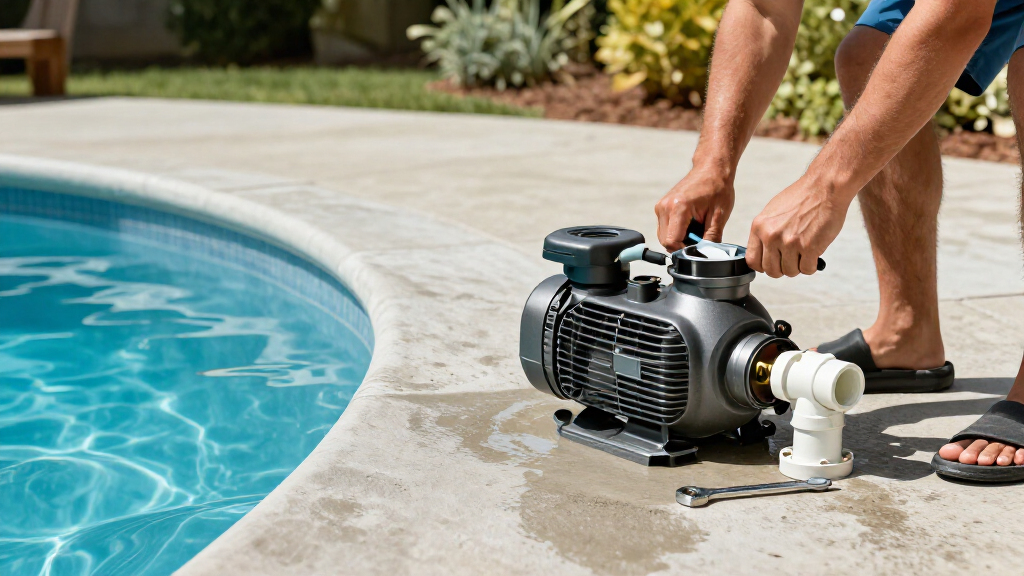
3 HP pool pump with compatible plumbing
As an affiliate, we earn on qualifying purchases.
As an affiliate, we earn on qualifying purchases.
Choose smart controls that solve a real problem
Smart controls are worth choosing when they make your pool easier to run without creating a control conflict. The CrestWave candidate is described as app-controlled, the BLACK+DECKER listing includes Wi-Fi, VEVOR lists a programmable timer, and Dewenwils lists a full-color touchscreen. Those features can help you change schedules or check settings, but they do not replace compatibility checks with your existing automation panel.
Think about how you actually manage the pool. If you normally set a schedule in spring and leave it alone, built-in programming may be all you need. If you adjust circulation after heavy swimming, storms, or vacuuming, remote access can be handy. On a windy evening, for instance, you could check a schedule from indoors rather than walking to a damp equipment pad in the dark.
Before paying attention to the app interface, find out how the pump behaves when Wi-Fi drops. Can you still change speeds at the unit? Does the schedule remain stored locally? Can an external controller command the pump? A smart pump should still be useful when your home network is having a bad day.
Also check whether the listed controls refer to the pump’s own motor settings or to full pool automation. Those are different jobs. A touchscreen can make local programming easier, while a compatible automation connection can coordinate the pump with a heater, lights, and sanitizer. Ask for the control protocol and wiring details rather than assuming a feature name guarantees integration.
For a family that uses the pool on weekends, a simple weekday filtration schedule and a temporary higher-speed setting for cleaning may be more helpful than a long list of app features. Pick controls that fit your routine, and confirm the pump remains operable from the equipment pad.
Treat electrical work and pump replacement as safety work
A pool pump replacement involves electricity near water, so a licensed pool professional or electrician should handle wiring and verify the installation. A product’s 220- or 230-volt label does not tell you whether your circuit, disconnect, grounding, bonding, or overcurrent protection is correct. Local electrical codes and permit rules may apply; don’t skip them to make a swap seem simple.
Before anyone opens a pump’s electrical compartment, the circuit must be switched off and verified de-energized with appropriate test equipment. Keep water away from electrical parts, use suitable personal protective equipment, and follow the manufacturer’s installation instructions. A breaker label alone is not proof that the correct circuit is off, especially in a crowded equipment area with several circuits.
Plumbing deserves care too. A pump installed with misaligned pipes can strain unions and create leaks, while a poorly sealed suction connection can draw air and cause noisy, unreliable operation. If the pump sits on a concrete pad beside a heater and filter, measure clearances and plan the union layout before the old unit comes out. The new motor may be longer or wider even when the horsepower matches.
For example, replacing a hard-wired 230-volt unit with a 220-volt-listed candidate may sound straightforward, but a professional must confirm the motor’s permitted supply range and the existing circuit’s suitability. They can also check bonding and grounding requirements and whether the installation needs a permit or inspection in your area.
Do not work on energized pool equipment. Electrical, gas, structural, and roof work belongs with appropriately licensed professionals, with power isolated and verified before service.
Make your shortlist around service, materials, and fit
A useful shortlist balances pump performance with construction, support, and installation fit. The supplied brief lists the Doheny’s pump as thermoplastic, CrestWave and BLACK+DECKER as plastic, and Dewenwils as GFPP; it does not specify VEVOR’s material. These labels alone do not establish service life, saltwater suitability, or corrosion resistance, so ask for the manufacturer’s exact material and pool-chemistry guidance. Material names describe composition, but they don’t tell you how the complete wet end, seals, fasteners, and electronics will hold up in your particular environment. A material claim should therefore prompt specific questions about chemical compatibility and warranty coverage, not be treated as a durability ranking.
Here is a practical way to narrow the candidates. If you need an explicitly named in-ground option, the BLACK+DECKER listing says “in-ground,” while the supplied CrestWave and VEVOR titles describe above-ground or in/above-ground use. Treat those titles as prompts for verification, not final proof. If your priority is a listed maximum flow, compare the BLACK+DECKER’s stated 85 GPM with VEVOR’s 190 GPM only after checking the pump curves and your system’s limits. A higher listed maximum may provide headroom, but it does not mean the pump will be more effective in your plumbing; if your equipment needs less flow, the extra capacity may not benefit you. Conversely, a lower maximum is not automatically a problem if the curve provides the flow your system requires at its operating resistance.
Warranty terms, replacement parts, and local service can matter more than a flashy control screen. Before buying, look up the warranty exclusions, who handles a claim, and whether seals, baskets, lids, and control components can be obtained. These details shape the practical cost of ownership: a pump with accessible parts and nearby service may be easier to maintain, while a limited warranty or hard-to-source proprietary component can extend a breakdown and add expense. Compare what the warranty covers and for how long, rather than relying on the word “warranty” alone.
Picture two owners with similar-sized pools. One has a simple circulation loop and a local technician familiar with the selected brand; the other has a heater, spa spillover, and older automation. Their “best” pumps may differ even if both want 3 HP. The second system has more equipment and control interactions to satisfy, so a model that fits the first owner’s straightforward setup may need extra verification—or may not be suitable at all. Ask a qualified pool professional to compare the system requirements with the pump curve, installation details, and available support before you commit.
Use current manufacturer documentation for final specifications. Product pages can change, and the source brief’s candidate details are a comparison snapshot, not a warranty or confirmation that a product is currently sold.
Frequently Asked Questions
Is a 3 HP variable speed pump right for every pool?
No. A 3 HP pump may suit a large pool or a system with demanding equipment, but pool volume alone does not decide pump size. Ask a pool professional to check plumbing resistance, filter and heater limits, and the pump curve before choosing.
Can I replace a 230-volt pump with one listed as 220 volts?
Do not assume the labels are interchangeable without checking the manufacturer’s permitted voltage range and your circuit. Have a licensed electrician or pool professional verify the motor nameplate, wiring, protection, grounding, and bonding before installation.
Will a variable speed pump always save 70–80% on electricity?
No fixed saving applies to every pool. Savings depend on your old pump, operating hours, chosen speeds, electricity rate, and system resistance; the 70–80% figure is a possible comparison cited in general product guidance, not a guaranteed result. Ask for an estimate based on your actual schedule and equipment.
Which alternative has the highest stated flow?
In the supplied specifications, VEVOR lists 190 GPM, while CrestWave lists 11,359 GPH, which converts to about 189 GPM. Those are product-listing figures, not a head-to-head performance test, and your installed flow depends on the pump curve and plumbing.
Do I need Wi-Fi or an app on a pool pump?
No. An app can make schedule changes convenient, but a built-in timer may be enough if you rarely adjust settings. Before choosing smart control, check whether the pump remains operable without Wi-Fi and whether it can work with your existing pool automation.
Can I install a 3 HP pool pump myself?
Pool pump replacement can involve hazardous electrical work near water, hard-wiring, bonding, and code requirements. Use an appropriately licensed professional to verify the circuit and install the equipment; never open electrical compartments until power has been switched off and verified de-energized.
Conclusion
Choose the pump that fits your whole pool system, not the one with the biggest number on its product page. Confirm the pump curve, electrical requirements, plumbing, controls, and service support before buying, then have a qualified professional install and set it up safely.
A well-matched pump should disappear into your routine: clear water, steady circulation, and a quiet equipment pad instead of a daily guessing game.
Columbus Day / Indigenous Peoples' Day Picks
long weekend sales
As an affiliate, we earn on qualifying purchases.