TL;DR

Get cleaning gear delivered free with Prime
- Fast, free delivery on millions of items
- Prime Video, Amazon Music and more included
- Member-only deals all year
A House Beautiful report cites arborist Logan Foltz and horticulturist Nathan Heinrich on how to manage tree of heaven, an invasive tree that can spread rapidly and resprout after cutting. They describe stump treatment and repeated cutting as possible approaches, while warning that rock salt can make soil inhospitable to new plants. Correct identification matters because some native trees look similar.
A House Beautiful report featuring certified arborist Logan Foltz and horticulturist Nathan Heinrich says property owners dealing with tree of heaven should not simply cut the tree down: damaged roots or a cut trunk can prompt new shoots. The guidance matters because the Ailanthus altissima can spread quickly, displace other plants and, according to the report, damage nearby pipes or hardscaping as its roots grow.
The experts describe tree of heaven as a fast-growing invasive tree native to China. Heinrich said it can grow up to 15 feet in its first year and spread across a range of climates and locations. The report says it produces large numbers of seeds that can germinate in places including sidewalk cracks, gutters and gardens. Foltz said the tree can outcompete North American trees in their natural habitats and is difficult to control.
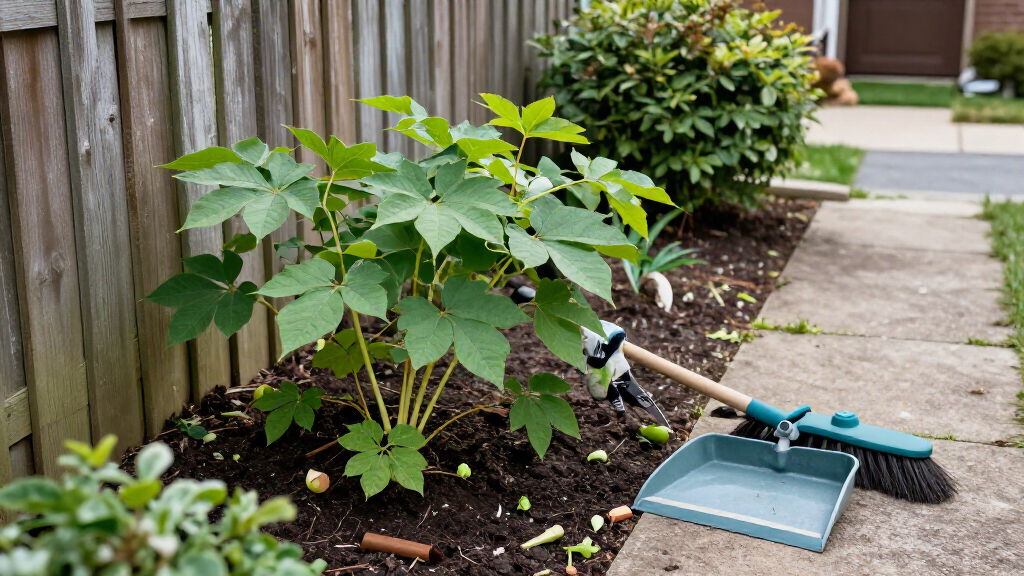
Identification is a necessary first step. The tree has a slim but sturdy trunk and fern-like leaves, with gland-like teeth at the base of each leaflet; female trees may have clusters of red, yellow or green seeds. The report cautions that black walnut and some sumac can look similar, so owners should establish what they have before attempting removal.
Foltz described cutting the tree to its base, drilling holes in the stump and filling them with rock salt as one removal approach. He said this can dry out the stump and connected roots, but warned that salt can leave soil unsuitable for new plantings. Heinrich recommended carrying out that approach in July or August and suggested herbicide injected into drilled holes and cuts in the stump as an alternative. The report also describes repeatedly cutting back growth to exhaust the tree’s energy reserves. It does not provide a tested comparison of these methods or a guarantee that any one will eradicate a tree.
Risks to Nearby Plants and Property
The concern extends beyond the presence of an unwanted tree. According to the report, tree of heaven can spread through seeds and shoots from its roots, making a single removal attempt potentially insufficient. Its root system can extend as far as 50 feet from the trunk, the source says, and may crack pipes or hardscaping while growing toward water. Those effects could matter to homeowners with the tree near buildings, paved areas or underground infrastructure.
The tree is also associated with the spread of another invasive species. The report cites the U.S. Department of Agriculture in saying tree of heaven is a host plant for the spotted lanternfly, which feeds on sap from trees and other plants and can spread plantborne diseases. That connection gives property-level identification and management broader ecological relevance, although the supplied material does not quantify local lanternfly risk or describe a specific outbreak.
tree of heaven identification field guide native lookalikes
As an affiliate, we earn on qualifying purchases.
As an affiliate, we earn on qualifying purchases.
Why Cutting Can Trigger Regrowth
Tree of heaven is described in the report as resilient partly because it can resprout after the trunk is cut or its root system is damaged. Foltz said the tree responds by sending up suckers from its roots, which can grow into new trees. That is why the article cautions against treating felling alone as complete removal.
The report presents several options rather than a single universally suitable method. Rock salt may affect soil beyond the stump, herbicide use has its own considerations, and repeated cutting requires continued follow-up. Foltz also said some mature trees might be retained after considering their ecological impact and whether native planting would better serve the area. The recommendations come from the two experts quoted by House Beautiful; the supplied source does not include guidance from a government agency on treatment rules or local regulations.
“The tree “outcompetes” many of our North American trees in their natural habitats and is “notoriously challenging” to control.”
— Logan Foltz, certified arborist at Urban Arborists
tree stump drill bit set for stump treatment
As an affiliate, we earn on qualifying purchases.
As an affiliate, we earn on qualifying purchases.
Identification and Treatment Limits
The supplied report does not state how many trees or properties are affected, identify a particular location facing a new outbreak, or provide a publication date. Its removal methods are presented as expert recommendations, not as a controlled comparison; outcomes may depend on the tree, site and follow-up. It also does not specify what herbicide to use, the required application rate, or whether local rules restrict treatment.
Some native trees resemble tree of heaven, so a mistaken identification could lead to removing a non-invasive plant. The report recommends confirming the species but does not provide a diagnostic service or a full identification guide. It is also unclear from the source whether a given mature tree should be removed: Foltz says that decision depends on its ecological impact and the value of replacing it with native plants.
tree of heaven cut stump herbicide applicator brush
As an affiliate, we earn on qualifying purchases.
As an affiliate, we earn on qualifying purchases.
Confirm the Tree Before Removal
Property owners can start by checking the leaf and seed characteristics described in the report and confirming the species before acting, particularly where black walnut or sumac may be present. If removal is planned, they should account for possible root suckers and the effects of the chosen treatment on nearby soil and plantings. The source does not identify a scheduled follow-up announcement or official action; it advises repeated cutting as one possible strategy and notes that removal decisions can vary by site.
heavy duty pruning saw for invasive tree removal
As an affiliate, we earn on qualifying purchases.
As an affiliate, we earn on qualifying purchases.
Key Questions
Why does the report advise against just cutting down tree of heaven?
Arborist Logan Foltz says a cut trunk or damaged roots can trigger new shoots, or suckers, from the root system. Cutting the trunk may not stop the tree from growing again.
How can I recognize tree of heaven?
The report describes a sturdy, slim trunk and fern-like leaves with gland-like teeth at the base of each leaflet. Female trees may carry red, yellow or green seed clusters. Black walnut and some sumac can look similar, so confirm the identification before removal.
What removal methods do the experts discuss?
The report describes drilling holes into a cut stump and using rock salt, injecting herbicide into holes and cuts, or repeatedly cutting back growth. It does not establish that any method works in every situation or provide detailed application instructions.
Can rock salt affect other plants?
Yes. Foltz warns that rock salt can make the soil inhospitable to new plantings, so the method may be unsuitable where the owner wants to grow other plants nearby.
Does every tree of heaven need to be removed?
Not necessarily, according to Foltz. He says owners should consider the tree’s ecological impact and whether a native planting would better serve the community; the report does not offer a single answer for every property.
Source: rss
Fall Picks
fall essentials
As an affiliate, we earn on qualifying purchases.