
TL;DR
Cordless stick vacuum cleaners are battery-powered cleaners built for quick, convenient everyday jobs, and many convert to handheld vacuums. To choose one, match its tested floor performance, usable run time, weight, bin, filtration, and replacement parts to your home; maximum battery claims and suction figures alone tell you little.
The vacuum you grab in ten seconds is often more useful than the heavier one you keep meaning to bring upstairs. That’s the appeal of a cordless stick vacuum: it hangs near the kitchen, lifts crumbs from the floor, and can often turn into a small handheld cleaner for the sofa.

Get cleaning gear delivered free with Prime
- Fast, free delivery on millions of items
- Prime Video, Amazon Music and more included
- Member-only deals all year
These machines are powered cleaners designed for quick everyday jobs, though that convenience comes with tradeoffs. Their batteries and smaller bins may not suit a long session across a large, carpeted house.
This guide gives you key facts for choosing among cordless stick vacuums: how to read run-time claims, match a head to your floors, judge handling and filtration, and account for upkeep. You’ll leave knowing when one machine can cover your routine—and when a full-size vacuum still earns its closet space.
Treat maximum run time as a best-case claim; check performance with the floor head and power setting you’ll actually use.
Match the brush and floor head to your surfaces, and seek independent tests for carpet or hard-floor performance.
Judge weight by balance and handling as well as total mass, especially if you clean stairs or reach overhead.
Compare bin emptying, sealed filtration, filter care, replacement batteries, parts, and warranty alongside the purchase price.
A cordless stick vacuum may cover a small, mostly hard-floor home; a larger machine can still help with extensive or deep-pile carpet.
Know what a cordless stick vacuum can handle
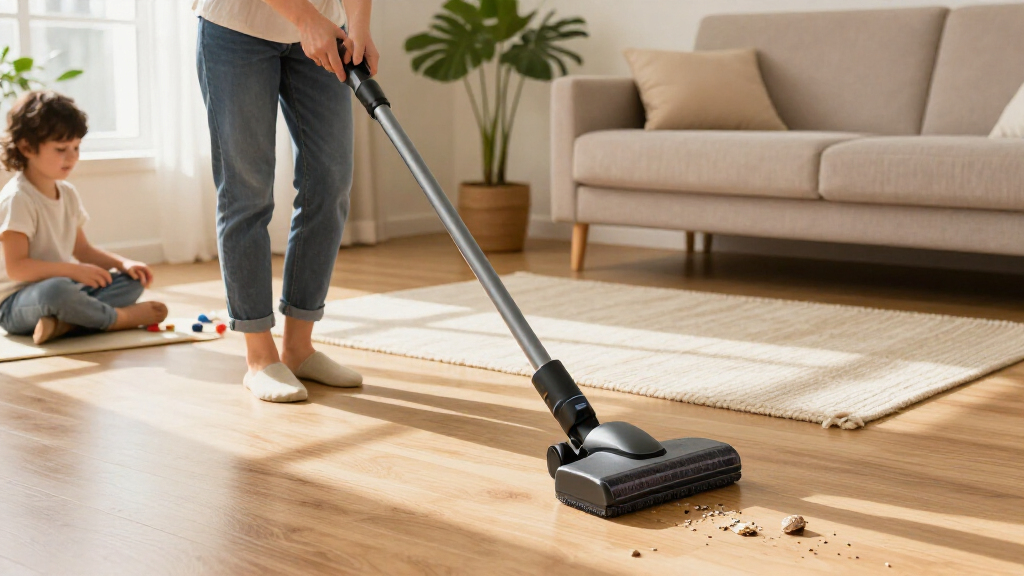
A cordless stick vacuum is a lightweight, battery-powered floor cleaner made for frequent, smaller cleaning jobs, and many models detach into handheld vacuums. That makes them handy for crumbs beneath a breakfast stool, dust along a hallway, or a quick pass over couch cushions after a snack. Think of one as a commuter bike: easy to reach for and nimble in tight spaces, while a full-size vacuum is more like a cargo van for longer, heavier jobs.
That distinction matters when you’re deciding whether to replace an upright or canister. In a small apartment with tile and one low-pile rug, a stick model may handle nearly all your routine cleaning. In a large home with thick carpet and a shedding dog, it may work beautifully for daily touch-ups while a larger vacuum handles deeper, longer sessions.
Many cordless stick vacuums include tools for upholstery, crevices, or pet hair. Check what comes in the box: a handheld body is more useful if it includes an attachment suited to your sofa or stairs. A feature list can sound generous, but an attachment you never use adds little value.
Convenience is the main strength; capacity and sustained cleaning are common limits. Smaller bins need more frequent emptying, and a battery-powered machine may run out before a large job ends. If you picture cleaning every room at once, include those limits in your decision.
Products Worth Considering

Coway Airmega AP-1512HHS Smart Air Purifier, Black

Dyson V8 Cordless Vacuum

Bose SoundLink Max Portable Bluetooth Speaker, IP67 Waterproof and Dustproof, Up to 20 Hours of Battery Life, Black
As an affiliate, we earn on qualifying purchases.
Read battery claims before you plan a whole-house clean
Cordless stick vacuum cleaners run as long as their battery and settings allow, but an advertised maximum is not a reliable estimate for every cleaning session. “Up to” run time usually describes best-case use on a low-power setting, sometimes without the motorized floor head. A powered attachment or boost mode can drain the battery faster, and the battery’s condition also affects how long it lasts. That gap matters because running out mid-clean can leave you with unfinished rooms or force you to wait for a recharge; a high maximum is useful only if it translates into enough time for the way you clean.
Imagine cleaning a two-bedroom flat after a muddy walk. You switch to boost for the rug, run the floor head along the entry, and then use the handheld tool on a dog bed. The box’s maximum figure may describe a different combination of settings and tools than that real routine. Think of the battery claim as a car’s ideal fuel-economy figure: useful for comparison only when you know how it was measured. If your usual session mixes surfaces and tools, a lower but realistic estimate helps you judge whether you can finish without rationing power.
Before buying, look for the run time on the setting and attachment you expect to use. Check whether the battery is removable, whether a replacement or spare is available, whether a spare is included, and what the warranty covers. A removable battery can let you swap in a charged one, extending a session without waiting, but it adds value only if replacements are easy to get and fit your budget. A built-in battery may keep the setup simpler, though the machine’s useful life can depend more directly on battery service options.
Plan around usable run time, not the biggest number on the box. If you usually clean in short bursts, charging between sessions may be fine; if you do the whole house at once, battery capacity matters more. Think through where a pause would occur: a battery that covers your regular route comfortably is less frustrating than one that requires you to skip a room or switch constantly to low power.
Charging and storage belong in the same calculation. A wall dock saves floor space, but it may require installation; a freestanding dock avoids that work but takes room. Choose the setup that fits where you actually park the vacuum, and check that the charging location is convenient enough for the machine to stay ready between short cleaning jobs.
Match the floor head to your rugs, carpet, and hard floors
Cleaning performance depends on the floor head, brush design, suction, and airflow together; a power rating alone can’t tell you how well a vacuum will clean your floors. On smooth hard floors, a soft roller may collect fine dust and crumbs without scattering them. On carpet, a motorized brush roll can help lift debris, but deep-pile carpet and embedded dirt place greater demands on the machine. This difference matters because the same vacuum can feel excellent in one room and disappointing in another: the head must make good contact with the surface and move debris into the airflow.
Suppose your living room has oak boards and a thick wool rug. A vacuum that glides neatly over the wood may leave crumbs tucked into the rug’s fibers, while an aggressive brush may be less pleasant on delicate flooring. A mixed-floor household needs a head and settings that can cope with both surfaces, not just an impressive headline specification. If a model requires you to stop and change heads every time you cross a rug, consider whether that small interruption fits your routine or makes you less likely to clean promptly.
Recent designs may add anti-tangle brushes or heads that adapt to changing floor surfaces. Those features can reduce hair wrap or make switching surfaces easier, but they don’t guarantee that the machine will pick up everything. If you have pets, check whether the brush is easy to inspect and clear; even a tangle-resistant roll may need attention after a week of long hair. Easier maintenance saves time over months of use, while a feature that merely delays tangling still leaves you responsible for clearing it eventually.
Use independent cleaning tests that match your flooring where possible. Compare like with like: suction figures from different test methods and run times measured with different attachments can mislead. If you can’t find a test for your exact floor, look for results on a similar surface and treat them as a guide, not a promise. The closer the test conditions are to your home, the more confidently you can trade one strength for another—for example, accepting modest carpet results if nearly all your floors are hard.
Check weight, bin size, and the small chores that add up
A vacuum that feels light in your hand can still become tiring if its weight sits high on the handle or if you need to carry it overhead. Total weight matters, but balance matters too. A top-heavy model may feel fine while you clean an open floor and awkward when you reach above a doorframe or carry it upstairs. That difference affects how often you choose to use it: a vacuum that is comfortable for your actual route can make quick jobs easier, while awkward handling may turn a promised convenience into another chore.
Try to imagine a real route through your home: down the hall, around chair legs, up the stairs, then over the car mats. For example, if your main job is sweeping crumbs from the kitchen, easy turns and a comfortable grip may matter more than a long reach overhead. If you clean several stair flights, check whether the handheld mode is manageable with the tool attached. Detaching the main body can reduce the weight you carry, but the balance changes with the attachment, so consider the complete setup rather than the bare handheld unit.
Stick vacuums usually have smaller bins than full-size machines, so expect to empty them more often. That’s a reasonable trade for a compact body, until fur fills the container halfway through cleaning a two-bedroom flat. Frequent emptying interrupts a longer session and may expose you to more dust, so bin capacity and the opening mechanism matter together. Check how the bin opens and whether you can remove and wash it according to the manufacturer’s instructions; an awkward latch can make a daily chore feel like a daily fight.
Noise, charging, and storage shape the routine as well. A wall dock may keep the machine ready beside the pantry, while a self-emptying dock can cut down on manual emptying at a higher price and with more space needed. New sensors or displays may help if they offer clear, useful information; extra electronics don’t replace a comfortable handle or an easy-to-clean brush. Weigh these conveniences against the space they occupy and the maintenance they add, especially if your home has limited storage.
Look beyond a filter label if allergies matter
Filtration depends on the whole airflow path and how well the vacuum is sealed, not just the name printed on a filter. A high-efficiency filter can help capture fine particles, but air can still escape elsewhere if the system isn’t sealed. If allergies matter in your home, check the product documentation for details about both the filter and the complete machine. The practical implication is that a filter specification describes one part of the route dust travels, while the machine’s overall design determines whether particles stay inside until you dispose of them.
Picture vacuuming a sunny room when dust hangs in a bright shaft of light. You want a vacuum that captures particles through its system and doesn’t send much dust back into the room when you empty it. A filter label on its own doesn’t tell you whether the bin opens cleanly or how much dust might escape during that step. Emptying is therefore part of the exposure question: a model that filters well during cleaning may still be inconvenient for a sensitive user if emptying releases a visible puff.
Emptying is part of filtration in everyday use. If you’re sensitive to dust, consider where you’ll empty the bin and how its design handles debris. A small bin may need more frequent emptying, which makes ease of use more than a minor detail. Follow the maker’s instructions for removing and cleaning filters; washing a filter that must stay dry can damage it or affect performance. A sealed bag or an outdoor emptying spot may reduce contact for some people, but only use a method compatible with the vacuum’s design and your home.
Check whether the model uses a sealed design and whether the relevant claims appear in its documentation. If details are vague, look for independent information before treating a “HEPA” label as proof of performance. A thoughtful purchase considers the route particles take through the machine, from floor head to exhaust and bin. Clear documentation gives you a basis for comparison; without it, the label alone cannot tell you how much dust the complete vacuum captures or retains.
Compare the full ownership cost, not just the sale price
The real cost includes useful tools, replacement batteries, filters, parts, and warranty support, not just the sticker price. A low-priced vacuum may be a good fit, but a missing floor head or costly replacement battery can change the calculation. Compare what each package actually includes before paying extra for features you may never use. A cheaper model is less of a bargain if the parts that wear out are unavailable or if replacing the battery costs enough to make repair impractical.
For example, a pet owner might get more value from a model with an easy-to-clean motorized tool and an available replacement brush roll than from one with an app that displays particle counts. A household with mostly hard floors may prefer a soft roller and a spare filter. The best bundle depends on the mess you clean every week. Paying for a tool that solves a frequent problem can save effort each time you clean; paying for a feature you rarely use mainly raises the upfront price.
Durability also relies on routine care. Hair can wrap around brush rolls, clogged filters can reduce performance, and batteries may eventually need replacement. Check that the maker sells parts you’re likely to need, and read the warranty terms for the battery and main vacuum. A machine you can maintain is easier to keep in service. Accessible parts can extend its useful life, though they still have a cost, so compare expected replacement prices as well as availability.
Spend on the problem you actually have. If your main challenge is pet hair on rugs, prioritize floor tests and brush access. If you mostly clean a compact kitchen, handling and quick storage may matter more. Features like self-emptying docks can save time, but they add cost, space, and maintenance of their own. Compare that ongoing convenience with how often you would otherwise empty the bin; for occasional crumbs, the extra equipment may not earn its price, while a high-volume household may value the time saved.
Use this five-step check to choose a model
A simple buying check starts with your floors and ends with the parts you can replace. This keeps a flashy feature list from distracting you from the chores the vacuum must do. For instance, a flat with tile, one rug, and a cat has different needs from a carpeted family home with stairs. The order matters: floor type and cleaning routine define the basic job, then battery, handling, upkeep, and cost tell you whether a particular machine can sustain it.
- List your surfaces: Note hard floors, rugs, carpet pile, stairs, and upholstery. A home with thick carpet needs stronger evidence from carpet tests than a home with mostly tile. If your floors vary, identify the surface that is hardest for a vacuum to clean; a model that handles that well is more likely to cover the rest.
- Choose a realistic session: Think about how long you clean and which powered heads you use. Compare run times under matching conditions when possible. Include the rooms you usually clean together, since a machine that only lasts through half that route may change your habits or require a charging break.
- Check handling and capacity: Consider weight balance, handheld use, bin size, and how cleanly the bin opens. Imagine carrying it upstairs or emptying it after collecting pet hair. These details determine whether the vacuum remains convenient after the first few uses, when the daily repetition matters more than the novelty.
- Review filtration and care: Read documentation about sealing, filter cleaning, brush-roll access, and replacement parts. If allergies matter, pay close attention to the whole system and emptying process. Maintenance requirements also affect performance over time: a filter or brush that is difficult to access is easier to neglect.
- Compare the complete package: Add the useful tools, battery options, warranty, dock, and likely replacement costs. Skip paid extras that don’t make your routine easier. Compare the expected cost of keeping the vacuum working with the time or effort a feature saves, rather than treating a higher price as proof of better fit.
Take that checklist to current product specifications and independent tests; lineups change often. If one model looks strong on hard floors but has weak carpet results, that may be a fair compromise in a mostly tiled home—and a poor one in a carpeted house. Your own floors are the final test case: the best overall score matters less than reliable cleaning on the surfaces you have and a routine you can keep up.
Frequently Asked Questions
How long does a cordless stick vacuum last on one charge?
It depends on the power setting, attachment, floor type, and battery condition. The advertised maximum often describes low-power use and may exclude a motorized head, so boost mode can shorten a session. Check the run-time details for the setup you expect to use.
Are cordless stick vacuums powerful enough for carpet?
Some clean low- or medium-pile carpet well, while deep-pile carpet and embedded debris demand more from the machine. Look for independent results on a carpet similar to yours and check whether the vacuum uses a suitable motorized brush. A strong suction figure alone can’t predict the result.
Can a cordless stick vacuum replace an upright or canister vacuum?
It can cover most cleaning for some households, especially in smaller homes with mostly hard floors and frequent spot cleaning. Large homes, extensive carpet, or long cleaning sessions may call for a full-size vacuum as well. Your floor area and cleaning routine decide the answer.
What should I check if I have pets?
Look for a motorized tool suited to pet hair, a brush roll that’s easy to clear, and a bin that can hold the hair you collect. Anti-tangle designs may reduce wrap, but they don’t remove the need for maintenance. Check whether replacement brush parts are available.
Are cordless vacuums suitable for people with allergies?
They can be, if the model has effective filtration and a sealed design. Check the product documentation for the whole airflow path, not just a filter label, and consider how much dust escapes when you empty the bin. Follow the maker’s cleaning instructions for filters.
Are self-emptying docks worth the extra cost?
A self-emptying dock can reduce how often you empty the vacuum by hand, which may help in a home that collects lots of dust or pet hair. It also costs more, takes up space, and needs maintenance. Decide whether the saved trips to the bin justify those tradeoffs in your routine.
Conclusion
Choose a cordless stick vacuum by tracing your real cleaning routine: the floors you cross, the time you spend, and the dust and hair you need to clear. Then check usable battery life, head performance, handling, bin design, filtration, and parts support against that routine.
Buy for the mess in your home, not the biggest number on the box. The right machine is the one you can grab before crumbs turn into a trail.