
The best CO2 rooftop ventilation systems depend on whether you need to exhaust hot attic air or bring fresh, filtered outdoor air into occupied rooms—two different jobs that the products in this roundup do not all perform. My best overall pick for targeted attic exhaust is the Master Flow 1500 CFM Roof Mount Attic Fan, while the Pioneer ERV-50 stands out for Wi-Fi control and energy recovery, and the Broan AI Series 210 CFM ERV is a stronger fit for planned whole-room ventilation. The main tradeoff is simple: high-CFM roof fans move large volumes of air but do not recover heat or directly control indoor CO2, while ERVs exchange indoor and outdoor air more deliberately but have lower airflow and more involved installation. Match the system to your space, ducting, climate, and actual ventilation goal before comparing controls or capacity. Read on for the full breakdown, selection criteria, and practical buying advice.

Get cleaning gear delivered free with Prime
- Fast, free delivery on millions of items
- Prime Video, Amazon Music and more included
- Member-only deals all year
Complete the kit



Key Takeaways
- Attic exhaust and indoor CO2 ventilation are different tasks: the high-CFM Master Flow, VEVOR, and QuietCool roof fans target attic air, while ERVs such as the Pioneer, Broan, and AprilAire exchange air in occupied spaces.
- ERV airflow is lower by design: the 60–210 CFM ERVs are aimed at controlled fresh-air delivery, not the rapid attic air movement offered by fans rated at 900–2400 CFM.
- Controls separate similar roof-fan choices: Master Flow’s humidistat and thermostat add automatic response, while QuietCool adds app control and two speeds; buyers should choose based on the control they will actually use.
- Installation can outweigh headline capacity: curb mounting, roof openings, duct routes, and electrical or solar requirements can rule out a model before its airflow rating becomes relevant.
- Solar is not the same as whole-building ventilation: the 40W solar fan can suit an attic-focused project, but its listed 2000 CFM rating does not make it a substitute for an ERV serving occupied rooms.
| Master Flow 1500 CFM Roof Mount Attic Fan with Humidistat and Thermostat |  | Best for Automatic Attic Climate Control | Airflow capacity: 1500 CFM | Recommended coverage: Up to 2,800 sq ft | Mounting: Roof mount | VIEW LATEST PRICE | See Our Full Breakdown |
| Pioneer ERV-50 Wi-Fi Wall-Mounted Energy Recovery Ventilator |  | Best for CO₂-Sensed Room Ventilation | Heat recovery: Up to 97% | Airflow with F7 filter: 11.8 / 23.5 / 29.4 / 35.3 CFM | Maximum sound output: 32.7 dB(A) | VIEW LATEST PRICE | See Our Full Breakdown |
| VEVOR Roof Exhaust Fan, Adjustable 900/1500 CFM |  | Best for Two-Speed Roof Exhaust | Airflow capacity: 900 / 1500 CFM | Motor power: 220 W | Speed: 1572 / 2200 rpm | VIEW LATEST PRICE | See Our Full Breakdown |
| VENTS-US Frigate ERV 120S Energy Recovery Ventilator, 162 CFM |  | Best for Balanced Whole-House Air Exchange | Airflow capacity: Up to 162 CFM | Power consumption: 19 W on LOW; 94 W maximum | Voltage: 120 V | VIEW LATEST PRICE | See Our Full Breakdown |
| AprilAire V22BEC Energy Recovery Ventilator, 120 CFM |  | Best for Flexible Indoor Installation | Airflow capacity: 120 CFM | Listed coverage: Homes up to 6,000 sq ft | Power: AC; 95 W | VIEW LATEST PRICE | See Our Full Breakdown |
| Panasonic WhisperComfort 60 Energy Recovery Ventilator, 60 CFM | 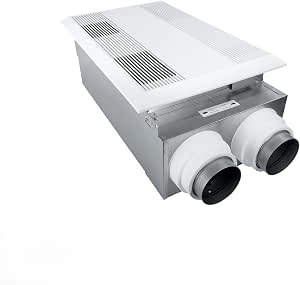 | Best for Small, Balanced Fresh-Air Ventilation | Model: FV-06VE1 | Maximum airflow: 60 CFM | Low-speed airflow: 20–50 CFM | VIEW LATEST PRICE | See Our Full Breakdown |
| QuietCool Smart App-Controlled 2-Speed Roof-Mount Attic Fan, 1266 CFM |  | Best for App-Controlled Attic Exhaust | Model: AFR SMT PRO-1.3 | Airflow: Up to 1,266 CFM | Motor: Two-speed PSC | VIEW LATEST PRICE | See Our Full Breakdown |
| Volkmi Upblast Roof Exhaust Fan, Stainless Steel, 1400/2400 CFM Dual Airflow, Curb Mount |  | Best for Heavy-Duty Commercial Exhaust | Airflow options: 1,400 CFM / 2,400 CFM | Material: Stainless steel | Mounting: Curb mount | VIEW LATEST PRICE | See Our Full Breakdown |
| Master Flow ERV6BL 1500 CFM Electric Roof-Mount Attic Fan with Thermostat | | Best for Thermostat-Controlled Attic Coverage | Model: ERV6BL | Airflow: 1,500 CFM | Recommended attic coverage: Up to 2,800 sq ft | VIEW LATEST PRICE | See Our Full Breakdown |
| Broan AI Series 210 CFM Energy Recovery Ventilator with Side Ports |  | Best for Monitored, Higher-Capacity ERV Ventilation | Model: B210E75RS | Maximum airflow: Up to 210 CFM | Mounting: Wall or suspended ceiling | VIEW LATEST PRICE | See Our Full Breakdown |
| Air Vent 53832 Roof Mounted Power Attic Ventilator |  | Best for Automated Humidity Control | Power source: AC | Wattage: 100 watts | Airflow: 1320 CFM | VIEW LATEST PRICE | See Our Full Breakdown |
| 40W Solar Attic Fan with Thermostat, 12-Inch Roof Vent, 2000 CFM |  | Best High-Airflow Solar Pick | Power: 40 watts | Airflow capacity: Up to 2000 CFM | Coverage: Up to 2500 sq. ft. | VIEW LATEST PRICE | See Our Full Breakdown |
| CO2 rooftop ventilation system | Mounting | Dimensions |
|---|---|---|
| Master Flow 1500 CFM Roof Moun | Roof mount | 25 × 25 × 9 in |
| Pioneer ERV-50 Wi-Fi Wall-Moun | Wall mounted; in-wall channel fits 11–18.5 in walls | — |
| VEVOR Roof Exhaust Fan | Roof mounted | 24.02 × 24.02 × 16.93 in |
| VENTS-US Frigate ERV 120S Ener | — | — |
| AprilAire V22BEC Energy Recove | — | — |
| Panasonic WhisperComfort 60 En | Ceiling or wall | — |
| QuietCool Smart App-Controlled | Roof mount | 28 × 28 × 10.25 in |
| Volkmi Upblast Roof Exhaust Fa | Curb mount | 24.02 × 24.02 × 19.09 in |
| Master Flow ERV6BL 1500 CFM El | Roof mount | 25 × 25 × 9 in |
| Broan AI Series 210 CFM Energy | Wall or suspended ceiling | 21 × 24.8 × 20.8 in |
| Air Vent 53832 Roof Mounted Po | — | 24 × 24 × 8.5 inches |
| 40W Solar Attic Fan with Therm | — | — |
More Details on Our Top Picks
Master Flow 1500 CFM Roof Mount Attic Fan with Humidistat and Thermostat
For a roof-mounted system that responds to both heat and moisture, I’d put this Master Flow ahead of the simpler VEVOR 900/1500 CFM Roof Exhaust Fan. Its 1500 CFM capacity is specified for spaces up to 2,800 square feet, while the HT1 controller can switch operation based on temperature and humidity—useful when attic conditions change without someone adjusting a dial. A galvanized steel body and internal screen add practical protection for a permanently installed roof unit. The tradeoff is that this is attic exhaust ventilation, not a CO₂-sensing fresh-air system: it does not list a CO₂ sensor or balanced air supply. It also needs hard-wired installation and is not compatible with tile roofing, so I’d skip it where roof type or wiring access is a poor fit.
Pros:- 1500 CFM capacity is specified for spaces up to 2,800 square feet.
- HT1 controller reacts to both temperature and humidity.
- Galvanized steel construction suits a roof-mounted installation.
- Internal screen helps keep animals out of the attic.
Cons:- Does not list a CO₂ sensor or balanced fresh-air supply.
- Not compatible with tile roofing.
- Requires hard-wired installation.
Best for: Homeowners with a compatible non-tile roof who want automatic temperature- and humidity-based attic exhaust for a space up to 2,800 square feet.
Not ideal for: Buyers seeking CO₂-triggered fresh-air exchange, tile-roof installation, or a fan that avoids hard-wired electrical work.
- Airflow capacity:1500 CFM
- Recommended coverage:Up to 2,800 sq ft
- Mounting:Roof mount
- Controller:HT1 humidistat and thermostat
- Power and connection:Corded electric; hard wired
- Material:Galvanized steel; plastic blade
- Dimensions:25 × 25 × 9 in
- Roof compatibility:Not compatible with tile roofing
Our verdict“Choose this Master Flow for automatic attic exhaust on a compatible roof, not for CO₂-controlled ventilation of occupied rooms.”
Pioneer ERV-50 Wi-Fi Wall-Mounted Energy Recovery Ventilator
This is the clearest match in this group for buyers who mean CO₂-responsive indoor ventilation: the Pioneer ERV-50 has a built-in CO₂ sensor and can bring in filtered outdoor air while exhausting stale air. Its Wi-Fi app, remote, and onboard controls give it more ways to manage operation than the push-button AprilAire V22BEC, and its F7 (MERV 13) filter is a higher filtration specification than the VENTS-US Frigate ERV 120S’s washable MERV 6 filters. Heat recovery is listed at up to 97%, which can help limit heat loss during air exchange. The main constraint is scale: maximum filtered airflow is just 35.3 CFM per unit, far below the larger whole-house ERVs here. It is wall-mounted, too, so it is not a roof-mounted attic fan.
Pros:- Built-in CO₂ sensor supports automated indoor air-quality management.
- F7 (MERV 13) filter and washable prefilter are included.
- Wi-Fi app, handheld remote, and onboard controls offer flexible operation.
- Heat recovery is rated up to 97%.
Cons:- Maximum airflow with the F7 filter is 35.3 CFM per unit.
- Wall-mounted design does not serve as a roof-mounted attic fan.
- In-wall channel fits walls only 11–18.5 inches thick.
Best for: Buyers who want a wall-mounted ventilator with CO₂-based automated control, app access, and stronger listed filtration for an individual room or modest ventilation need.
Not ideal for: Those needing high-volume rooftop attic exhaust or whole-house airflow beyond the unit’s 35.3 CFM maximum.
- Heat recovery:Up to 97%
- Airflow with F7 filter:11.8 / 23.5 / 29.4 / 35.3 CFM
- Maximum sound output:32.7 dB(A)
- Average power draw:8 W
- Filters:Washable prefilter and F7 (MERV 13)
- Air-quality sensor:Built-in CO₂ sensor
- Controls:Onboard interface, handheld remote, smartphone app
- Mounting:Wall mounted; in-wall channel fits 11–18.5 in walls
Our verdict“Pick the Pioneer when CO₂ sensing and filtered room-level air exchange matter more than high airflow or rooftop mounting.”
VEVOR Roof Exhaust Fan, Adjustable 900/1500 CFM
The VEVOR gives roof-exhaust buyers a choice between 900 and 1500 CFM, a useful distinction when full output is unnecessary for every condition. Compared with the Master Flow 1500 CFM model, it offers two airflow settings and a stated 220 W motor, but its listed control is a dial rather than the Master Flow’s automatic temperature-and-humidity controller. Its aluminum alloy housing, sealed design, and water-draining deflector suit outdoor exposure, while the supplied speed switch keeps the control approach straightforward. This is still an exhaust fan, not a balanced fresh-air ventilator: there is no listed CO₂ sensor, filter, or heat-recovery core. At 45.9 pounds it is also heavier than the Master Flow, and roof mounting plus a 120 V supply make installation a project rather than a plug-in setup.
Pros:- Two airflow settings provide 900 or 1500 CFM.
- Aluminum alloy housing is specified as corrosion-resistant.
- Sealed design and drainage deflector are intended for outdoor weather exposure.
- Includes a speed control switch.
Cons:- No CO₂ sensor, filtration, or heat-recovery core is listed.
- At 45.9 lb, it is heavier than the Master Flow roof fan.
- Requires roof mounting and a 120 V power supply.
Best for: Owners with a roof-mounted exhaust installation who want to choose between two airflow levels using a manual control.
Not ideal for: Buyers who need CO₂-based automation, balanced filtered air exchange, lightweight equipment, or a fan compatible with a non-roof installation.
- Airflow capacity:900 / 1500 CFM
- Motor power:220 W
- Speed:1572 / 2200 rpm
- Voltage:120 V
- Mounting:Roof mounted
- Material:Aluminum alloy (1060)
- Dimensions:24.02 × 24.02 × 16.93 in
- Weight:45.9 lb
Our verdict“Choose the VEVOR for manually selected two-speed roof exhaust, but choose a sensor-equipped ERV if indoor CO₂ management is the goal.”
VENTS-US Frigate ERV 120S Energy Recovery Ventilator, 162 CFM
Where the roof-mounted Master Flow and VEVOR remove attic air, the Frigate ERV 120S is designed to bring in fresh air while exhausting stale air. Its enthalpy core transfers heat and moisture between those streams, making it a more suitable whole-house ventilation approach than a one-way exhaust fan when maintaining indoor comfort matters. The listed 162 CFM maximum exceeds the AprilAire V22BEC’s 120 CFM, while electronic freeze protection and washable MERV 6 filters add practical cold-weather and maintenance features. Those advantages come with installation limits: this is a ceiling-mounted unit with 5-inch duct connections, not a roof-mounted ventilator. It also has no CO₂ sensor listed, and MERV 6 filtration is less specified than the Pioneer ERV-50’s MERV 13 filter. I’d rank it for ducted balanced ventilation, not direct CO₂ automation.
Pros:- Balanced supply and exhaust support whole-house air exchange.
- Enthalpy core transfers both heat and moisture.
- Electronic anti-frost system supports operation in cold conditions.
- Washable MERV 6 filters and three operating modes are included.
Cons:- Ceiling mounting and 5-inch duct connections require a ducted installation.
- Maximum airflow is 162 CFM, well below the roof fans’ stated capacity.
- No built-in CO₂ sensor is listed.
Best for: Homeowners planning ducted, balanced whole-house ventilation who want heat-and-moisture recovery, washable filters, and electronic freeze protection.
Not ideal for: Buyers seeking a roof-mounted attic exhaust fan, built-in CO₂ sensing, or higher-grade filtration than the listed MERV 6 filters.
- Airflow capacity:Up to 162 CFM
- Power consumption:19 W on LOW; 94 W maximum
- Voltage:120 V
- Noise level:1.9 sones
- Duct connection:5 in diameter
- Core:Enthalpy heat and moisture recovery
- Filters:Washable MERV 6 supply and exhaust filters
- Mounting and protection:Ceiling mount with brackets; electronic anti-frost system
Our verdict“Choose the Frigate ERV 120S for ducted balanced ventilation and recovery, not for rooftop attic exhaust or sensor-driven CO₂ control.”
AprilAire V22BEC Energy Recovery Ventilator, 120 CFM
The AprilAire V22BEC is the flexible-installation option among these balanced ventilators: its bracket supports wall, ceiling, or floor mounting, unlike the ceiling-mounted Frigate ERV 120S. It supplies outdoor air and exhausts stale indoor air through a core that transfers heat and moisture, so it offers a more balanced approach than the roof-mounted Master Flow or VEVOR exhaust fans. The stated coverage of homes up to 6,000 square feet gives buyers a sizing reference, though its 120 CFM capacity is lower than the Frigate’s 162 CFM. Push-button settings are straightforward, but the product data does not list a CO₂ sensor or app control, unlike the Pioneer ERV-50. Its 53 dB listed noise level and indoor-only installation also narrow where it makes sense.
Pros:- Bracket supports wall, ceiling, or floor mounting.
- Balanced fresh-air supply and stale-air exhaust.
- Recovery core transfers heat and moisture between air streams.
- Push-button controls provide airflow, supply, and exhaust settings.
Cons:- 120 CFM capacity is lower than the Frigate ERV 120S’s 162 CFM.
- Listed noise level is 53 dB.
- Designed for indoor installation and has no listed CO₂ sensor.
Best for: Homeowners who need a balanced ERV with several indoor mounting options and straightforward push-button airflow settings.
Not ideal for: Buyers who need roof-mounted exhaust, higher airflow than 120 CFM, CO₂-sensing automation, or a unit intended for outdoor installation.
- Airflow capacity:120 CFM
- Listed coverage:Homes up to 6,000 sq ft
- Power:AC; 95 W
- Voltage:120 V
- Noise level:53 dB
- Mounting options:Wall, ceiling, or floor
- Controls:Push button
- Certifications:ETL, HVI, UL
Our verdict“Pick the AprilAire for balanced indoor ventilation when mounting flexibility matters more than higher airflow or CO₂ automation.”
Panasonic WhisperComfort 60 Energy Recovery Ventilator, 60 CFM
The WhisperComfort 60 suits buyers who need tempered outdoor air and balanced exhaust rather than a high-volume attic fan. Its energy recovery core helps limit heat loss while ventilation supports steadier indoor moisture levels; selectable low-speed airflow from 20 to 50 CFM lets users match routine operation to the space, with a boost to 60 CFM when needed. Compared with the Broan AI Series 210 CFM ERV, Panasonic has less capacity and fewer monitoring features, but its lower airflow may be a better fit for a smaller area. The tradeoff is clear: this is not a roof-mounted exhaust fan and its 60 CFM ceiling rules it out for large spaces or heavy exhaust demands. Installation also requires a hardwired connection, despite flexible ceiling or wall mounting.
Pros:- Energy recovery core helps temper incoming air and manage indoor moisture.
- Selectable low-speed airflow and a boost setting allow adjustment to changing ventilation needs.
- Ceiling or wall mounting offers flexibility for the installation location.
- Static-pressure access ports support airflow verification.
Cons:- Maximum airflow of 60 CFM is limited for large spaces or strong exhaust needs.
- Requires a hardwired electrical connection.
- Does not provide the high-volume roof-mounted exhaust offered by attic and commercial fans in this lineup.
Best for: Owners of smaller, occupied spaces who want balanced fresh-air ventilation with heat and moisture recovery.
Not ideal for: Buyers ventilating large attics, kitchens, or workshops who need high-volume roof exhaust, or anyone seeking plug-in installation.
- Model:FV-06VE1
- Maximum airflow:60 CFM
- Low-speed airflow:20–50 CFM
- Number of speeds:3
- Noise level:2.5 sones
- Power:50 watts; corded electric
- Mounting:Ceiling or wall
- Certification:HVI certified
Our verdict“Choose the WhisperComfort 60 for modest, balanced ventilation with energy recovery, not for high-volume rooftop exhaust.”
QuietCool Smart App-Controlled 2-Speed Roof-Mount Attic Fan, 1266 CFM
The QuietCool is the lineup’s app-controlled pick for attic exhaust, pairing a two-speed motor with scheduling and automated operation from a phone. Its high setting moves up to 1,266 CFM, while the lower-power setting can help reduce energy use when full output is unnecessary. Compared with the Master Flow ERV6BL, QuietCool offers app control and a built-in fire safety shutoff, while Master Flow provides a higher stated airflow of 1,500 CFM and a thermostat controller. That makes this a stronger fit for owners who value remote control over maximum capacity. It is designed for indoor attic use, not occupied-room ventilation or commercial kitchen exhaust. The 20-foot cord eases placement, but the interchangeable flashings are sold separately, so roof compatibility can add planning and parts to the installation.
Pros:- App control supports automated fan operation.
- Two-speed motor delivers up to 1,266 CFM.
- Built-in fire safety shutoff adds a safety feature.
- UV-resistant coating and interchangeable flashing options support outdoor roof installation.
Cons:- Interchangeable flashings are sold separately.
- Designed for attic ventilation, not general occupied-space ventilation.
- Its maximum airflow is lower than the Master Flow ERV6BL’s stated 1,500 CFM.
Best for: Homeowners with an attic who want app-based scheduling and two-speed exhaust control without needing the highest airflow in the lineup.
Not ideal for: Buyers seeking an energy recovery ventilator, a commercial roof exhaust fan, or an all-in-one installation with flashings included.
- Model:AFR SMT PRO-1.3
- Airflow:Up to 1,266 CFM
- Motor:Two-speed PSC
- Power:120 V AC; 120 W
- Low-speed power:As low as 75.5 W
- Noise level:50 dB
- Mounting:Roof mount
- Dimensions:28 × 28 × 10.25 in
- Power cord:20 ft
Our verdict“Pick QuietCool if app control matters more than maximum airflow and your goal is attic exhaust.”
Volkmi Upblast Roof Exhaust Fan, Stainless Steel, 1400/2400 CFM Dual Airflow, Curb Mount
For buyers who need substantial rooftop exhaust, the Volkmi’s defining advantage is its choice of 1,400 or 2,400 CFM. That range suits demanding spaces such as workshops and commercial kitchens better than the QuietCool Smart Roof-Mount Attic Fan, which tops out at 1,266 CFM and is intended for attic use. The Volkmi also uses a stainless steel body, a practical choice where weather exposure and corrosion resistance matter. This is an exhaust fan, not an energy recovery ventilator: it removes air but does not temper incoming fresh air or recover heat. Its curb-mount design also narrows the buyer pool to sites with compatible roof infrastructure. At 35.6 pounds, it may call for roof support checks, and its industrial appearance is less suited to residential settings.
Pros:- Two airflow options provide 1,400 or 2,400 CFM for different exhaust demands.
- Stainless steel construction resists corrosion and weather exposure.
- Direct-drive motor is designed for stable operation with reduced maintenance needs.
- Curb-mount base suits installations that already have compatible roof infrastructure.
Cons:- Curb mounting requires compatible roof infrastructure.
- At 35.6 pounds, the unit may require roof support checks.
- Exhaust-only operation does not recover heat or supply tempered fresh air.
Best for: Commercial kitchen, garage, and workshop operators who need high-volume roof exhaust and have a compatible curb mount.
Not ideal for: Homeowners seeking balanced fresh-air ventilation, energy recovery, a compact fan, or a system that can mount directly without curb infrastructure.
- Airflow options:1,400 CFM / 2,400 CFM
- Material:Stainless steel
- Mounting:Curb mount
- Base size:25.59 in
- Dimensions:24.02 × 24.02 × 19.09 in
- Weight:35.6 lb
- Power source:AC
- Finish:Polished silver
Our verdict“Choose the Volkmi for high-volume commercial exhaust when your roof can support its curb-mounted installation.”
Master Flow ERV6BL 1500 CFM Electric Roof-Mount Attic Fan with Thermostat
The ERV6BL is a straightforward choice for buyers sizing a roof-mounted fan to an attic: it is rated for up to 2,800 square feet and moves up to 1,500 CFM. Its included hard-wired thermostat controller offers automatic temperature-based operation without the app setup of the QuietCool Smart Roof-Mount Attic Fan. QuietCool adds app control and a fire safety shutoff, while Master Flow supplies more stated airflow and a specified coverage area. The galvanized steel blade and weather-resistant metal housing suit attic duty, but this is not an ERV and does not recover heat or provide balanced fresh-air exchange. Roof compatibility is another firm limit: it is not compatible with tile roofing. Buyers should also plan for hardwired installation rather than expecting a simple plug-in setup.
Pros:- Moves up to 1,500 CFM for attic exhaust.
- Rated for attic spaces up to 2,800 square feet.
- Includes a hard-wired thermostat controller.
- Weather-resistant metal construction and galvanized steel blade suit roof use.
Cons:- Not compatible with tile roofing systems.
- Requires hard-wired installation.
- Attic exhaust design does not supply balanced, heat-recovered fresh air.
Best for: Homeowners with a non-tile roof and an attic up to 2,800 square feet who want thermostat-controlled exhaust.
Not ideal for: Owners of tile-roof homes, buyers who need app control, or anyone seeking heat-recovery ventilation for occupied rooms.
- Model:ERV6BL
- Airflow:1,500 CFM
- Recommended attic coverage:Up to 2,800 sq ft
- Voltage:120 V
- Mounting:Roof mount
- Controller:Thermostat; hard-wired
- Blade material:Galvanized steel
- Dimensions:25 × 25 × 9 in
- Roof compatibility:Not compatible with tile roofing
Our verdict“Choose the ERV6BL for thermostat-controlled attic exhaust if your roof is not tiled and its coverage rating fits your space.”
Broan AI Series 210 CFM Energy Recovery Ventilator with Side Ports
The Broan AI Series stands apart from the attic fans here because it provides balanced energy recovery ventilation, not just roof exhaust. At up to 210 CFM, it offers more capacity than the Panasonic WhisperComfort 60, making it a better match for buyers who need ERV service across a larger occupied space. Its VIRTUO technology automatically balances airflow, and the integrated LCD shows airflow, power use, and diagnostics—useful feedback absent from the simpler Panasonic. The washable MERV 8 filter is included, with optional HEPA filtration for buyers who want another filtration level. The tradeoffs are its larger installation footprint and side-port layout; the 210 CFM version does not offer the top-port configuration noted for smaller models. It also lacks automatic shutoff, a built-in timer, and humidity sensing.
Pros:- Up to 210 CFM provides more ERV capacity than the Panasonic WhisperComfort 60.
- VIRTUO technology automatically balances and adjusts airflow.
- Integrated LCD displays airflow, power use, and diagnostic information.
- Includes a washable MERV 8 filter and supports optional HEPA filtration.
Cons:- The 210 CFM model uses side ports; top-port configurations are available only on 180 CFM models.
- Does not include automatic shutoff, a built-in timer, or humidity sensing.
- Its 21 × 24.8 × 20.8-inch enclosure needs more installation space than the Panasonic.
Best for: Owners of larger occupied spaces who want balanced fresh-air exchange, automatic airflow balancing, and on-unit system diagnostics.
Not ideal for: Buyers needing high-volume rooftop attic exhaust, a top-port 210 CFM configuration, or built-in humidity sensing and timed shutoff.
- Model:B210E75RS
- Maximum airflow:Up to 210 CFM
- Mounting:Wall or suspended ceiling
- Port configuration:Side ports; 6 in
- Included filter:Washable MERV 8
- Optional filtration:HEPA
- Sensible recovery efficiency at 32°F:81% at 64 CFM
- Dimensions:21 × 24.8 × 20.8 in
- Certifications:HVI Certified; UL Listed
Our verdict“Choose the Broan for monitored, higher-capacity energy recovery ventilation, not for attic or commercial roof exhaust.”
Air Vent 53832 Roof Mounted Power Attic Ventilator
The Air Vent 53832 suits buyers who want a roof-mounted fan to respond to both attic heat and humidity. Its thermostat and humidistat automate when ventilation runs, while three speed settings and remote operation let you adjust airflow without reaching the unit. At 1320 CFM, it offers less stated airflow than the 2000 CFM solar model in this roundup, but it runs on AC rather than relying on sunlight or an adapter arrangement. That makes its power source more straightforward for households with an available electrical connection. The tradeoff is a brushed motor and 17.9-pound weight, which may make installation harder and offers less appeal to buyers prioritizing a brushless design. Its wood housing may also call for more weather-related upkeep than a metal-bodied option.
Pros:- Thermostat and humidistat can automate ventilation based on heat and humidity.
- Three speed settings and remote operation provide control without access to the fan itself.
- 1320 CFM airflow supports substantial attic exhaust.
- Includes a 10-year limited warranty and 5-year replacement protection.
Cons:- At 17.9 pounds, the unit may be harder to handle during roof installation.
- Brushed motor may be less durable than the brushless motor listed for the 40W solar fan.
- Wood housing may need more maintenance in harsh weather than a metal housing.
Best for: Homeowners with an AC connection who want automatic attic ventilation triggered by both temperature and humidity, plus remote speed control.
Not ideal for: Buyers seeking solar operation, a lighter installation, or a metal housing designed for lower-maintenance exposure to harsh weather.
- Power source:AC
- Wattage:100 watts
- Airflow:1320 CFM
- Speed settings:3
- Controls:Remote; button control
- Motor:Brushed
- Dimensions:24 × 24 × 8.5 inches
- Weight:17.9 lbs
- Warranty:10-year limited warranty / 5-year replacement protection
Our verdict“Choose the Air Vent 53832 if you want AC-powered roof ventilation that automatically responds to both attic temperature and humidity.”
40W Solar Attic Fan with Thermostat, 12-Inch Roof Vent, 2000 CFM
This solar fan is the lineup’s choice for buyers prioritizing high stated airflow without depending solely on AC power. It is rated at up to 2000 CFM and covers up to 2500 square feet, exceeding the Air Vent 53832’s listed 1320 CFM. Its adjustable solar panel can be angled to suit different installation conditions, and the thermostat plus four speeds give buyers more control than a basic single-speed solar setup. An included AC/DC adapter can supplement solar power for continuous operation, but that flexibility has limits: there is no battery backup, and mode 2 speed control requires the adapter. Unlike the Air Vent, this model has a brushless copper motor and metal construction, though buyers should check that its wall-mount specification fits their planned installation rather than assuming a roof-mount configuration.
Pros:- Rated airflow of up to 2000 CFM and stated coverage up to 2500 square feet.
- Adjustable solar panel supports a range of installation angles.
- Four speeds and a thermostat adjustable from 68–113°F provide flexible control.
- Brushless copper motor, metal construction, and included AC/DC adapter.
Cons:- No battery backup means solar power alone cannot provide stored-energy operation.
- Mode 2 speed control requires the AC/DC adapter.
- Listed as wall mount, so it may not suit buyers specifically seeking a roof-mounted unit.
Best for: Homeowners seeking high-capacity solar-assisted attic ventilation who can use the specified mounting setup and have access to the included AC/DC adapter when needed.
Not ideal for: Buyers who need battery-backed operation during low-sun conditions or who require a clearly specified roof-mount fan rather than the listed wall-mount design.
- Power:40 watts
- Airflow capacity:Up to 2000 CFM
- Coverage:Up to 2500 sq. ft.
- Fan diameter:12 inches
- Power source:Solar; AC/DC adapter for household power
- Speeds:4
- Thermostat range:68–113°F
- Motor:Brushless copper
- Mounting type:Wall mount
Our verdict“Pick this model for high stated airflow and solar-assisted operation if its wall-mount specification and lack of battery backup fit your installation.”

How We Picked
I compared the 12 listed products by their intended ventilation job first: roof-mounted attic exhaust versus energy recovery ventilation for occupied spaces. Within each group, I weighed the stated airflow, control options, installation format, and the likely usefulness of the design for common residential needs. A large CFM figure was not treated as an automatic advantage; its value depends on the room or attic volume, available intake air, and whether the product is intended to manage indoor air quality or attic heat.
The ranking favors products with a clear use case, practical controls, and a fit that can be understood from the supplied specifications. I also considered the tradeoffs buyers must resolve, including energy recovery versus simpler exhaust, roof work versus duct routing, and automated features versus basic operation. Since the provided product details do not establish measured CO2 performance, exact sound levels, or compatibility with every roof and duct layout, I do not treat any listing as a guaranteed CO2 solution; buyers should confirm sizing and installation requirements before purchase.
| CO2 rooftop ventilation system | Mounting |
|---|---|
| Master Flow 1500 CFM Roof Moun | Roof mount |
| Pioneer ERV-50 Wi-Fi Wall-Moun | Wall mounted; in-wall channel fits 11–18.5 in walls |
| VEVOR Roof Exhaust Fan | Roof mounted |
| VENTS-US Frigate ERV 120S Ener | — |
| AprilAire V22BEC Energy Recove | — |
| Panasonic WhisperComfort 60 En | Ceiling or wall |
| QuietCool Smart App-Controlled | Roof mount |
| Volkmi Upblast Roof Exhaust Fa | Curb mount |
| Master Flow ERV6BL 1500 CFM El | Roof mount |
| Broan AI Series 210 CFM Energy | Wall or suspended ceiling |
| Air Vent 53832 Roof Mounted Po | — |
| 40W Solar Attic Fan with Therm | — |
Factors to Consider When Choosing Best CO2 Rooftop Ventilation Systems
Before choosing a unit, decide what air you need to move and where it needs to go. A rooftop attic fan, a ducted ERV, and a solar-powered attic ventilator may all be described as ventilation products, but they do not provide interchangeable results. These checks help prevent buying a high-capacity fan when the real need is fresh air in an occupied room.
Spend More for the Right System, Not Extra Capacity Alone
Paying more can make sense when energy recovery, suitable duct connections, or useful automation solves a real installation or operating problem. It is less compelling when the added capacity serves no practical need or when the unit is intended for a different space than yours. Compare the full project cost, including electrical work, roof modifications, ducting, controls, and maintenance—not just the appliance. A basic attic fan may be the sensible choice for a straightforward attic-heat problem, while a room-serving ERV may justify a more involved installation for continuous fresh-air exchange. Ask for a design that explains airflow and intake locations before choosing a larger model. This keeps the decision tied to outcomes rather than the biggest specification on the label.
Frequently Asked Questions
Will a rooftop attic fan lower CO2 in my bedroom or living room?
Not necessarily. The roof-mounted attic fans in this roundup are designed to exhaust attic air, and they do not by themselves create a controlled fresh-air path through occupied rooms. Indoor CO2 usually calls for outdoor air supplied to the occupied space and stale air removed from it. An ERV may be a better starting point when the ventilation goal is room air, but its suitability depends on airflow needs and duct layout. Check CO2 levels in the room where people spend time and have the ventilation design reviewed before relying on an attic fan.
Can I compare an ERV’s CFM directly with a roof fan’s CFM?
The numbers describe airflow capacity, but they do not make the products equivalent. A roof fan can move a large volume of attic air, while an ERV routes outdoor and indoor air through a controlled exchange path and recovers heat and moisture. The right comparison is between products serving the same space and purpose, with duct resistance and installation conditions included. A high CFM rating does not show how much fresh air reaches a particular room. Ask for a ventilation calculation based on the room, occupancy, and air path rather than choosing by the largest figure.
Should I choose an ERV or a simple roof exhaust fan?
Choose based on the air you need to manage. An exhaust fan is generally suited to removing hot air from an attic, while an ERV is intended to exchange indoor and outdoor air in occupied spaces with heat and moisture recovery. An ERV involves more planning for ducts, placement, and maintenance, but it addresses a different ventilation need. A roof fan may be simpler for an attic project, yet it is not a direct replacement for fresh-air delivery to bedrooms or living areas. If both attic heat and indoor CO2 are concerns, they may require separate parts of a ventilation plan.
Does a solar attic fan work when sunlight is limited?
A solar fan’s operation depends on the power available to its panel, so shaded locations and low-light periods can limit how consistently it runs. The listed 40W Solar Attic Fan is an attic-focused option, not a dedicated indoor CO2 ventilation system. Before choosing it, check roof exposure, the maker’s operating details, and whether any backup power is included or needed. Do not assume the stated airflow will be available under every light condition. If steady ventilation is required regardless of sunlight, compare a powered option or a properly designed ERV system.
What should I verify before installing a roof-mounted ventilation system?
Confirm the roof opening, pitch, curb or mounting format, flashing method, electrical requirements, and clearance from existing vents. For an ERV, also map the intake and exhaust routes, duct size, room connections, and filter access. The airflow rating can fall short of expectations if ducts are restrictive or the system lacks a suitable makeup-air path. Have a qualified installer check the roof structure and sealing plan, especially when cutting a new opening. A written installation design can expose fit problems before the unit is purchased.
Conclusion
For an attic-exhaust project, my best overall pick is the Master Flow 1500 CFM Roof Mount Attic Fan with Humidistat and Thermostat because its automatic controls pair clearly with its stated roof-fan role. The best value for straightforward attic ventilation is the Air Vent 53832 when a simpler roof-mounted power ventilator fits the project; confirm its specifications and controls before deciding. For a premium, room-focused ventilation approach, consider the Broan AI Series 210 CFM ERV, while the best for beginners seeking app control is the Pioneer ERV-50, provided its airflow and wall-mounted format suit the space. For specific needs, the QuietCool adds app-based two-speed attic control, the Volkmi offers a curb-mount, dual-airflow exhaust format, and the 40W solar fan suits an attic with strong sun exposure. If your main goal is lowering CO2 in occupied rooms, prioritize a properly sized ERV or other room-serving ventilation design—not an attic fan selected by CFM alone.