
Choosing among ducted fan coil units starts with a basic distinction: some listings are complete ducted heat-pump systems, while others are indoor coils intended to connect to existing refrigeration or hydronic equipment. My strongest all-around pick for flexible ducted installation is the Cooper & Hunter 36,000 BTU system, with its multi-position air handler and included 25-foot installation kit. For a smaller space and connected controls, the ROVSUN 17,000 BTU system is the more compact, app-enabled choice. Buyers replacing a conventional horizontal air handler may prefer the First Company 18HX5, which pairs DX cooling with 5 kW electric heat.

Get cleaning gear delivered free with Prime
- Fast, free delivery on millions of items
- Prime Video, Amazon Music and more included
- Member-only deals all year
The tradeoff is not just capacity. The ROVSUN and Cooper & Hunter are packaged mini-split heat-pump systems that include outdoor-unit requirements, while the First Company models are fan coils meant to fit particular existing system designs. The 4HBC3RH hydronic unit is different again: it serves chilled- or hot-water piping, not a standard mini-split setup. I rank these options by how clearly their stated configuration fits a ducted buyer’s needs, then weigh installation flexibility, controls, and the work or components still required.
Complete the kit


Key Takeaways
- Cooper & Hunter is the broadest ducted fit: its 36,000 BTU system supports horizontal, upflow, and downflow air-handler positions, but needs a compatible outdoor unit and separately purchased auxiliary heat if required.
- ROVSUN suits smaller connected spaces: its 17,000 BTU capacity, app and voice controls, and 36 dB mute mode are appealing, though installation is professional work and an extra power cord is required.
- First Company 18HX5 is a replacement-oriented fan coil: it combines DX cooling and 5 kW electric heat in a horizontal uncased form, but needs a compatible 208/230 V system and careful fit checks.
- First Company 4HBC3RH is for hydronic infrastructure: its hot- or chilled-water coil does not replace a DX mini-split air handler, and its right-hand coil and left-hand drain connections must suit the site.
- Match the system before comparing features: refrigerant-based heat pumps, DX fan coils, and water coils are not interchangeable; verify capacity, duct layout, electrical service, and connections with an HVAC professional.
| Cooper & Hunter 36,000 BTU Ducted Mini Split Heat Pump, 230V |  | Best Overall for Flexible Ducted Layouts | Cooling capacity: 36,000 BTU | System type: Single-zone ducted mini-split heat pump | Efficiency: 17.2 SEER2 | VIEW LATEST PRICE | See Our Full Breakdown |
| ROVSUN 17,000 BTU Smart Wi-Fi Ducted Mini-Split Heat Pump, 20.3 SEER2, 230V | 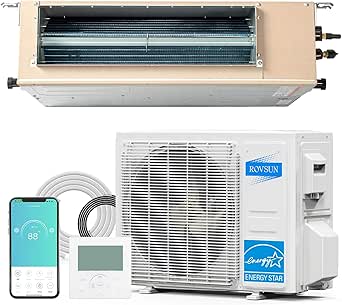 | Best for Smaller Spaces and Smart Controls | Cooling capacity: 17,000 BTU | Heating capacity: 18,000 BTU | Coverage: Up to 1,000 sq. ft. | VIEW LATEST PRICE | See Our Full Breakdown |
| First Company 18HX5 Horizontal Fan Coil Unit with 5 kW Electric Heat, 1.5 Ton |  | Best Replacement-Style DX Fan Coil | Model: 18HX5 | Capacity: 1.5 tons | Cooling type: Direct expansion (DX) | VIEW LATEST PRICE | See Our Full Breakdown |
| First Company 4HBC3RH 400 CFM Horizontal Hydronic Fan Coil |  | Best for Existing Hot- or Chilled-Water Systems | Model: 4HBC3RH | System type: Hydronic fan coil for hot or chilled water | Airflow: Conflicting listing: 400 CFM in title; 600 CFM in supplied specifications | VIEW LATEST PRICE | See Our Full Breakdown |
| ducted fan coil unit | Voltage | Cooling capacity | System type | Efficiency |
|---|---|---|---|---|
| Cooper & Hunter 36,000 BTU Duc | 230V | 36,000 BTU | Single-zone ducted mini-split heat pump | 17.2 SEER2 |
| ROVSUN 17,000 BTU Smart Wi-Fi | 230V | 17,000 BTU | — | 20.3 SEER2 (listed as 20.3 SEER in supplied specifications) |
| First Company 18HX5 Horizontal | 208/230 V | — | — | — |
| First Company 4HBC3RH 400 CFM | — | — | Hydronic fan coil for hot or chilled water | — |
More Details on Our Top Picks
Cooper & Hunter 36,000 BTU Ducted Mini Split Heat Pump, 230V
I place this Cooper & Hunter first because it gives ducted buyers the clearest combination of substantial stated capacity and indoor-unit placement flexibility. The 36,000 BTU, 3-ton heat-pump system can be installed with the air handler in horizontal, upflow, or downflow positions. That gives a contractor more options when adapting a duct route to a basement, attic, or utility area than the horizontal-only First Company 18HX5 offers.
The supplied 25-foot installation kit is another practical distinction: it gives more line-set reach than the 16.4-foot kit listed for the smaller ROVSUN system, though actual routing and installation requirements still need a professional check. App and remote controls, automatic restart, and refrigerant-leak detection add useful operating and protective functions. The listed 17.2 SEER2 efficiency is lower than ROVSUN’s stated 20.3 SEER2, so I would not choose it simply for the highest efficiency figure. Instead, its appeal is a larger capacity class and flexible air-handler orientation.
There are real limitations. The system requires a compatible outdoor unit, and an auxiliary electric heater is not included; the supported 5 kW–20 kW range refers to separately sold equipment. Its 39.5 dB listed noise level is also higher than ROVSUN’s 36 dB mute-mode figure, though those figures may describe different operating conditions. I would put it at the top for buyers whose duct layout and load call for this capacity, but not for someone who wants a self-contained indoor replacement without confirming the matched outdoor equipment.
Pros:- 36,000 BTU capacity is suited to applications requiring more output than the 17,000 BTU ROVSUN.
- Air handler supports horizontal, upflow, and downflow installation.
- Includes a 25-foot installation kit, app control, and a remote.
- Leak detection and automatic restart are included features.
Cons:- Requires a new compatible outdoor unit.
- Auxiliary electric heat is sold separately.
- Its stated 17.2 SEER2 is lower than the ROVSUN’s listed 20.3 SEER2.
Best for: Buyers needing a 36,000 BTU ducted heat-pump system whose air handler may need horizontal, upflow, or downflow positioning.
Not ideal for: Anyone seeking a small-space unit, a hydronic coil, or a system with auxiliary electric heat already included.
- Cooling capacity:36,000 BTU
- System type:Single-zone ducted mini-split heat pump
- Efficiency:17.2 SEER2
- Voltage:230V
- Refrigerant:R-454B
- Noise level:39.5 dB
- Air-handler positions:Horizontal, upflow, or downflow
- Installation kit:25 ft
Our verdict“I rank Cooper & Hunter first for ducted buyers who need a higher-capacity heat pump and want more air-handler placement options, provided the matched outdoor unit and any auxiliary heat are accounted for.”
ROVSUN 17,000 BTU Smart Wi-Fi Ducted Mini-Split Heat Pump, 20.3 SEER2, 230V
The ROVSUN is the lineup’s most connected small-capacity option. Its 17,000 BTU rating and stated coverage of up to 1,000 square feet give buyers a useful starting point for smaller ducted zones, while app and voice control allow adjustments away from the wired controller. For anyone prioritizing connected operation, this is more feature-forward than either First Company fan coil, whose listed details focus on coil and electrical configuration rather than smart controls.
Its stated 20.3 SEER2 efficiency is higher than the Cooper & Hunter’s listed 17.2 SEER2, and its 36 dB mute-mode figure is lower than that model’s stated 39.5 dB noise level. Those comparisons are based on the supplied specifications, not a claim that conditions or measurement methods are identical. In practical terms, the ROVSUN is the more compelling pick when a smaller load, quiet-mode operation, and remote access matter more than the Cooper & Hunter’s 36,000 BTU capacity or multi-position air handler.
The package still calls for planning. Professional HVAC installation is recommended, an additional power cord is needed, and the two boxes may arrive at different times. Its 16.4-foot copper line set is shorter than Cooper & Hunter’s 25-foot kit, so the route from indoor unit to outdoor equipment deserves an early check. I would not select this unit solely from its stated square-foot coverage; insulation, climate, duct design, and room loads can shift the required capacity. It is a strong smaller-system candidate, but it is not a standalone hydronic fan coil or a simple DIY replacement.
Pros:- App, wired-controller, Alexa, and Google Assistant control options.
- 20.3 SEER2 is the highest stated efficiency figure in this lineup.
- Mute mode is listed at 36 dB.
- Provides heating, cooling, and dehumidification.
Cons:- Requires professional HVAC installation and an additional power cord.
- The 16.4-foot included line set is shorter than Cooper & Hunter’s 25-foot kit.
- The two shipping boxes may arrive separately.
Best for: Homeowners looking for a smaller ducted heat-pump system with app and voice control, subject to a professional load and installation review.
Not ideal for: Buyers who need the higher capacity or installation-position flexibility of Cooper & Hunter, or who want a hydronic water coil.
- Cooling capacity:17,000 BTU
- Heating capacity:18,000 BTU
- Coverage:Up to 1,000 sq. ft.
- Efficiency:20.3 SEER2 (listed as 20.3 SEER in supplied specifications)
- Voltage:230V
- Refrigerant:R-454B
- Noise level:36 dB in mute mode
- Included line set:16.4 ft copper lines and signal cord
Our verdict“I recommend ROVSUN for a smaller ducted zone where smart control and its stated efficiency matter more than high capacity or a longer line set.”
First Company 18HX5 Horizontal Fan Coil Unit with 5 kW Electric Heat, 1.5 Ton
The 18HX5 is the most conventional fan-coil choice in this group for a buyer replacing or specifying a horizontal direct-expansion air handler. Its 1.5-ton DX cooling and built-in 5 kW electric heat put cooling and supplemental heat in one indoor unit, unlike the ROVSUN and Cooper & Hunter listings, which are complete ducted mini-split heat-pump systems with their own control and outdoor-equipment requirements. That difference makes this First Company unit less of a general-purpose package and more of a fit for a compatible existing system design.
Its stated dimensions—10 × 37.25 × 21 inches—and 59-pound weight help establish whether the unit can fit a particular horizontal installation. Those numbers do not establish that it will connect to a given duct opening, refrigerant circuit, or return-air arrangement; the installer must confirm those details. The 208/230 V single-phase requirement is also a specific electrical condition, rather than something to assume from the home’s general service.
The main tradeoff is that the unit is uncased and only described for horizontal installation. Buyers who need a cabinet or a different orientation may find Cooper & Hunter’s multi-position air handler more adaptable. It also lacks the smart-control, line-set, and heat-pump package details supplied for the two mini-split systems. In return, it includes 5 kW electric heat rather than requiring a separate auxiliary heater as the Cooper & Hunter does. I would shortlist it for a compatible horizontal DX replacement, but skip it when the project calls for a complete new ducted heat-pump system or hydronic heating and cooling.
Pros:- Combines direct-expansion cooling with 5 kW electric heat.
- Horizontal configuration and dimensions are specified for fit planning.
- Uses 208/230 V single-phase power.
- A distinct replacement-style option compared with the complete ROVSUN and Cooper & Hunter systems.
Cons:- Uncased construction may not suit installations requiring a finished cabinet.
- Designed for horizontal installation rather than the three positions offered by Cooper & Hunter.
- Requires a compatible DX system and 208/230 V electrical supply.
Best for: A contractor-led replacement project requiring a horizontal 1.5-ton DX fan coil with 5 kW electric heat and compatible 208/230 V service.
Not ideal for: Buyers who need a complete mini-split heat-pump package, smart controls, a cased cabinet, or non-horizontal mounting.
- Model:18HX5
- Capacity:1.5 tons
- Cooling type:Direct expansion (DX)
- Electric heat:5 kW
- Voltage:208/230 V
- Power:Single phase, 60 Hz
- Dimensions:10 × 37.25 × 21 in
- Weight:59 lb
Our verdict“I would choose the 18HX5 only when a compatible horizontal DX installation calls for its 1.5-ton capacity and built-in 5 kW electric heat.”
First Company 4HBC3RH 400 CFM Horizontal Hydronic Fan Coil
This First Company unit belongs in the roundup for a very specific buyer: someone with hydronic distribution already in place. Its copper-tube, three-row coil is described for chilled- or hot-water use, making it fundamentally different from the DX First Company 18HX5 and the refrigerant-based ROVSUN and Cooper & Hunter systems. If the building already supplies water at the required temperatures, this fan coil may fit the project; if not, it is the wrong type of indoor unit to substitute for a mini-split.
Installation details matter more here than app features or line-set length. The unit is a ceiling-mount horizontal design with a 120 V three-speed motor, an insulated condensate drain pan, and a manual air vent. Its standard right-hand coil connections and left-hand drain connection can guide a contractor’s layout, but they can also rule it out if piping and drainage approach from the opposite side. That orientation is a sharper constraint than Cooper & Hunter’s choice of three air-handler positions.
The supplied data also contains a specification mismatch: the title calls it a 400 CFM unit, while the listed airflow specification says 600 CFM. I would ask the seller or manufacturer to confirm the applicable airflow before sizing ducts or matching it to a hydronic system. The listed dimensions are 36-1/8 × 21-1/2 × 10 inches, while another product-dimensions entry gives 2.1 × 2.1 × 2.1 inches; that second figure does not align with the stated unit measurements and needs verification. This is the most specialized pick, not a universal budget replacement: it makes sense only after water-system compatibility, connections, airflow, and physical dimensions are confirmed.
Pros:- Designed for chilled- or hot-water applications.
- Copper-tube coil and three-speed motor are specified.
- Insulated condensate drain pan and manual air vent are included features.
- Stated coil and drain connection sides help contractors check layout fit.
Cons:- Right-hand coil connections and left-hand drain may not match the site.
- Airflow is inconsistent in the supplied listing: 400 CFM in the title and 600 CFM in the specifications.
- A listed 2.1 × 2.1 × 2.1-inch product-dimensions entry conflicts with the stated unit dimensions.
Best for: Buyers with an existing hot- or chilled-water system who need a horizontal ceiling-mount fan coil and can use the stated connection orientation.
Not ideal for: Anyone replacing a refrigerant-based ducted mini-split or DX air handler, or anyone unable to confirm the conflicting airflow and dimension details.
- Model:4HBC3RH
- System type:Hydronic fan coil for hot or chilled water
- Airflow:Conflicting listing: 400 CFM in title; 600 CFM in supplied specifications
- Motor:120 V, three-speed
- Coil:Three rows; heating or cooling
- Connections:Right-hand coil; left-hand drain
- Stated dimensions:36-1/8 W × 21-1/2 D × 10 in H
- Weight:50 lb
Our verdict“I would shortlist the 4HBC3RH only for a verified hydronic project, and I would confirm airflow, dimensions, and connection orientation before ordering.”

How We Picked
I treated “ducted fan coil unit” as a buying category that can include several different indoor-air-handler arrangements, but I did not pretend the four products are interchangeable. The supplied lineup contains two ducted mini-split heat-pump systems, one direct-expansion fan coil with electric heat, and one hydronic fan coil. I made that distinction central to the ranking because the correct choice depends first on the equipment and utilities already installed at the property.
My ranking favors the clarity of the stated application and the range of useful installation details. The Cooper & Hunter leads for ducted flexibility because its air handler supports three orientations and its system capacity is clearly specified. ROVSUN follows for smaller applications where connected control and quiet operation matter, although its listed coverage is not a substitute for a room-by-room load calculation. The First Company DX model ranks as a practical fit for a compatible horizontal system, and the hydronic model earns a distinct place for buildings with water piping rather than refrigerant-based indoor equipment.
I also weighed what buyers must supply or verify. The ROVSUN listing calls for professional installation and an additional power cord; Cooper & Hunter requires a compatible outdoor unit and sells auxiliary heat separately. Both First Company products need a closer fit check against the existing system, voltage, duct opening, and connection orientation. I used only the provided descriptions and specifications, so I do not infer unlisted performance, compatibility, certifications, or installation parts. My picks are starting points for qualified HVAC review, not substitutes for equipment selection and installation by a licensed professional.
| ducted fan coil unit | System type |
|---|---|
| Cooper & Hunter 36,000 BTU Duc | Single-zone ducted mini-split heat pump |
| ROVSUN 17,000 BTU Smart Wi-Fi | — |
| First Company 18HX5 Horizontal | — |
| First Company 4HBC3RH 400 CFM | Hydronic fan coil for hot or chilled water |
Factors to Consider When Choosing Best Ducted Fan Coil Units
I would identify the system type before comparing capacity or controls. These four products cover three different equipment arrangements, and a unit that is attractive on paper may not connect to the piping, refrigerant circuit, ductwork, or electrical supply already in place.
Start with the system already in the building
ROVSUN and Cooper & Hunter are ducted mini-split heat-pump systems. Their descriptions include an indoor air handler, outdoor-equipment relationship, refrigerant, and controls. The Cooper & Hunter listing specifically says a compatible outdoor unit is required. The First Company 18HX5 is instead a DX fan coil with 5 kW electric heat; it should be considered only where the refrigerant system and installation details match. The 4HBC3RH uses hot or chilled water. It is not a direct replacement for either type of refrigerant-based system.
Before shopping further, ask an HVAC professional what the existing system uses and which components are staying. If the project is a full system replacement, verify that the selected indoor and outdoor equipment are specified to work together. If only the indoor fan coil is being replaced, check refrigerant, coil, control, airflow, and electrical compatibility against the existing installation. A similar-looking cabinet is not proof of a compatible match.
Size to the building, not a headline coverage figure
The two mini-split listings differ sharply in stated capacity: 17,000 BTU for ROVSUN and 36,000 BTU for Cooper & Hunter. ROVSUN also gives coverage of up to 1,000 square feet, but a square-foot estimate cannot account for ceiling height, insulation, air leakage, sun exposure, climate, or the amount and layout of ductwork. Cooper & Hunter’s higher capacity is not automatically a better match for a smaller zone; oversized or undersized equipment can create comfort and operating problems.
Ask for a professional load calculation and confirm that the air handler’s airflow and external static-pressure capability match the duct design. The supplied details do not include enough airflow or static-pressure information to compare these two systems on duct performance alone. For the hydronic First Company listing, resolve the 400-versus-600-CFM conflict before using it in a duct plan. For the 18HX5, verify that the 1.5-ton capacity fits the calculated load and existing equipment design.
Check orientation, connections, and physical access
Air-handler position can decide whether a model fits. Cooper & Hunter supports horizontal, upflow, and downflow placement, while the 18HX5 and 4HBC3RH are described as horizontal units. Compare those configurations with the available mechanical space, service access, return-air path, and duct connections. Measure the route into the space as well as the final footprint; a unit that fits the opening may still be difficult to install or maintain once in place.
Connection orientation is especially relevant to the 4HBC3RH, which lists right-hand coil connections and a left-hand drain. Confirm those sides against the water piping and condensate route. Its stated dimensions should also be checked against the conflicting product-dimensions entry. For the ROVSUN, compare the 16.4-foot included line set with the actual route to the outdoor unit; Cooper & Hunter provides a 25-foot kit, but that does not guarantee the run is suitable for every installation.
Verify electrical and supplemental heating needs
These products do not share one electrical specification. The mini-split systems list 230 V; the First Company 18HX5 calls for 208/230 V, single-phase, 60 Hz; and the hydronic fan coil has a 120 V, three-speed motor. An electrician or HVAC installer should verify the circuit, disconnect, controls, and any manufacturer requirements before purchase. ROVSUN also states that an additional power cord is needed, so do not assume the included installation kit covers every electrical component.
Heating arrangements differ as well. ROVSUN and Cooper & Hunter are heat-pump systems. The 18HX5 includes 5 kW electric heat, while Cooper & Hunter supports an optional 5 kW–20 kW auxiliary heater that is sold separately. The 4HBC3RH relies on hot water supplied by a hydronic system. If the building needs backup heat, confirm the required output, control sequence, and included components rather than treating “heating” as a uniform feature.
Compare controls, efficiency, and operating details fairly
ROVSUN stands out for app and voice control, with a wired controller and compatibility with Alexa and Google Assistant. Cooper & Hunter lists app and remote controls. The First Company descriptions do not list comparable smart features, so buyers should check what controls are needed for the existing equipment rather than assume they are included. A control option is useful only if it works with the system design and provides the functions the household needs.
ROVSUN lists 20.3 SEER2 in its title, though its supplied specification field calls the figure 20.3 SEER; I would confirm the exact rating with the manufacturer before making a direct efficiency comparison. Cooper & Hunter lists 17.2 SEER2. The noise figures also describe different information: ROVSUN specifies 36 dB in mute mode, while Cooper & Hunter lists 39.5 dB without the same mode qualification. Treat those as product details, not a controlled head-to-head test. Ask for the applicable performance data and operating conditions when efficiency or sound is central to the decision.
Plan for professional installation and missing items
Ducted heat pumps and fan coils call for qualified installation. Refrigerant work, electrical connection, condensate drainage, duct sealing, controls, and startup all affect safe operation and system performance. ROVSUN recommends a licensed HVAC technician; the other listings also need a professional compatibility and installation review. I would confirm exactly which indoor and outdoor components, line sets, wiring, drains, mounting parts, and controls are included before scheduling work.
ROVSUN requires an additional power cord, Cooper & Hunter requires a compatible outdoor unit and sells auxiliary heat separately, and the 18HX5 and 4HBC3RH need to match existing system infrastructure. Product arrival can matter too: ROVSUN says its two boxes may arrive at different times. Keep the installation date flexible until all required equipment and parts have been checked on site.
Frequently Asked Questions
Are all four products complete ducted heat-pump systems?
No. ROVSUN and Cooper & Hunter are ducted mini-split heat-pump systems. The First Company 18HX5 is a direct-expansion fan coil with 5 kW electric heat, and the First Company 4HBC3RH is a hydronic fan coil for hot- or chilled-water systems. Their required connections and compatible equipment differ, so I would identify the building’s existing system before choosing among them.
Which product is best for a smaller ducted zone?
ROVSUN is the smaller-capacity mini-split option at 17,000 BTU, and its listing gives coverage of up to 1,000 square feet. That makes it a logical candidate to review for a smaller zone, not an automatic fit based on floor area. Have a professional check the building load, ductwork, climate, and line-set route; Cooper & Hunter’s 36,000 BTU capacity is aimed at a different capacity need.
Which option offers the most installation-position flexibility?
Cooper & Hunter has the clearest advantage on stated air-handler orientation: it supports horizontal, upflow, or downflow installation. The First Company 18HX5 and 4HBC3RH are described as horizontal units. Position flexibility does not remove the need to check clearances, duct connections, drain routing, service access, and the manufacturer’s installation instructions.
Can I replace a mini-split air handler with the hydronic First Company unit?
Not as a like-for-like swap. The 4HBC3RH needs a hot- or chilled-water system, while the ROVSUN and Cooper & Hunter use refrigerant-based mini-split arrangements. The First Company 18HX5 is a DX fan coil, which is also a different configuration from the hydronic unit. A contractor should identify the existing system and specify a compatible replacement rather than relying on cabinet size or a shared “fan coil” label.
What details should I confirm before ordering the 4HBC3RH?
I would ask the seller or manufacturer to confirm the unit’s airflow and physical dimensions because the supplied listing conflicts: its title says 400 CFM, the specification field says 600 CFM, and one dimensions entry differs sharply from the stated 36-1/8 × 21-1/2 × 10-inch size. Also verify that the right-hand coil connections and left-hand drain match the site, and that the hydronic supply conditions suit the application.
Conclusion
My recommendation depends on what the building needs. For a new ducted heat-pump project with a larger required capacity and several possible air-handler orientations, I would start with Cooper & Hunter, while confirming the compatible outdoor unit and budgeting for any separately sold auxiliary heater. For a smaller ducted zone where connected controls, mute-mode operation, and the higher stated efficiency figure are priorities, I would compare ROVSUN against a professional load calculation and verify its power-cord and line-set requirements.
If the job is a horizontal replacement in a compatible DX system and built-in electric heat is useful, First Company 18HX5 is the focused option. If the property already has hot- or chilled-water piping, First Company 4HBC3RH may suit that hydronic application, but I would resolve its conflicting airflow and dimension data before placing an order. In every case, match the system type, capacity, electrical supply, duct layout, and connections first; choose controls and convenience features only after those basics fit.