
TL;DR

Get cleaning gear delivered free with Prime
- Fast, free delivery on millions of items
- Prime Video, Amazon Music and more included
- Member-only deals all year
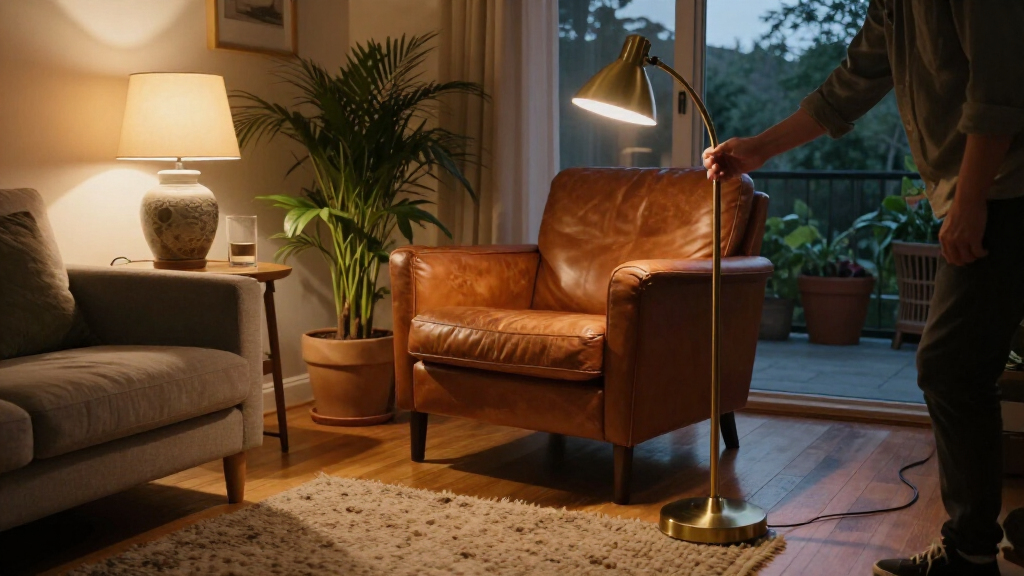
Designer Fatih Arslan has published a tour of the lamps in his home, featuring vintage and modern design classics by Artemide, Isamu Noguchi and Louis Poulsen. He says the collection is costly but personally worthwhile, while noting that less expensive alternatives and secondhand finds are available.
Designer Fatih Arslan has published a tour of the lamps in his house, showing pieces by Artemide, Isamu Noguchi and Louis Poulsen alongside notes on their design histories and use at home. The report offers readers a look at a personal collection of celebrated lighting, while Arslan says the lamps are expensive and that their value for him is tied partly to collecting rather than illumination alone.
Arslan’s collection includes the Artemide Tolomeo Mini, designed by Michele De Lucchi and Giancarlo Fassina in 1987, and the Tizio Micro, a smaller version of Richard Sapper’s 1972 desk lamp. Arslan describes the Tolomeo as easy to move and suited to a work desk. The Tizio’s arms carry electricity, avoiding wires along them, while counterweights let the lamp hold its position when adjusted.
Several lamps in the home are from Noguchi’s Akari series, which began in 1951. Arslan says his examples include the 1A, 3A, 16A and 75A. The 1A came to him secondhand from Germany, while the 75A, roughly 75 centimetres across, is the largest lamp in his house. He also notes that the Akari lamps are made by hand at Ozeki, a family-run workshop in Gifu, Japan, using traditional methods.
The tour also covers two Louis Poulsen PH lamps and an AJ wall lamp. Poul Henningsen designed the PH 5 in 1958; its layered shades help conceal the bulb and soften the light. Arslan says he broke the glass on his PH 3/2 and waited months for a replacement. The AJ wall lamp, designed by Arne Jacobsen in 1957 for Copenhagen’s SAS Royal Hotel, appeals to Arslan because it can be tilted.
Why These Lamps Matter to Collectors
The article shows how household lighting can be valued as design and craftsmanship, not just as a source of light. Arslan connects individual lamps to particular designers, materials and histories, while describing how size, adjustability and the quality of the light affect where each piece works in his home.
His account also makes a distinction between buying a lamp for practical use and building a collection. He says the lamps are not necessarily worth their prices in purely practical terms, but are worth it to him. That personal perspective matters for readers weighing a design purchase: the report does not establish that these products are objectively worth their cost, nor does it offer a price comparison.
Arslan points out that less expensive options exist, including IKEA lamps he says can cost about one-tenth as much as the designs he owns. He also says vintage shops and fairs can offer the featured styles at good prices. Those are his observations, not a guarantee that a particular model will be available or affordable.
As an affiliate, we earn on qualifying purchases.
From Desk Lighting to Akari
The lamps in Arslan’s tour span several decades of design. The Tolomeo and Tizio are presented as adjustable desk lights shaped by designers’ interest in practical use; Arslan says Sapper developed the Tizio after wanting a better lamp for his own desk. Noguchi began the Akari series after visiting Gifu, known for its paper lanterns, and used washi paper to diffuse light while creating light sculptural forms.
Henningsen’s PH designs use overlapping shades to soften illumination. Arslan says the PH 3/2 used that three-shade system and dates to 1925, while the PH 5 arrived in 1958. Jacobsen designed the AJ lamp for the SAS Royal Hotel in 1957. These dates and design details are presented in Arslan’s report; the article is a personal collection tour, not an independent product review or market survey.
Arslan says he designed an adaptor to attach his Tolomeo Mini directly to a USM Haller desk. He also describes moving an Akari 16A from his office to his bedroom and replacing it there with the larger 75A. The examples show how his choices depend on the rooms and surfaces where he uses the lamps.
““At a certain point, it becomes more like collecting, and collecting things is very different from just having a lamp to illuminate a room.””
— Fatih Arslan
Isamu Noguchi Akari paper lanterns
As an affiliate, we earn on qualifying purchases.
As an affiliate, we earn on qualifying purchases.
Prices and Availability Vary
The report does not list the purchase prices of Arslan’s lamps, say when or where he acquired every piece, or compare current prices across retailers. Its comments about vintage bargains and lower-cost alternatives are general observations. Availability, condition and cost for any particular model remain unclear from the article.
Arslan’s account is also not a technical evaluation of each lamp’s performance, durability or energy use. He describes personal preferences and experiences, including the broken glass on his PH 3/2, but does not provide test results or a full assessment of maintenance needs. The source material ends during his description of the AJ wall lamp, so it does not establish what additional details he may have shared about that piece.
As an affiliate, we earn on qualifying purchases.
Readers Can Explore the Full Tour
Arslan’s published post is the next point of reference for readers seeking the complete tour and its photographs, which he says were taken in his house. The report does not announce a product launch, exhibition or planned follow-up, so no further development is confirmed. Readers interested in buying a similar lamp can check current retailer listings or local vintage sellers, while verifying the model, condition and price independently.
As an affiliate, we earn on qualifying purchases.
Key Questions
Who published the lamp collection tour?
Fatih Arslan published the first-person report on his website on October 5, 2026.
Which designers’ lamps appear in the tour?
The collection includes designs associated with Michele De Lucchi, Giancarlo Fassina, Richard Sapper, Isamu Noguchi, Poul Henningsen and Arne Jacobsen.
Does Arslan say the lamps are worth their prices?
He says they may not be worth their prices on practical grounds, but are worth it to him as a collector. That is his personal view, not an independent valuation.
Are there cheaper ways to find similar lighting?
Arslan says IKEA offers well-designed lamps at about one-tenth the price of some pieces in his collection, and that vintage shops and fairs can have good prices. Specific availability and prices are not provided.
Source: hn
Fall Picks
fall essentials
As an affiliate, we earn on qualifying purchases.