
TL;DR

Get cleaning gear delivered free with Prime
- Fast, free delivery on millions of items
- Prime Video, Amazon Music and more included
- Member-only deals all year
Turn the central heating off and allow radiators to cool fully before opening a bleed valve, Ideal Home reports, citing radiator specialist Nick Duggan. After bleeding, check the boiler pressure against its recommended range; the source gives no universal waiting time or pressure figure.
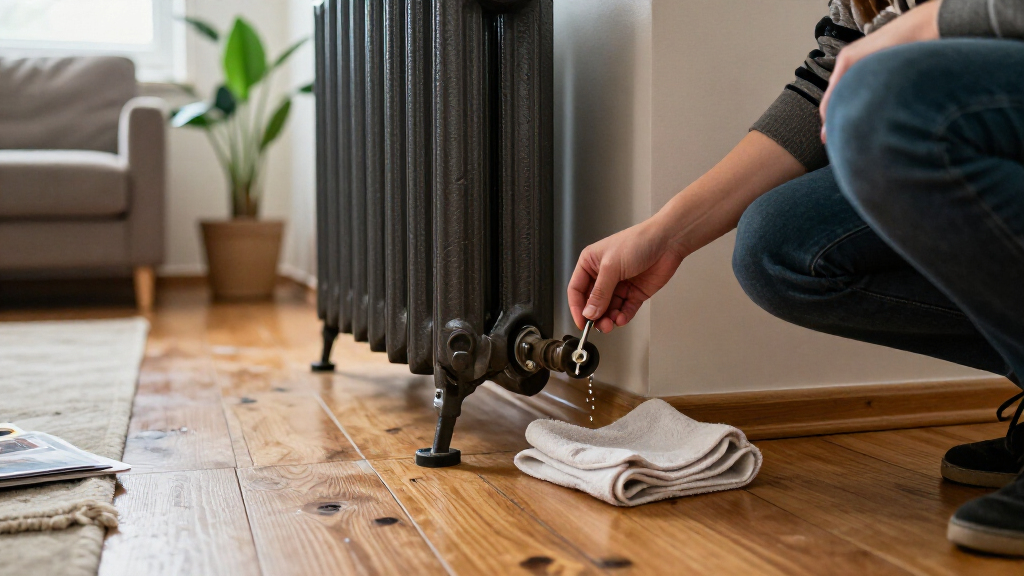
Switch off the central heating and let radiators cool completely before opening a bleed valve, an Ideal Home report advises, citing Nick Duggan, director of The Radiator Centre. The guidance matters because hot water can escape during bleeding and cause burns; after the task, homeowners should check their boiler pressure before restarting the system.
The heating can be used beforehand to help spot possible air in the system: a radiator that is warm at the bottom but cold at the top may have trapped air. For more guidance on the order, see which radiators to bleed first. But the actual bleeding should be done with the heating off and the radiator cold. Duggan told Ideal Home that opening a valve while hot water is circulating can release hot water and create a burn risk. A cooler radiator also gives the air and water inside time to settle.
Bleeding while the system is running can also make the job messier, as water may come out faster, and the report says it may be less effective. Once the valve has been closed, there is no fixed waiting period before the heating can go back on. Duggan advises waiting a few minutes, checking the boiler pressure and confirming it remains within the range recommended for the system.
Air may be indicated by cold spots, but their absence does not prove a system contains no air. Darren Danks, head of training at Worcester Bosch, told Ideal Home that small pockets can be present even when radiators feel warm throughout. The report says bleeding takes about 30 seconds per radiator and around 15 minutes for all radiators in a typical home, though covers or other obstacles can add time.
Prevent burns and uneven heating
Doing the job with the heating off reduces the chance of hot water escaping from an open valve, while waiting for the radiator to cool also makes the task easier to control. The source describes cold spots and reduced heating performance as possible signs of trapped air; it also reports Danks’s warning that small air pockets may not create an obvious cold patch.
Checking pressure afterward is a practical part of restarting the system. Bleeding several radiators may lower the pressure slightly, Duggan said. The source does not give a single pressure target for every boiler, so homeowners should use the range specified for their own system rather than assume one number applies to all homes.
As an affiliate, we earn on qualifying purchases.
Spotting air before bleeding
The Ideal Home report frames the task as routine preparation before switching central heating on for colder weather. A radiator that is cold at the top and warmer below can point to trapped air, but it is a warning sign, not a complete test. According to Danks, air can be present even when radiators feel warm.
The article says bleeding each radiator takes roughly half a minute, with a full home taking around 15 minutes in total. That estimate can vary if radiator covers need removing. The supplied report mentions a radiator key and a way to catch drips as useful equipment, but does not provide a full step-by-step procedure or instructions for every heating system.
“Make sure the heating is switched off and, ideally, wait until your radiators have gone completely cold.”
— Nick Duggan, director of The Radiator Centre, quoted by Ideal Home
As an affiliate, we earn on qualifying purchases.
Pressure targets vary by system
The source does not specify a universal boiler-pressure figure, a set time to wait before restarting, or a complete procedure covering different radiator and heating-system designs. Its advice is to check the pressure against the recommended range for the individual boiler. It also does not establish that every radiator in every home needs bleeding; the suggestion to check more than one is presented as practical advice, not a requirement for all systems.
As an affiliate, we earn on qualifying purchases.
Check pressure before restarting
After the radiators have been bled, wait a few minutes and check the boiler pressure before switching the heating back on, as Duggan advises. If pressure has fallen, follow the boiler manufacturer’s guidance for the correct range and next steps. If the pressure is outside that range, or the homeowner is unsure how the system should be handled, seek advice from a qualified heating professional rather than guessing.
As an affiliate, we earn on qualifying purchases.
Key Questions
Should the heating be on or off when bleeding radiators?
Off. The Ideal Home report, citing Nick Duggan of The Radiator Centre, recommends switching off the heating and waiting until the radiators are cold before opening a bleed valve.
Why should radiators cool before bleeding?
Hot water can escape when a valve is opened and may cause burns. The report says cooling also gives the air and water time to settle and can make the job less messy.
When can I turn the heating back on?
The source gives no fixed waiting time. Duggan advises waiting a few minutes after bleeding, then checking the boiler pressure before restarting the heating.
Does a radiator need bleeding if it has no cold spots?
Not necessarily, but the absence of cold spots does not rule out trapped air. Worcester Bosch training head Darren Danks told Ideal Home that small air pockets may not be noticeable by touch.
What should I check after bleeding radiators?
Check that boiler pressure is within the range recommended for your system. The source notes that pressure may drop slightly after several radiators are bled but does not give one target figure for all boilers.
Source: rss
Columbus Day / Indigenous Peoples' Day Picks
long weekend sales
As an affiliate, we earn on qualifying purchases.