TL;DR

Get cleaning gear delivered free — and shop member deals
- Fast, free delivery on millions of items
- Access to Prime Big Deal Days deals on October 6–7
- Prime Video, Amazon Music and more included
A Hunker report describes a pocket-sized, dual-grit sharpening puck as a portable alternative to a bench grinder for lawn mower blades. The article outlines hand-sharpening steps, but gives no independent test results or specific measurements of sharpening performance.
Hunker has described a pocket-sized sharpening puck as a hand-operated alternative to a bench grinder for sharpening lawn mower blades, outlining a method that uses a coarse and medium grit. The report says the stone is portable and avoids a powered grinding wheel, while advising users to remove and clamp the blade and balance it before reinstalling it.
A sharpening puck is a small whetstone typically made from silicon carbide, according to Hunker. The report describes common pucks as roughly 3 inches wide and 1 inch thick. Some, including the Lansky Puck cited in the article, have two grit surfaces: a coarser side for removing material and shaping the edge, and a medium side for finishing it.
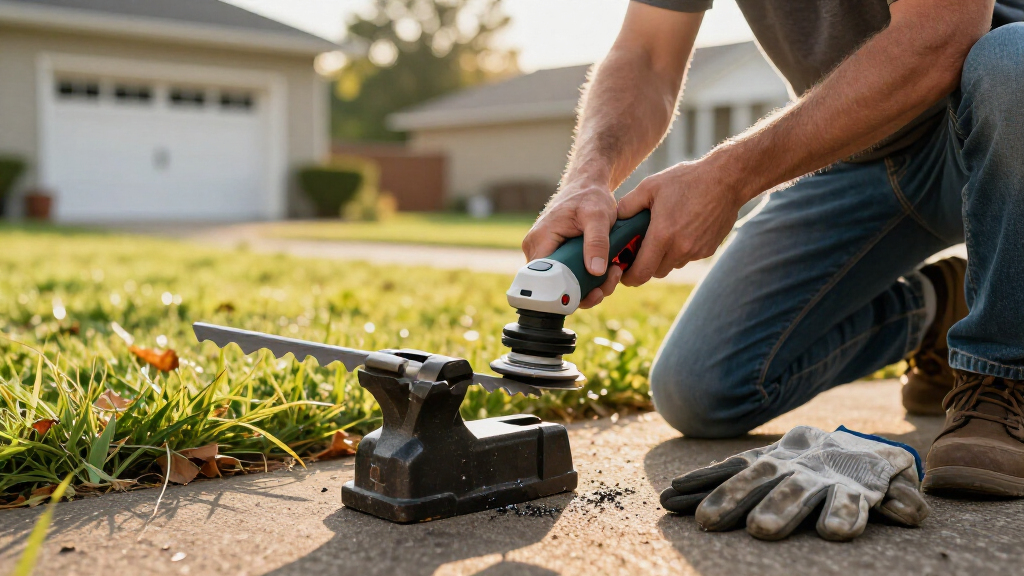
Hunker’s instructions begin with removing the mower blade from the deck and securing it in a vice so it cannot slip. The report recommends applying honing oil to the stone, working at a consistent angle with a circular motion, and starting with the coarse side if the blade is very dull. The medium side is then used to finish the edge.
Before the blade goes back on the mower, Hunker says to check and balance it. The article also recommends applying honing oil to the puck after use to clear away metal residue and storing it in a toolbox. It does not specify an exact sharpening angle, balancing method or sharpening time.
A Portable Option for Blade Care
The practical appeal is portability and simplicity: unlike a bench grinder, a puck needs no powered wheel and can be kept with other tools. That may suit people who want to sharpen a blade without setting up a stationary grinder, though the report does not compare the time, edge quality or cost of the two approaches.
Blade condition can affect the cut. Hunker says dull blades may tear grass rather than cut it cleanly, potentially stressing the lawn. The report presents regular sharpening as a way to maintain a cleaner cut, but does not provide research or quantified results supporting a particular sharpening schedule or lawn-health outcome.
dual grit sharpening puck for lawn mower blades
As an affiliate, we earn on qualifying purchases.
As an affiliate, we earn on qualifying purchases.
How the Two-Grit Stone Works
The report contrasts the puck with a bench grinder, which it describes as a versatile but less mobile tool. A puck instead relies on manual pressure and repeated strokes across the blade edge. Its two grits serve different stages: the coarse surface removes material more quickly, while the medium surface refines the edge.
Hunker also notes that sharpening pucks can be used on other blades, including those on axes and shovels. Its lawn mower guidance is specifically about removing the blade before sharpening, rather than working on a blade while it remains attached to the mower.
“A sharpening puck is a whetstone made of silicon carbide that’s usually 3 inches wide and 1 inch thick.”
— Hunker report
portable lawn mower blade sharpener
As an affiliate, we earn on qualifying purchases.
As an affiliate, we earn on qualifying purchases.
Performance Details Not Provided
The source does not report independent testing, compare the puck’s results with a bench grinder, or provide data on how long sharpening takes. It also does not name a suitable angle for a particular mower blade, explain a balancing procedure, or set out how much metal should be removed. Tool specifications and grit levels may differ between products.
The report describes the puck as a safer option because it lacks a fast-spinning wheel, but that is not the same as saying hand sharpening is risk-free. A detached mower blade remains sharp and can move if it is not secured. The article does not provide a full set of protective-equipment or mower-isolation instructions.
As an affiliate, we earn on qualifying purchases.
Check the Blade Before Reuse
Anyone following the method should consult the mower maker’s instructions for blade removal, sharpening and balancing, and confirm that the blade is firmly secured before using a stone. After sharpening, the blade should be balanced and correctly reattached before the mower is operated. The Hunker report does not announce a product launch or follow-up testing; its next practical step for readers is to assess their blade and choose an appropriate sharpening method.
As an affiliate, we earn on qualifying purchases.
Key Questions
What is a sharpening puck?
It is a small whetstone, commonly made of silicon carbide, used to sharpen blades by hand. Some versions have coarse and medium grit on opposite sides.
Does the blade stay on the mower during sharpening?
No. Hunker’s method says to remove the blade from the deck and secure it in a vice before sharpening.
Why does the method use two grits?
The coarse side is used to remove material and shape a dull edge; the medium side is used to finish it.
Does the blade need balancing afterward?
Yes. Hunker advises balancing the blade before reinstalling it. The report does not explain a specific balancing procedure, so users should check their mower’s guidance.
Is a sharpening puck proven to outperform a bench grinder?
The source does not provide a direct performance comparison or test results. It describes the puck as portable and simple to use, but does not establish that it sharpens faster or produces a better edge than a grinder.
Source: rss
Fall Picks
fall essentials
As an affiliate, we earn on qualifying purchases.