The best basement insulation kit for most homeowners is the FROTH-PAK 630 Closed-Cell Spray Foam Kit, which pairs professional-grade yield with a 15-foot hose that lets you reach rim joists and crawlspace corners without dragging tanks around. If budget leads your decision, the Amptern 12-Pack delivers 240 board feet of closed-cell foam at one of the lowest costs per board foot in this lineup, while the Kraken Bond Fastcoat stands out for its Class A fire rating — a genuine advantage when insulating near furnaces and water heaters. The core tradeoff across this category is coverage versus control: two-component tank kits cover far more area but demand careful setup and fast, continuous spraying, while smaller canister kits are easier to handle but cost more per square foot. Closed-cell foam dominates every kit here because basements demand a moisture-resistant air barrier, not just thermal resistance. Read on for the full breakdown, including which kits suit first-time sprayers and which ones earn their premium price.

Get cleaning gear delivered free with Prime
- Fast, free delivery on millions of items
- Prime Video, Amazon Music and more included
- Member-only deals all year
Complete the kit


Key Takeaways
- Board-foot yield varied widely across the 12 kits — from roughly 60 to 630 board feet — and yield, not sticker appeal, is the single biggest driver of real cost on a basement job.
- Every kit in this lineup is closed-cell foam, confirming that open-cell products have effectively disappeared from the DIY basement market because basements need a vapor-resistant air barrier.
- Fire ratings separated the premium tier: only the Kraken Bond Fastcoat and Sprayman kits carry Class A ratings, which matters for code compliance near mechanical rooms and furnace spaces.
- Hose length and tank design mattered as much as foam chemistry — the FROTH-PAK 630’s 15-foot hose was the clear usability winner for rim joist and crawlspace work compared with shorter-hose rivals.
- Small canister multipacks like the Magic Chems 6-Pack are convenient for patch jobs but cost several times more per board foot than tank kits, making them a poor fit for full wall coverage.
- Beginner-friendly chemistry (slower cream times, forgiving reapplication) clustered in the Y’allCanDIY and Adhesive Guru kits, while pro-grade kits like the BEEST FullStop demand faster technique to avoid waste.
| ixirpro Spray Foam Insulation Kit, 18-Pack, 30 oz |  | Best Value for Small Sealing Jobs | Pack size: 18 cans | Can size: 30 oz | Coverage: Up to 23 board feet | VIEW LATEST PRICE | See Our Full Breakdown |
| STANLEY Supercoat Closed-Cell Spray Foam Insulation Kit, 24-Pack |  | Best Complete Starter Package | Insulation type: Closed-cell polyurethane spray foam | Coverage: Up to 480 sq. ft. | R-value: 11.32 per 2 inches | VIEW LATEST PRICE | See Our Full Breakdown |
| FROTH-PAK 630 Closed-Cell Spray Foam Insulation Kit with 15 ft Hose | 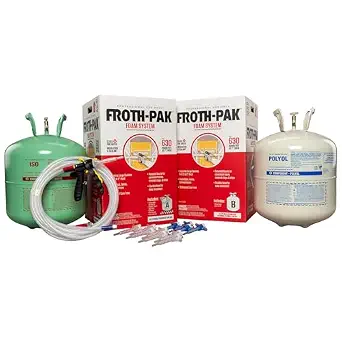 | Best for Large Basement Projects | Type: Two-component closed-cell polyurethane spray foam | Coverage: Up to 630 sq. ft. at 1-inch thickness | R-value: 6.2 per inch | VIEW LATEST PRICE | See Our Full Breakdown |
| Amptern 12-Pack Closed-Cell Spray Foam Insulation Kit, 240 Board Feet |  | Best Balanced Mid-Size Kit | Pack size: 12 cans | Coverage: 240 board feet | Foam type: High-density closed-cell | VIEW LATEST PRICE | See Our Full Breakdown |
| Vega Bond V200 Closed-Cell Spray Foam Insulation Kit, 200 Board Feet |  | Best for Tight, Damp Spaces | Type: Closed-cell, two-component spray foam | Coverage: 200 board feet | Density: 2 lb. | VIEW LATEST PRICE | See Our Full Breakdown |
| Magic Chems Polyurethane Spray Foam Insulation Kit, 6-Pack |  | Best Starter Kit for Small Basement Jobs | Brand: Magic Chems | Model: MPUSET-6 | Material: Polyurethane | VIEW LATEST PRICE | See Our Full Breakdown |
| ixirpro Spray Foam Insulation Kit, 18 Cans, 26.46 oz Each |  | Best Big-Batch Value for Multi-Surface Basements | Brand: ixirpro | Model: FX900-18 | Foam cans: 18 cans, 26.46 oz (750 g) each | VIEW LATEST PRICE | See Our Full Breakdown |
| Adhesive Guru Closed-Cell Spray Foam Insulation Kit, 12 Cans |  | Best for Spec-M minded Buyers | Brand: Adhesive Guru | Foam type: Closed-cell polyurethane | Can quantity: 12 cans, 930 g (32.8 oz) each | VIEW LATEST PRICE | See Our Full Breakdown |
| Y’allCanDIY Spray Foam Insulation Kit, 18 Cans |  | Best Two-Person Setup Kit | Brand: Y’allCanDIY | Foam cans: 18 cans, 25.3 fl oz (750 ml) each | Thermal resistance: Up to R-8 at 2-inch thickness | VIEW LATEST PRICE | See Our Full Breakdown |
| BEEST FullStop Spray Foam Insulation Kit, 240 Board Feet |  | Best Fire-Rated Performance | Brand: BEEST | Model: B-BNDL-SFI-12PK | Coverage: Up to 240 board feet | VIEW LATEST PRICE | See Our Full Breakdown |
| Kraken Bond Fastcoat Class A Fire-Rated Closed-Cell Spray Foam Insulation Kit, 18-Pack |  | Most Complete All-in-One Kit | Brand: Kraken Bond | Material: Polyurethane closed-cell foam | Pack size: 18 cans (27.1 oz each) | VIEW LATEST PRICE | See Our Full Breakdown |
| Sprayman Fire-Rated Closed-Cell Spray Foam Insulation Kit, 18-Pack |  | Best for Walls and Ceilings | Brand: SPRAYMAN | Material: Closed-cell polyurethane foam | Pack quantity: 18 cans | VIEW LATEST PRICE | See Our Full Breakdown |
| basement insulation kit | Coverage | R-value | Brand |
|---|---|---|---|
| ixirpro Spray Foam Insulation | Up to 23 board feet | 5.6 per inch | — |
| STANLEY Supercoat Closed-Cell | Up to 480 sq. ft. | 11.32 per 2 inches | — |
| FROTH-PAK 630 Closed-Cell Spra | Up to 630 sq. ft. at 1-inch thickness | 6.2 per inch | — |
| Amptern 12-Pack Closed-Cell Sp | 240 board feet | — | — |
| Vega Bond V200 Closed-Cell Spr | 200 board feet | — | — |
| Magic Chems Polyurethane Spray | Up to 120 sq ft | — | Magic Chems |
| ixirpro Spray Foam Insulation | — | — | ixirpro |
| Adhesive Guru Closed-Cell Spra | Up to 20 sq ft per can at 1-inch thickness; 240 board ft total | 5.66 per inch | Adhesive Guru |
| Y’allCanDIY Spray Foam Insulat | — | — | Y’allCanDIY |
| BEEST FullStop Spray Foam Insu | Up to 240 board feet | 8.24 at 2 inches | BEEST |
| Kraken Bond Fastcoat Class A F | 360 sq ft at 2 inches | 11.32 per 2 inches (5.66 per inch) | Kraken Bond |
| Sprayman Fire-Rated Closed-Cel | 360 sq ft | 11.32 at 2 inches | SPRAYMAN |
More Details on Our Top Picks
ixirpro Spray Foam Insulation Kit, 18-Pack, 30 oz
Most kits in this roundup push you toward a full wall-cavity project, but the ixirpro 18-pack takes a different approach: it is a straightforward can-based system for sealing cracks, rim joists, and penetrations rather than blanketing entire walls. At up to 23 board feet total, it is the lightest-duty option here, and that is exactly the point — buyers insulating a single basement wall or sealing sill plates do not need a two-tank rig like the FROTH-PAK 630. The closed-cell foam delivers solid R-5.6 per inch and cures into a trimmable, shapeable mass that works on wood, masonry, and metal.
The main tradeoff is the missing spray gun. Unlike the Amptern 12-pack, which bundles a gun, nozzles, and gloves, this kit assumes you already own an applicator — budget for one if you do not. Coverage also swings with temperature and humidity, so expect less yield on cold basement walls.
Pros:- Closed-cell foam provides both thermal and sound insulation at R-5.6 per inch
- Adheres to wood, masonry, metal, and other common basement surfaces
- Foam can be trimmed and shaped after curing for a clean finish
- Large 18-can supply covers repeated small jobs without reordering
Cons:- Spray foam gun is not included, adding cost if you do not own one
- Real-world coverage varies with temperature, humidity, and application conditions
Best for: DIYers sealing rim joists, cracks, and pipe penetrations in a basement who already own a foam gun
Not ideal for: Anyone insulating full wall sections — 23 board feet disappears fast compared to 200+ board foot kits like the Vega Bond V200
- Pack size:18 cans
- Can size:30 oz
- Coverage:Up to 23 board feet
- R-value:5.6 per inch
- Foam type:Closed-cell, high-density
- Spray foam gun:Not included
Our verdict“A sensible buy if your basement project is really a crack-sealing project and you already have an applicator.”
STANLEY Supercoat Closed-Cell Spray Foam Insulation Kit, 24-Pack
What separates the STANLEY Supercoat from most of this lineup is everything in the box: 24 foam cans, 2 cleaners, a gun, gloves, glasses, and a full suit. Compared with the ixirpro 18-pack — which ships with no applicator at all — this is a true open-and-go package for a first-time basement insulator who owns nothing but a basement. The closed-cell polyurethane is waterproof and paintable, which matters in below-grade spaces where moisture and finished-wall aesthetics are both real concerns.
Coverage is rated up to 480 sq. ft., putting it well ahead of the Amptern’s 240 board feet for whole-room ambitions. The tradeoff is that can-based systems like this one are slower and messier than two-tank kits like the FROTH-PAK 630 — expect more passes, more nozzle changes, and more cleanup rather than one continuous spray.
Pros:- Truly complete kit includes gun, cleaners, gloves, glasses, and protective suit
- Waterproof closed-cell foam suits damp basement conditions
- Paintable cured surface works for finished basement walls
- Up to 480 sq. ft. coverage leads most can-based rivals in this lineup
Cons:- Can-based application is slower than two-tank systems for large areas
- Seamless coverage depends heavily on user technique and steady overlap
Best for: First-time DIYers who want a genuinely complete kit with applicator and safety gear included from day one
Not ideal for: Impatient large-project builders — 24 individual cans cannot match the continuous output of a hose-fed two-component kit
- Insulation type:Closed-cell polyurethane spray foam
- Coverage:Up to 480 sq. ft.
- R-value:11.32 per 2 inches
- Water resistance:Waterproof
- Volume per can:27.1 fluid ounces
- Package quantity:24 cans
- Included components:24 foam cans, 2 cleaners, foam gun, gloves, glasses, suit
Our verdict“The pick for someone who wants one box, one order, and everything needed to start spraying the same weekend.”
FROTH-PAK 630 Closed-Cell Spray Foam Insulation Kit with 15 ft Hose
When the job is a full basement worth of walls and headers, can-based kits start to feel like filling a pool with a garden hose. The FROTH-PAK 630 is the professional-style answer: a two-component tank system rated for 630 sq. ft. at 1-inch thickness — roughly triple the practical coverage of the Vega Bond V200. The 15-foot hose lets you work across a room without dragging tanks, and the 30-second cure time means you can spray, trim, and move on in a single afternoon. It bonds to wood, drywall, and masonry, and carries Green Circle, LEED v4, and ICC credentials none of the other kits here can match.
Two tradeoffs temper the appeal. No protective equipment is included — unlike the STANLEY Supercoat — so factor in a suit, gloves, and respirator. The delivery also requires a customer signature, which complicates drop-off scheduling.
Pros:- 630 sq. ft. coverage at 1 inch is the largest capacity in this roundup
- 15 ft hose allows continuous spraying without repositioning tanks
- Green Circle Certified, LEED v4 compliant, and ICC listed
- Fast 30-second cure time speeds up large jobs
Cons:- Required PPE is not included, adding cost and a separate purchase
- Adult signature required at delivery can complicate shipping
Best for: Homeowners insulating an entire basement who want professional-grade coverage and certified materials
Not ideal for: Small crack-sealing jobs — the capacity, cost, and setup of a two-tank rig are overkill for rim joists and gaps
- Type:Two-component closed-cell polyurethane spray foam
- Coverage:Up to 630 sq. ft. at 1-inch thickness
- R-value:6.2 per inch
- Cure time:30 seconds
- Hose length:15 ft
- Certifications:Green Circle Certified, LEED v4 compliant, ICC listed
Our verdict“The right tool when a whole basement is on the schedule and can kits simply cannot keep up.”
Amptern 12-Pack Closed-Cell Spray Foam Insulation Kit, 240 Board Feet
The Amptern 12-pack occupies the sensible middle ground between the ixirpro’s 23 board feet and the FROTH-PAK’s industrial scale. With 240 board feet of high-density closed-cell foam and a bundled gun, nozzles, cleaner, straws, gloves, goggles, and suit, it covers a mid-sized basement project without leaving you to source an applicator separately — the exact gap the ixirpro kit leaves open. The foam bonds to wood, concrete, brick, stone, metal, PVC, and glass, which makes it a good fit for mixed-surface basement work where you are sealing masonry walls one hour and PVC penetrations the next.
Its weakness is precision: the listing gives no cured expansion or per-can coverage figures, so planning material quantities becomes guesswork. It is also temperature-sensitive — cans should sit around 68°F and be applied between 41°F and 86°F, which rules out cold, uninsulated basements in winter unless you warm the space first.
Pros:- Complete kit includes gun, nozzles, cleaner, straws, and full protective gear
- 240 board feet suits mid-size projects without two-tank complexity
- Adheres to wood, concrete, brick, stone, metal, PVC, glass, and MDF
- High-density closed-cell foam reduces air movement and sound transfer
Cons:- No stated cured expansion or per-can coverage makes material planning difficult
- Strict temperature requirements for cans and workspace limit winter use
Best for: DIYers tackling a medium basement job across mixed surfaces who want tools and protective gear in one box
Not ideal for: Cold-climate basements in winter — the 41°F–86°F working range and 68°F can temperature are hard to hit without heating the space
- Pack size:12 cans
- Coverage:240 board feet
- Foam type:High-density closed-cell
- Included components:Spray gun, adjustable nozzle, gun cleaner, disposable straws, gloves, goggles, coverall suit
- Recommended can temperature:Approximately 68°F
- Working temperature:41°F–86°F
- Application distance:10–12 inches
Our verdict“A well-rounded middle option for a half-finished basement — just warm the room and cans before you spray.”
Vega Bond V200 Closed-Cell Spray Foam Insulation Kit, 200 Board Feet
Basements are humid places, and the Vega Bond V200 is built for that reality: its 2-lb closed-cell foam cures into an airtight seal and vapor barrier with the highest per-inch rating in this batch at R-7 — ahead of the FROTH-PAK’s 6.2 and well past the ixirpro’s 5.6. For crawl spaces, rim joists, and around pipes and ducts where moisture migration is as much a problem as heat loss, that vapor-barrier performance is the differentiator. The 9.5 ft gun-and-hose assembly is shorter than FROTH-PAK’s 15-footer, but far more maneuverable inside cramped basement corners, and the low-GWP formula is a plus for anyone mindful of indoor air chemistry.
The tradeoffs are real, though. The mask is not included — the STANLEY Supercoat covers your eyes and body but skips the respirator too, so plan on buying one regardless. The canisters also need warming to 75°F–85°F, a narrower window than the Amptern’s range, before you get consistent spray.
Pros:- R-7 per inch is the highest thermal rating in this lineup
- Cured foam forms an airtight seal and vapor barrier for damp spaces
- Low-GWP formula reduces environmental footprint
- Includes gun and hose assembly, coverall, glasses, and 8 nozzle tips
Cons:- Respirator mask is not included despite the kit’s other safety gear
- Canisters must be warmed to 75°F–85°F for reliable application
Best for: Owners of damp basements, crawl spaces, and rim-joist bays who need a vapor barrier as much as insulation
Not ideal for: Large open-wall projects — 200 board feet trails the FROTH-PAK 630 by more than triple
- Type:Closed-cell, two-component spray foam
- Coverage:200 board feet
- Density:2 lb.
- Thermal resistance:R-7 per inch
- Formula:Low GWP
- Included components:9.5 ft gun and hose assembly, coverall, safety glasses, 4 fan tips, 4 cone tips
- Application temperature:75°F–85°F
Our verdict“The pick for moisture-prone basement corners where R-value per inch and vapor control matter more than raw square footage.”
Magic Chems Polyurethane Spray Foam Insulation Kit, 6-Pack
Not every basement project demands 18 cans of foam, and that’s exactly where Magic Chems’ six-can kit earns its place. With roughly 120 sq ft of coverage, it’s sized for sealing rim joists, sill plates, and pipe penetrations rather than insulating entire walls. Compared with the Y’allCanDIY 18-can kit, this is a fraction of the commitment — ideal if you’re unsure whether spray foam suits your workflow. The bundled foam gun, cleaner, nozzles, and full protective gear mean there’s nothing else to buy, which beginners will appreciate. The tradeoff is value per can: larger kits like ixirpro’s deliver more foam for the money, and you’ll need to wait a full 24 hours before trimming any excess. Spray technique also affects results, so expect a learning curve on your first few cans.
Pros:- Complete starter package with foam gun, cleaner, nozzles, and protective gear
- Right-sized for small sealing projects without leftover material
- Works indoors and outdoors for thermal and sound insulation
- Water-resistant foam suits damp-prone basement areas
Cons:- Lowest foam volume in the roundup, so cost per board foot is high
- 24-hour cure time delays trimming and finishing
- Results depend heavily on maintaining proper spray distance
Best for: First-time DIYers tackling small basement sealing jobs like rim joists and gap-filling
Not ideal for: Homeowners insulating full basement walls — the 120 sq ft coverage runs out quickly on large jobs
- Brand:Magic Chems
- Model:MPUSET-6
- Material:Polyurethane
- Can volume:25.4 fl oz (750 ml) each, 6 cans
- Coverage:Up to 120 sq ft
- Full cure time:24 hours
- Water resistance:Water resistant
- Includes:Foam gun, gun cleaner, nozzle tips, coverall, goggles, gloves, mask
Our verdict“Buy this if you want a low-commitment, everything-included introduction to spray foam for small basement gaps.”
ixirpro Spray Foam Insulation Kit, 18 Cans, 26.46 oz Each
When a basement job involves mixed surfaces — concrete foundation walls, stone, metal ductwork, and wood framing — the ixirpro 18-can kit stands out for material versatility. Few kits in this roundup list compatibility with granite, MDF, and glass alongside the usual concrete and brick, which matters in older basements with mixed construction. At 26.46 oz per can, it edges out the Y’allCanDIY cans (25.3 oz each) slightly on volume, and the high-density closed-cell formula delivers firmer, more moisture-resistant fills than open-cell alternatives. The 40-pound shipping weight tells you this is a serious quantity of material. The tradeoff: like nearly every kit here, you’re locked out of trimming for about 24 hours, and the listed dimensions suggest minimal retail packaging — plan your storage accordingly.
Pros:- 18-can capacity handles multi-wall basement projects without reordering
- Adheres to an unusually wide list of materials including stone, glass, and MDF
- High-density closed-cell foam resists moisture better than open-cell options
- Trimable and shapeable after curing for clean finishes
Cons:- 24-hour cure window before any trimming can begin
- Large physical kit to store and transport at 40 pounds
- No stated R-value, making thermal comparisons with BEEST harder
Best for: Owners of older homes with mixed-material basements needing a large foam supply in one purchase
Not ideal for: Renters or single-room DIYers — 18 cans is overkill for small gap-sealing tasks
- Brand:ixirpro
- Model:FX900-18
- Foam cans:18 cans, 26.46 oz (750 g) each
- Foam type:High-density closed-cell polyurethane
- Compatible materials:Wood, concrete, metal, glass, stone, brick, granite, MDF
- Cure time:24 hours
- Item weight:40 pounds
- Includes:Foam gun, gun cleaner, nozzles, protective suit, safety glasses, gloves
Our verdict“This is the pick for large basements with varied surfaces where one kit needs to stick to everything.”
Adhesive Guru Closed-Cell Spray Foam Insulation Kit, 12 Cans
Most kits in this category are vague about thermal performance, but Adhesive Guru publishes hard numbers: R-5.66 per inch and thermal conductivity of 0.025 W/(m·K). For a buyer comparing options on paper, that transparency is rare and useful — you can actually calculate whether a 1-inch fill meets your basement’s target. Each 930 g can covers up to 20 sq ft at 1-inch thickness, and the kit includes 24 nozzles (12 blue, 12 black), double the usual count, which helps when nozzles clog mid-job. Compared with the Magic Chems 6-pack, you get double the cans and stronger spec documentation. The catch is bonding: adhesion can lag on uneven surfaces or in gaps, which is a real issue on rough poured-concrete basement walls. Prep work matters more here than with BEEST’s kit.
Pros:- Published R-value of 5.66 per inch enables real thermal planning
- Generous 24 replacement nozzles reduce mid-job interruptions
- Large 930 g cans offer strong per-can coverage
- Full accessory bundle including gun, cleaner, and safety gear
Cons:- Bonding may be delayed on gaps or uneven basement surfaces
- Up to 24-hour full cure time
- 12 cans may fall short for whole-basement coverage compared with 18-can kits
Best for: Detail-oriented DIYers who want published R-values and thermal data before buying
Not ideal for: Those with rough or uneven concrete walls — bonding may be delayed and require extra prep
- Brand:Adhesive Guru
- Foam type:Closed-cell polyurethane
- Can quantity:12 cans, 930 g (32.8 oz) each
- Coverage:Up to 20 sq ft per can at 1-inch thickness; 240 board ft total
- R-value:5.66 per inch
- Thermal conductivity:0.025 W/(m·K)
- Full cure time:Up to 24 hours
- Country of manufacture:Türkiye
Our verdict“Choose this kit when you want verified thermal specs and don’t mind extra surface prep on rough concrete.”
Y’allCanDIY Spray Foam Insulation Kit, 18 Cans
What separates Y’allCanDIY from every other kit here is the doubled tooling: two foam guns, two gun cleaners, two coveralls, two masks, and two pairs of safety glasses. Basement insulation goes much faster with a second person — one spraying high on the walls while the other handles rim joists — and this is the only kit built for that workflow. Even solo users benefit from the backup gun if one clogs mid-project. The foam itself delivers up to R-8 at the recommended 2-inch thickness, comparable to the BEEST kit’s R-8.24, though Y’allCanDIY demands more from you: the spec sheet is candid that coverage swings with depth, surface conditions, and technique. With a wide 60–90°F application window, it’s also more forgiving of temperature than BEEST’s narrow 68–77°F range — a genuine advantage in a cool basement.
Pros:- Two complete applicator setups enable faster two-person work
- Up to R-8 at 2-inch thickness for solid thermal performance
- Wide 60–90°F application temperature range suits cool basements
- Extensive accessory bundle including long straws for recessed gaps
Cons:- Coverage varies significantly with application depth and technique
- Requires careful surface preparation for reliable adhesion
- No fire-rating certification listed unlike BEEST’s ASTM E84 data
Best for: DIY pairs insulating a basement together who need duplicate guns and safety gear
Not ideal for: Buyers wanting predictable coverage — results vary noticeably with technique and surface conditions
- Brand:Y’allCanDIY
- Foam cans:18 cans, 25.3 fl oz (750 ml) each
- Thermal resistance:Up to R-8 at 2-inch thickness
- Application temperature:60–90°F (15–32°C)
- Compatible surfaces:Wood, concrete, metal, glass, brick, drywall, masonry
- Guns included:2 foam guns with 2 gun cleaners
- Accessories:18 gun straws, 18 spreaders, 4 long straws, 4 nozzles, gloves, glasses, masks, coveralls
Our verdict“Grab this kit if two people will share the work and you want spare tools plus a forgiving temperature range.”
BEEST FullStop Spray Foam Insulation Kit, 240 Board Feet
For basement work specifically, fire performance isn’t optional polish — it’s a legitimate safety concern, and BEEST is the only kit in this batch with documented ASTM E84 results: a Flame Spread Index of 0 and Smoke Developed Index of 120. That Class A surface-burning rating matters if your basement houses a furnace, water heater, or finished living space. The R-8.24 at 2 inches slightly beats both the Y’allCanDIY (R-8) and Adhesive Guru (R-5.66/inch × 2 = ~R-11.3, but only if you spray a full 2 inches successfully). The tradeoff is the strictest application window in the lineup: 68–77°F. Cold basements in winter may need space heaters running before you can start, which adds planning the other kits don’t demand. Coverage of 240 board feet matches the Adhesive Guru kit despite fewer variables.
Pros:- Class A fire performance documented under ASTM E84 testing
- Highest stated R-value in this batch at R-8.24 for 2 inches
- Bonds to wood, metal, drywall, concrete, and brick
- Complete kit with gun, cleaner, and full safety gear
Cons:- Narrow 68–77°F application temperature range restricts timing
- 240 board feet may not cover large basements in a single purchase
- 24-hour cure adds downtime before trimming
Best for: Safety-conscious homeowners insulating basements near furnaces, water heaters, or finished spaces
Not ideal for: Cold-climate DIYers in winter — the 68–77°F application window is hard to hit without heating the space
- Brand:BEEST
- Model:B-BNDL-SFI-12PK
- Coverage:Up to 240 board feet
- R-value:8.24 at 2 inches
- Flame Spread Index:0 (ASTM E84)
- Smoke Developed Index:120 (ASTM E84)
- Application temperature:68–77°F
- Number of cans:12
- Item weight:26.6 pounds
Our verdict“This is the kit for anyone who prioritizes verified fire safety over application convenience.”
Kraken Bond Fastcoat Class A Fire-Rated Closed-Cell Spray Foam Insulation Kit, 18-Pack
What separates this Kraken Bond kit from the rest of the roundup is everything that comes in the box. Beyond the 18 cans of closed-cell foam, you get an application gun, cleaner, nozzles, goggles, a worksuit, and gloves — a full setup that most competitors, like the Y’allCanDIY 18-can kit, leave you to source separately. For a basement project, that matters: closed-cell foam’s airtight, watertight seal is exactly what damp-prone walls and rim joists need, and the Class A fire rating (ASTM E84) adds a layer of reassurance for an enclosed space. The tradeoff is fussiness — cans perform best at 68°F, so cold basements may require warming the cans first, and you’ll need proper ventilation during application. Compared with the Sprayman kit below, coverage and R-value are nearly identical, so the real differentiator is the included safety gear rather than performance.
Pros:- Class A fire rated and meets ASTM E84 for enclosed basement spaces
- Creates an airtight, watertight seal suited to damp-prone foundation walls
- Complete kit includes gun, cleaner, nozzles, goggles, worksuit, and gloves
- Delivers both thermal and acoustic insulation at 5.66 R-value per inch
Cons:- Cans must be conditioned to roughly 68°F for reliable foam quality
- Application demands ventilation and careful adherence to safety guidelines
Best for: First-time DIYers insulating a full basement who want a complete kit without buying safety gear and tools separately
Not ideal for: Anyone working in an unheated basement in winter — the strict 68°F can temperature requirement adds hassle that other kits handle more flexibly
- Brand:Kraken Bond
- Material:Polyurethane closed-cell foam
- Pack size:18 cans (27.1 oz each)
- Coverage:360 sq ft at 2 inches
- R-value:11.32 per 2 inches (5.66 per inch)
- Application temperature:41°F to 86°F (cans at 68°F)
- Included components:18 cans, application gun, cleaner, wide nozzle, goggles, worksuit, gloves
Our verdict“Buy this if you want a true turnkey basement insulation project with safety gear included; skip it if you can’t control ambient temperatures during application.”
Sprayman Fire-Rated Closed-Cell Spray Foam Insulation Kit, 18-Pack
The Sprayman kit earns its spot with application-specific engineering. Its two interchangeable nozzles — one tuned for walls, one for ceilings — give you better control on overhead basement ceiling cavities and vertical foundation walls, something the Kraken Bond Fastcoat kit with its single wide nozzle doesn’t match. Coverage and R-value are essentially identical to Kraken Bond at 360 sq ft and 11.32 at 2 inches, so the choice comes down to spray control versus included safety gear. The cured foam resists cracking, shrinking, and settling, and it’s paintable, which matters if your basement walls will eventually be finished living space. On the downside, UV exposure can discolor the foam over time, so any exposed areas near window wells should be covered, and real energy savings hinge on consistent application technique.
Pros:- Two interchangeable nozzles optimized separately for walls and ceilings
- Cured foam resists cracking, shrinking, and settling over time
- Paintable finish suits basements being converted to living space
- Class A fire rating and compatibility with a wide range of surfaces
Cons:- UV exposure may gradually discolor the foam in areas with light exposure
- Actual energy savings vary with application conditions and technique
- No safety gear included, unlike comparable all-in-one kits
Best for: Homeowners finishing a basement who need precision spraying on both vertical walls and overhead ceiling cavities, plus a paintable finished surface
Not ideal for: Buyers who want maximum value from included accessories — the kit skips safety gear, offering only the gun, cleaner, and adhesive
- Brand:SPRAYMAN
- Material:Closed-cell polyurethane foam
- Pack quantity:18 cans
- Coverage:360 sq ft
- R-value:11.32 at 2 inches
- Nozzles:Two interchangeable (wall and ceiling)
- Included components:Application gun, gun cleaner, SprayCoat urethane adhesive
Our verdict“This is the pick if nozzle precision and a paintable, durable finish on walls and ceilings matter more than bundled safety equipment.”

How We Picked
I evaluated each kit against the factors that actually determine success on a basement project: total board-foot yield, cost per board foot, spray control, hose reach, cure behavior, and safety credentials. Because basements are below-grade environments with moisture risk, I gave preference to closed-cell formulations and flagged any kit with a verified fire rating, since foam left exposed near mechanical equipment can run into code problems. I also weighed usability cues that matter to first-time sprayers — tank setup complexity, nozzle clogging tendency, pot life after activation, and whether the kit includes enough spare tips to survive a full session.
The ranking order reflects a simple philosophy: the best kit is the one that finishes the whole job without waste or reorders. High-yield tank systems that balance coverage with manageable handling ranked highest, value-oriented multipacks filled the middle tier for smaller budgets, and single-purpose patch kits landed lower despite their convenience because they fail the full-basement test. Where two kits offered similar chemistry, the tiebreaker went to hose length, tip count, and fire rating — the details that determine whether a weekend project goes smoothly or ends with half-cured tanks in the trash.
Factors to Consider When Choosing Best Basement Insulation Kits
Choosing between these kits comes down to matching kit capacity and chemistry to the actual scope of your basement project. Before you buy, work through the factors below — they explain why two kits with identical foam chemistry can be a perfect match for one buyer and a costly mistake for another.Calculate Board Feet Before You Buy Anything
Board feet — the standard yield measurement for spray foam — equals coverage area multiplied by thickness in inches, and buying too little is the most common and expensive mistake in this category. A typical basement with 400 square feet of wall at two inches of foam needs roughly 800 board feet, which exceeds every single kit in this roundup and means you’ll be combining multiple kits or planning a second order. Remember that advertised yield assumes perfect technique: first-time sprayers routinely lose 10 to 20 percent to overspray, drips, and uneven passes. My advice is to calculate your requirement, then add a full kit’s worth of buffer rather than buying marginally. Shipping foam kits separately also risks batch mismatch, since tanks activated on different days behave slightly differently where the foam meets.
Why Closed Cell Is Non-Negotiable Below Grade
Every kit in this roundup is closed-cell foam, and that’s not a coincidence — it’s the physics of basements. Open-cell foam absorbs and transmits moisture, and below-grade walls are constantly exposed to vapor drive from surrounding soil. Closed-cell foam creates a vapor-retarding air barrier at typical two-inch applications, which handles both the humidity and the air leakage that makes basements feel cold and damp. It’s also structurally rigid and dense enough (around R-6 to R-7 per inch) to hit insulation targets in thinner layers, which matters when you’re trying to preserve headroom along rim joists. If you ever see a cheaper open-cell kit marketed for basements, treat it with suspicion — moisture trapped behind open-cell foam against a concrete wall becomes a mold problem within a few years.
Fire Ratings and Code Compliance
Spray foam left exposed is a combustible surface, and most residential codes require it to be covered by a thermal barrier like drywall — or to carry a validated fire rating where it remains exposed. This matters most around rim joists, furnace rooms, and water heater spaces, exactly the zones basement projects tend to target. Kits like the Kraken Bond Fastcoat and Sprayman carry Class A ratings, which gives you flexibility in mechanical areas where drywall is impractical. Check your local code before assuming a rating solves everything, though: some jurisdictions require an ignition barrier regardless, and others have specific rules for crawlspace applications. A fire rating is also a reasonable proxy for manufacturing quality, since certification requires consistent formulation and third-party testing rather than factory self-claims.
Tank Kits Versus Canister Multipacks
The lineup splits into two delivery systems, and the right choice depends on job size and your tolerance for setup work. Two-component tank kits mix chemicals at the nozzle, deliver high pressure, and spray large areas fast — but once activated, the clock is running, and unused product cures in the lines if you stop too long. Canister multipacks trade yield for convenience: each can is self-contained, you can pause between cans indefinitely, and cleanup is minimal. That makes multipacks genuinely better for staged projects, patch work, and hard-to-reach gaps, even though the cost per board foot runs considerably higher. A useful rule: if your job is under about 100 board feet, multipacks are reasonable; anything larger and the tank kit’s economics win decisively.
Technique Demands and Beginner Realities
Spray foam punishes hesitation, and buyer reviews of every kit in this category are full of stories about ruined product from rushed or timid first attempts. Kits vary in cream time and forgivingness: slower-cream formulations give beginners a longer window to correct passes and re-tack layers, while fast professional-grade foams demand continuous, steady gun movement with no pauses. Ambient temperature also matters more than most buyers expect — tanks need to be warm (generally above 70°F) before spraying, or the foam under-expands and yields far below the advertised figure. Shake tanks thoroughly, keep the gun moving at a consistent speed, and spray in multiple thin passes rather than one thick flood. If you’ve never sprayed before, budget one smaller kit purely as practice material before committing to the big tank system.
Safety Gear and Ventilation Are Part of the Cost
None of these kits include the protective equipment you actually need, and skipping it turns a weekend project into a health hazard. Uncured isocyanates irritate lungs and skin, so a NIOSH-rated respirator with organic vapor cartridges, chemical-resistant gloves, and eye protection belong on your shopping list alongside the kit. Basements compound the risk because they’re below grade with limited natural airflow — run a fan and ventilate to the outside during spraying, and stay out of the space for several hours after to let the foam finish off-gassing. Pets and family members should be kept away entirely during application. Plan the full safety budget into your cost comparison: a kit that looks cheaper upfront can end up costing more once you add proper respiratory protection, which is not an optional accessory with two-component foam.
Frequently Asked Questions
How many board feet do I actually need for a typical basement?
Measure your wall area and multiply by your target thickness in inches — a 30-by-30-foot basement with 8-foot walls has roughly 960 square feet of wall, which needs about 960 board feet at one inch or 1,920 at two inches. Most basements aiming for a proper thermal break use two inches of closed-cell foam, so plan on combining multiple tank kits. Because kits like the FROTH-PAK 630 cover 630 board feet under ideal conditions, a full basement typically needs three or more kits once you account for overspray and technique losses. Always calculate first and buy with a buffer, since running out mid-wall means a second shipment and a visible seam line between spray sessions.
Is a fire-rated kit worth the extra cost for a basement?
If your foam will stay exposed anywhere near a furnace, water heater, or electrical panel, a Class A rated kit like the Kraken Bond Fastcoat or Sprayman is worth it for both code compliance and insurance peace of mind. Unrated foam left uncovered technically requires a thermal barrier such as drywall in most jurisdictions, and an inspector can force you to frame and cover it after the fact — far more expensive than the kit upgrade. That said, if you’re planning to finish the walls with drywall anyway, the rating buys you little, and a standard closed-cell kit makes more sense. The practical middle ground many homeowners take is using rated kits in mechanical areas and standard kits on walls destined for drywall.
Can I use leftover spray foam from a partially used tank kit?
Generally no, and this is the hidden cost of tank kits that catches first-time buyers off guard. Once a two-component tank system is activated, the chemicals begin curing in hoses and valves, and most manufacturers give you a very short working window — often the same day — before remaining product is unusable. Some kits can be stored briefly with fresh mixing tips if both tanks stay pressurized and sealed, but yield drops and clogging becomes frequent. This is why sizing your purchase to the job matters so much: a half-empty tank isn’t a savings for later, it’s waste. If your project is small or staged, canister multipacks like the Magic Chems or ixirpro can sets are the smarter choice since each unopened can stores indefinitely.
Can I spray basement insulation in cold weather?
You can, but the foam chemistry needs warmth to perform, and cold basements are where most yield complaints originate. Tanks and canisters should be conditioned to roughly 70-80°F before spraying — warm them in a heated room overnight, not with a direct open heat source — and the surface being sprayed should ideally be above 60°F. Cold chemical under-expands, delivering a fraction of advertised board feet and leaving dense, poorly adhered foam. In winter, run a space heater in the basement for a day before spraying, and expect the room itself to need active ventilation afterward anyway since off-gassing lingers longer in cold air. Slow, cold spraying also produces coarse foam texture and weaker cell structure, so warmth is genuinely a quality issue, not just a yield issue.
Should I insulate basement walls or just the rim joists first?
If budget forces a choice, rim joists deliver the biggest comfort return per dollar, because they’re where the coldest air infiltration and condensation problems concentrate. Sealing the rim joist box with closed-cell foam stops the stack effect that pulls cold air through the entire house, and it addresses the condensation that causes mold in corners and behind stored items. Full wall insulation matters more if you’re finishing the basement as living space or fighting persistent floor coldness upstairs. A phased approach works well here: use a smaller kit like the Vega Bond V200 or a canister multipack for rim joists now, then invest in large tank kits for the walls when you’re ready to finish the space. Just keep records of foam thickness, since inspectors sometimes ask when you later frame over it.
Conclusion
The right kit depends entirely on the scope of your basement project and your experience with a spray gun. For best overall, the FROTH-PAK 630 wins on raw yield, hose reach, and professional chemistry — it’s the pick for full basement walls in a single weekend. The Amptern 12-Pack takes best value with 240 board feet of solid closed-cell performance at a cost per board foot that undercuts most rivals here. For premium buyers and code-sensitive jobs, the Kraken Bond Fastcoat justifies its price with a Class A fire rating that keeps you compliant near mechanical rooms. First-time sprayers should start with the Y’allCanDIY 18-can kit, whose forgiving chemistry and staged canister format let you learn without risking a large tank cure-out, while the Magic Chems 6-Pack serves as the best patch-and-gap option for rim joists, pipe penetrations, and small repairs. Whatever you choose, size up your board-foot requirement, prep your safety gear, and warm the tanks — the kit you pick matters less than buying enough of it and spraying it right.