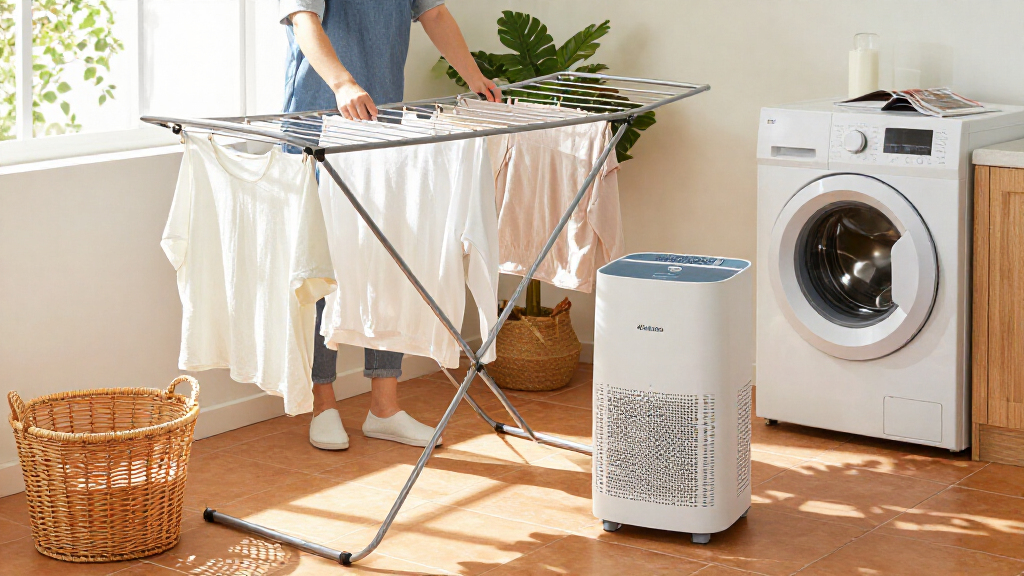

When hanging clothes indoors, the KNKA 2500 Ft² Max 34 Pints Dehumidifier stands out as the best overall choice for its balance of high extraction rate and manageable footprint. For those with limited space, the BREEZOME 60 oz Portable Dehumidifier offers a compact solution that fits directly under drying racks without consuming excessive floor area. The primary tradeoff in this category is between moisture removal speed and operational noise; larger units dry clothes faster but may disrupt daily life, while quieter models require longer drying times. This guide breaks down these tradeoffs to help you select the right unit for your specific laundry habits and room size. Continue reading for a detailed comparison of features, performance, and suitability for different living situations.

Get cleaning gear delivered free with Prime
- Fast, free delivery on millions of items
- Prime Video, Amazon Music and more included
- Member-only deals all year
Complete the kit


Key Takeaways
- Semiconductor (thermoelectric) models like the BREEZOME are quieter but slower, making them suitable for overnight drying in small rooms rather than rapid daytime drying.
- Units with continuous drain hose options, such as the KNKA and 80-Pint models, significantly reduce maintenance burden compared to tank-only designs during heavy laundry cycles.
- Coverage area claims vary widely; small-capacity units (under 1000 sq ft) struggle to lower humidity in large open-plan laundry areas, leading to damp towels even after hours of operation.
- Energy Star certification, seen in the AEOCKY model, correlates with lower electricity costs during the extended runtimes required for indoor laundry drying.
- Smart humidity controls and auto-shutoff features are critical for preventing over-drying, which can stiffen fabrics and increase static cling in synthetic blends.
| BEDRED 95 oz Dehumidifier for Home, 1,000 sq. ft., with Sleep Mode and Auto Shutoff |  | Best for a Bedroom Near the Laundry | Type: Semiconductor dehumidifier | Coverage area: 1,000 sq. ft. | Tank volume: 95 fl oz | VIEW LATEST PRICE | See Our Full Breakdown |
| OWAAE Dehumidifier for Home with Auto Shutoff and Sleep Mode – 1000 sq ft |  | Best for Quiet, Occasional Laundry Drying | Coverage area: 1,000 sq. ft. | Dehumidification capacity: 1 L/day | Tank capacity: 95 fl oz | VIEW LATEST PRICE | See Our Full Breakdown |
| NineSky Dehumidifier with 95 oz Tank, Auto Shutoff, and 7-Color LED Light |  | Best for a Stated Moisture-Removal Figure | Type: Semiconductor dehumidifier | Coverage area: 1,000 sq. ft. | Tank capacity: 95 oz | VIEW LATEST PRICE | See Our Full Breakdown |
| KNKA 2500 Ft² Max 34 Pints Dehumidifier for Basement with Drain Hose, White |  | Best Overall for a Dedicated Laundry Room | Type: Compressor dehumidifier | Coverage area: Up to 2,500 sq. ft. | Moisture removal: Up to 34 pints/day at 95°F and 90% RH | VIEW LATEST PRICE | See Our Full Breakdown |
| BREEZOME 60 oz Portable Dehumidifier with Dual Semiconductor Condensers |  | Best Compact Pick for Small Laundry Corners | Model: MCS008 | Recommended floor area: 350 sq. ft. | Tank capacity: 1.8 L (60 oz) | VIEW LATEST PRICE | See Our Full Breakdown |
| TABYIK 35 oz Portable Dehumidifier with Auto Shut-Off |  | Best for a Laundry Closet | Dehumidification capacity: 0.45 liters per day | Tank capacity: 1,000 ml (35 oz) | Recommended floor area: 280 sq. ft. | VIEW LATEST PRICE | See Our Full Breakdown |
| 80-Pint Dehumidifier for Areas up to 4,500 Sq. Ft. with Drain Hose |  | Best for Large Laundry Rooms | Dehumidification capacity: Up to 80 pints per day | Coverage area: Up to 4,500 sq. ft. | Tank capacity: 1.72 gallons | VIEW LATEST PRICE | See Our Full Breakdown |
| Windangel 44 oz Portable Dehumidifier with Auto Shut-Off |  | Best Compact Pick with Multiple Modes | Dehumidification capacity: Up to 11.8 oz (349 ml) per day | Tank capacity: 44 fl oz (1.3 L) | Recommended floor area: 215 sq. ft. | VIEW LATEST PRICE | See Our Full Breakdown |
| ToLife Portable Dehumidifier, 95 oz Tank, 1000 sq ft, Sleep Mode and Auto Shutoff |  | Best for Quiet, Occasional Laundry Drying | Dehumidification capacity: 1 liter per day | Tank capacity: 95 fluid ounces | Coverage area: 1,000 sq. ft. | VIEW LATEST PRICE | See Our Full Breakdown |
| Dehumidifier for Bedroom and Bathroom, Small Spaces, with Drain Hose, up to 400 sq ft |  | Best Small-Space Pick with Drain Hose | Dehumidification capacity: 0.7 liters per day | Floor area coverage: 400 sq. ft. | Tank capacity: 68 fluid ounces | VIEW LATEST PRICE | See Our Full Breakdown |
| Dehumidifier 68oz(2000ml) Small Dehumidifier with Drain Hose |  | Best for Continuous Drainage in Small Spaces | Coverage Area: Up to 650 sq ft | Dehumidification Rate: 1 liter (35 oz) per day | Tank Capacity: 2 liters (68 oz) | VIEW LATEST PRICE | See Our Full Breakdown |
| PSOS Quiet Dehumidifier with 98 oz Tank, Humidity Display |  | Best Balanced Performance for Medium Rooms | Coverage Area: Up to 1,000 sq ft | Dehumidification Rate: 40 pints per day | Tank Capacity: 98 fluid ounces | VIEW LATEST PRICE | See Our Full Breakdown |
| AEOCKY 5500 sq ft ENERGY STAR Most Efficient 2025 Dehumidifier |  | Best for Large Basements and Whole-Home Drying | Coverage Area: Up to 5,500 sq ft | Dehumidification Rate: 80 pints per day (at 95°F) | Noise Level: 44 dB (lowest setting) | VIEW LATEST PRICE | See Our Full Breakdown |
| Small Dehumidifier 1657ml (58 oz) for Home up to 230 ft² |  | Best Ultra-Compact for Tiny Closets | Coverage Area: Up to 230 sq ft | Dehumidification Rate: 0.3 liters per day | Tank Capacity: 1657 ml (58 oz) | VIEW LATEST PRICE | See Our Full Breakdown |
| dehumidifiers for laundry | Dimensions | Weight | Tank capacity | Coverage area |
|---|---|---|---|---|
| BEDRED 95 oz Dehumidifier for | 6.7 × 8.7 × 14.6 in | 5.8 lb | — | 1,000 sq. ft. |
| OWAAE Dehumidifier for Home wi | 7.8 × 4.9 × 13 in | 2.4 kg | 95 fl oz | 1,000 sq. ft. |
| NineSky Dehumidifier with 95 o | 8.3 × 5.7 × 14 in (description); 8 × 5 × 13 in (listed) | 5 lb | 95 oz | 1,000 sq. ft. |
| KNKA 2500 Ft² Max 34 Pints Deh | 13.23 × 10.31 × 20.87 in | 8 kg | — | Up to 2,500 sq. ft. |
| BREEZOME 60 oz Portable Dehumi | 6.26 × 8.62 × 11.34 in | 1.7 kg | 1.8 L (60 oz) | — |
| TABYIK 35 oz Portable Dehumidi | 5.9 × 5.9 × 10.1 in | 2.2 lbs | 1,000 ml (35 oz) | — |
| 80-Pint Dehumidifier for Areas | 8.6 × 14.6 × 23.8 in | 30 lbs | 1.72 gallons | Up to 4,500 sq. ft. |
| Windangel 44 oz Portable Dehum | 5.91 × 5.91 × 8.46 in | 2.6 lb (1.32 kg) | 44 fl oz (1.3 L) | — |
| ToLife Portable Dehumidifier | 8.27 × 5.55 × 13.78 in | 2.66 kg | 95 fluid ounces | 1,000 sq. ft. |
| Dehumidifier for Bedroom and B | 4.8 × 8.7 × 13.4 in | 4.9 pounds | 68 fluid ounces | — |
| Dehumidifier 68oz(2000ml) Smal | — | 5 pounds | 2 liters (68 oz) | Up to 650 sq ft |
| PSOS Quiet Dehumidifier with 9 | 8.25 x 5.49 x 13.75 inches | — | 98 fluid ounces | Up to 1,000 sq ft |
| AEOCKY 5500 sq ft ENERGY STAR | 14.45 x 8.66 x 24.09 inches | 31 lbs | — | Up to 5,500 sq ft |
| Small Dehumidifier 1657ml | 4.96 x 5.89 x 9.53 inches | 2.3 pounds | 1657 ml (58 oz) | Up to 230 sq ft |
More Details on Our Top Picks
BEDRED 95 oz Dehumidifier for Home, 1,000 sq. ft., with Sleep Mode and Auto Shutoff
The BEDRED CT11 suits buyers who want a small dehumidifier for a bedroom or bathroom where laundry dries occasionally, rather than a machine to keep up with a steady load of wet clothes. Its sleep mode and automatic shutoff make it easier to run near living spaces, while its 95-ounce tank holds more than the BREEZOME’s 60-ounce reservoir before needing attention. That convenience has limits: this is a semiconductor model with intermittent operation, and the listed specs do not state a daily moisture-removal rate. For a dedicated laundry room or persistently damp space, the KNKA’s compressor, DRY mode, and continuous-drain option are a more capable fit. Choose the BEDRED for light-duty moisture management and compact placement, not fast clothes drying.
Pros:- 95-ounce tank offers more capacity between emptying than the BREEZOME’s 60-ounce tank.
- Sleep mode is useful when the unit runs near a bedroom.
- Automatic shutoff helps prevent overflow when the tank fills.
- Compact 5.8-pound design is easier to move between residential rooms.
Cons:- Intermittent operation is a limitation for continuous laundry drying.
- No daily moisture-removal figure is provided in the supplied specs.
- The 95-ounce tank still needs periodic emptying.
Best for: People who air-dry a few garments in a bedroom or bathroom and want a compact unit with sleep mode and automatic shutoff.
Not ideal for: Households drying full laundry loads or managing a persistently damp room; its intermittent semiconductor operation is less suited to sustained moisture removal.
- Type:Semiconductor dehumidifier
- Coverage area:1,000 sq. ft.
- Tank volume:95 fl oz
- Capacity:5.9 lb
- Wattage:85 W
- Operation mode:Intermittent
- Dimensions:6.7 × 8.7 × 14.6 in
- Weight:5.8 lb
Our verdict“Pick the BEDRED for occasional laundry drying in a bedroom or bathroom, but choose the KNKA for a dedicated laundry room.”
OWAAE Dehumidifier for Home with Auto Shutoff and Sleep Mode – 1000 sq ft
When the drying rack shares space with a nursery, bedroom, or small bathroom, the OWAAE’s sleep mode below 30 dB is its clearest advantage. Its built-in handle and 95-ounce removable tank make it practical to move near a rack and empty afterward, while the stated 1 L/day capacity gives a clearer sense of light-duty performance than the BEDRED, whose supplied specs omit a daily removal rate. That figure also sets expectations: this is not a quick-drying substitute for a full-size compressor dehumidifier. Compared with the KNKA, the OWAAE is smaller and quieter for nearby use, but it lacks the KNKA’s dedicated DRY mode and continuous-drain setup. I’d choose it for a few garments and overnight operation, not a heavily loaded laundry room.
Pros:- Sleep mode is specified below 30 dB for use near sleeping areas.
- 95-ounce removable tank provides a useful buffer for light moisture removal.
- Built-in handle supports moving it between a bathroom, closet, and laundry rack.
- Two-year warranty is stated in the product data.
Cons:- Stated dehumidification capacity is only 1 L per day.
- Tank may need frequent emptying in humid conditions.
- No dedicated clothes-drying mode or continuous-drain option is listed.
Best for: Apartment residents or parents who dry a small number of garments near a bedroom and prioritize low operating noise and portability.
Not ideal for: People drying frequent or large laundry loads; its stated 1 L/day capacity and small tank can mean slower progress and regular emptying.
- Coverage area:1,000 sq. ft.
- Dehumidification capacity:1 L/day
- Tank capacity:95 fl oz
- Wattage:85 W
- Sleep-mode noise:Below 30 dB
- Voltage:220 V
- Dimensions:7.8 × 4.9 × 13 in
- Weight:2.4 kg
- Warranty:2 years
Our verdict“Choose the OWAAE for quiet, light-duty laundry drying near bedrooms, not for rapid drying or a consistently damp laundry room.”
NineSky Dehumidifier with 95 oz Tank, Auto Shutoff, and 7-Color LED Light
The NineSky is a useful choice for buyers who want a published moisture-removal number before choosing a compact unit for a small laundry area. It claims up to 34 oz per day, but only at 86°F and 80% relative humidity, so I would not treat that as a guaranteed everyday result. The figure gives it a more concrete laundry-use case than the BEDRED, which has no daily rate in its supplied specs; still, neither compact option matches the KNKA’s compressor-based 34-pint-per-day rating and dedicated DRY mode. NineSky’s 95-ounce tank, auto shutoff, and carry handle suit occasional drying and room-to-room use. The tradeoff is uncertainty: the test conditions matter, and the supplied dimensions differ between the description and item listing.
Pros:- Lists up to 34 oz/day of moisture removal with test conditions specified.
- 95-ounce tank and automatic shutoff help manage occasional use.
- Built-in handle makes it easier to move between rooms.
- Noise level is listed at 40 dB or less.
Cons:- The 34 oz/day figure applies only at 86°F and 80% relative humidity.
- Listed dimensions differ between the product description and item data.
- No continuous-drain connection or dedicated laundry-drying mode is listed.
Best for: Buyers drying a modest amount of laundry in a small room who want a stated moisture-removal figure and a portable unit.
Not ideal for: People who need dependable high-volume drying or exact fit measurements; the daily figure is condition-specific and the dimensions conflict across listings.
- Type:Semiconductor dehumidifier
- Coverage area:1,000 sq. ft.
- Tank capacity:95 oz
- Moisture removal:Up to 34 oz/day at 86°F and 80% RH
- Noise level:≤40 dB
- Weight:5 lb
- Dimensions:8.3 × 5.7 × 14 in (description); 8 × 5 × 13 in (listed)
- Features:Automatic shutoff, sleep mode, 7-color LED light, built-in carry handle
Our verdict“The NineSky makes sense for light laundry drying when a stated, condition-specific capacity is useful, but the KNKA is better for regular loads.”
KNKA 2500 Ft² Max 34 Pints Dehumidifier for Basement with Drain Hose, White
For laundry that regularly dries indoors, the KNKA’s compressor and DRY mode make it the strongest fit in this group. Its stated removal capacity—up to 34 pints per day at 95°F and 90% RH—is in a different class from the compact semiconductor models, including the NineSky’s condition-specific 34 ounces per day. In practice, the included drain hose is a key laundry-room advantage: continuous drainage avoids repeated tank trips while clothes release moisture. The 3-liter tank remains available when a drain is inconvenient, and wheels help reposition the larger unit. Those capabilities come with a bigger footprint and a stated 230-watt draw; its capacity rating also uses very humid test conditions. I’d choose it for frequent indoor drying, not a tiny closet or a room needing only occasional moisture control.
Pros:- Compressor design and dedicated DRY mode are better suited to frequent laundry drying than the compact semiconductor picks.
- Included drain hose supports continuous operation without routine tank emptying.
- Adjustable humidity control and automatic humidity adjustment allow more tailored operation.
- Wheels, washable filter, and child lock add practical household features.
Cons:- Larger 20.87-inch height and 13.23-inch depth require more placement space than portable options.
- The 34-pint daily rating is stated at very warm, highly humid test conditions.
- At 230 W, it has a higher listed wattage than the small semiconductor models.
Best for: Households that air-dry laundry several times a week in a dedicated room and can use the included hose for continuous drainage.
Not ideal for: People with very limited floor space or only occasional single-garment drying; it is larger and more capable than a compact semiconductor unit needs to be.
- Type:Compressor dehumidifier
- Coverage area:Up to 2,500 sq. ft.
- Moisture removal:Up to 34 pints/day at 95°F and 90% RH
- Tank volume:3 L
- Wattage:230 W
- Drainage:Included 3.28 ft (1 m) drain hose; continuous drainage
- Humidity settings:30%–80%
- Dimensions:13.23 × 10.31 × 20.87 in
- Weight:8 kg
Our verdict“Choose the KNKA for frequent laundry drying and continuous drainage; skip it if you need only a compact unit for occasional garments.”
BREEZOME 60 oz Portable Dehumidifier with Dual Semiconductor Condensers
The BREEZOME is the most space-conscious choice here for a small bathroom, closet, or RV where laundry is limited to a few items. Its dual semiconductor condensers are paired with a 48-watt draw, and its 60-ounce tank keeps the body compact; that smaller reservoir, however, needs emptying sooner than the 95-ounce BEDRED, OWAAE, or NineSky when moisture is high. The listed capacity is 0.56 L per day, while the description says up to 700 ml per day under specified conditions, so I’d treat it as a light-duty helper rather than a dependable way to dry a full rack quickly. Automatic defrost, a timer, and 35 dB sleep mode add useful flexibility. Compared with the KNKA, it gives up drying power and drainage for a smaller, easier-to-place design.
Pros:- Compact dimensions and built-in handle make it easy to position near a small drying rack.
- 35 dB sleep mode supports use in shared living spaces.
- Automatic defrost and automatic shutoff add useful safeguards.
- Timer offers 12-, 24-, 36-, and 48-hour settings.
Cons:- 60-ounce tank is smaller than the 95-ounce tanks on the BEDRED, OWAAE, and NineSky.
- Listed capacity is 0.56 L/day, with the description’s up-to-700-ml figure tied to specified conditions.
- Recommended floor area is 350 sq. ft., making it a poor fit for larger laundry rooms.
Best for: People in small homes or RVs who air-dry a few garments in a compact bathroom or closet and value a small footprint.
Not ideal for: Households drying full racks or using a laundry room daily; the smaller tank and sub-liter listed capacity suit light-duty moisture control.
- Model:MCS008
- Recommended floor area:350 sq. ft.
- Tank capacity:1.8 L (60 oz)
- Dehumidification capacity:Listed 0.56 L/day; up to 700 ml/day under specified conditions
- Wattage:48 W
- Sleep-mode noise:35 dB
- Timer:12, 24, 36, or 48 hours
- Dimensions:6.26 × 8.62 × 11.34 in
- Weight:1.7 kg
Our verdict“Pick the BREEZOME for occasional laundry in a tight space, but choose the KNKA when drying speed and continuous drainage matter more.”
TABYIK 35 oz Portable Dehumidifier with Auto Shut-Off
For a small laundry closet or enclosed drying nook, the TABYIK is easier to place than the much larger 80-Pint Dehumidifier, and its 2.2-pound build and handle make it simple to move near a drying rack. It collects up to 0.45 liters per day, so think of it as light-duty support for lingering dampness rather than a way to dry a full load quickly. The transparent tank lets me check water without opening the unit, while automatic shut-off helps prevent overflow. Its 28 dB operation is a plus in a nearby bedroom, though there is only one operating speed. The main tradeoff is capacity: compared with the Windangel, it collects more per day, but it still suits small spaces and stops before the 1,000 ml tank is full.
Pros:- Compact, 2.2-pound design with a built-in carrying handle
- Transparent tank makes the water level easy to check
- Automatic shut-off helps prevent overflow
- Quiet 28 dB operation and separate seven-color light
Cons:- 0.45-liter daily collection capacity is limited for laundry drying
- Shuts off at 700–800 ml, before the 1,000 ml tank reaches capacity
- One operating speed offers little adjustment
Best for: People who air-dry a small amount of laundry in a closet or compact room and want a lightweight unit they can move between spaces.
Not ideal for: Households drying several loads in a large room, since its 0.45-liter daily capacity is modest and it has only one speed.
- Dehumidification capacity:0.45 liters per day
- Tank capacity:1,000 ml (35 oz)
- Recommended floor area:280 sq. ft.
- Noise level:28 dB
- Power:40 watts
- Dimensions:5.9 × 5.9 × 10.1 in
- Weight:2.2 lbs
- Water tank shut-off:At 700–800 ml
- Warranty:2 years
Our verdict“Choose the TABYIK for quiet, light-duty moisture control beside a small laundry setup, not for speeding up drying in a busy room.”
80-Pint Dehumidifier for Areas up to 4,500 Sq. Ft. with Drain Hose
When laundry dries in a large, persistently damp room, this is the lineup’s capacity pick: it removes up to 80 pints per day and covers up to 4,500 sq. ft., far beyond what the compact TABYIK or Windangel is intended to handle. The included hose can send water to a drain, avoiding repeated tank trips during heavy operation; the 1.72-gallon tank remains useful when a drain is unavailable, but may need frequent emptying at high moisture levels. Adjustable humidity settings and a 90-degree air outlet give more control over room conditions and airflow than the small portable models. Energy Star certification, a washable filter, and swivel wheels add practical value. The tradeoffs are its 30-pound size and 40 dB operating level, which can be noticeable near quiet living areas.
Pros:- Up to 80 pints per day for large, damp spaces
- Included hose supports continuous drainage
- Adjustable humidity range and 90-degree air outlet
- Energy Star certified, with washable filter and swivel wheels
Cons:- The 1.72-gallon tank can require frequent emptying during heavy use
- At 30 pounds, it is much less portable than the small Peltier models
- Listed 40 dB noise may be noticeable in quiet rooms
Best for: Households with a large laundry room, basement drying area, or frequent indoor clothes drying that can use a continuous drain hose.
Not ideal for: People who need a compact unit beside a bedroom drying rack or cannot accommodate a 30-pound floor-standing appliance.
- Dehumidification capacity:Up to 80 pints per day
- Coverage area:Up to 4,500 sq. ft.
- Tank capacity:1.72 gallons
- Adjustable humidity range:30%–80%
- Noise level:40 dB
- Dimensions:8.6 × 14.6 × 23.8 in
- Weight:30 lbs
- Drainage:Self-shutoff tank or included hose for continuous drainage
- Certification:Energy Star
Our verdict“Pick this model for high-volume laundry drying in a large room, especially when you can use the included hose for continuous drainage.”
Windangel 44 oz Portable Dehumidifier with Auto Shut-Off
The Windangel suits a small room where noise and simple controls matter more than fast laundry drying. Its sleep, normal, and performance modes give it more flexibility than the one-speed TABYIK, and the timer can stop operation after 24, 48, or 72 hours. At up to 11.8 oz of collection per day, though, it is a modest moisture helper—not a substitute for the 80-Pint model when several loads are drying in a large space. The 44 oz tank is larger than the TABYIK’s 35 oz tank, and automatic shut-off and defrost reduce routine monitoring. Its compact footprint and 2.6-pound weight make repositioning easy. Buyers should still match expectations to its 215-square-foot recommended area; the color light and timer do not change its limited daily extraction.
Pros:- Three modes, including a quieter sleep mode
- 44 oz tank with automatic shut-off when full
- Automatic defrost and 24-, 48-, or 72-hour timer options
- Compact 2.6-pound design for moving between small rooms
Cons:- Daily collection is limited to up to 11.8 oz under stated conditions
- Recommended for spaces up to 215 sq. ft.
- Small tank can need frequent emptying during sustained use
Best for: People drying occasional laundry in a compact room who want sleep mode, timed operation, and a portable unit.
Not ideal for: Families drying multiple loads or anyone trying to control humidity across a large laundry room, given its 11.8 oz daily collection limit.
- Dehumidification capacity:Up to 11.8 oz (349 ml) per day
- Tank capacity:44 fl oz (1.3 L)
- Recommended floor area:215 sq. ft.
- Modes:Sleep, normal, performance
- Timer settings:Continuous, 24, 48, or 72 hours
- Power consumption:24 W per hour
- Dimensions:5.91 × 5.91 × 8.46 in
- Weight:2.6 lb (1.32 kg)
- Special features:Automatic shut-off, automatic defrost, 10-color light
Our verdict“Choose the Windangel for timed, low-volume moisture control in a small laundry space, rather than for quick drying of frequent loads.”
ToLife Portable Dehumidifier, 95 oz Tank, 1000 sq ft, Sleep Mode and Auto Shutoff
For laundry drying near a bedroom or in a shared living space, the ToLife prioritizes quiet operation and a larger reservoir over the raw extraction power of the 80-Pint Dehumidifier. Its sleep mode is listed below 30 dB, while the 95-ounce tank means less frequent emptying than the TABYIK’s 35-ounce tank. The stated capacity is 1 liter per day, so it is better viewed as support for occasional indoor drying than as a high-output laundry-room workhorse. Semiconductor condensation keeps the design compact, and shut-off when the tank is full or incorrectly positioned adds a useful safeguard. Although the listed coverage reaches 1,000 sq. ft., the modest daily collection rate is the more relevant limit for wet clothes. I’d choose it for quiet convenience, not for heavy loads or rapid moisture removal.
Pros:- Sleep mode noise is listed below 30 dB
- 95-ounce tank holds more than the TABYIK’s 35-ounce reservoir
- Shuts off when full or when the tank is incorrectly positioned
- Compact design with handles and seven-color lighting
Cons:- One-liter daily capacity is limited for drying frequent laundry loads
- Tank still needs manual emptying when full
- Listed 220-volt voltage may not suit every household outlet
Best for: People who dry laundry occasionally in a bedroom, closet, or other shared space and value quiet operation and fewer tank checks.
Not ideal for: Households with frequent loads or a large, damp laundry room that need substantially more than 1 liter of daily moisture removal.
- Dehumidification capacity:1 liter per day
- Tank capacity:95 fluid ounces
- Coverage area:1,000 sq. ft.
- Sleep mode noise:< 30 dB
- Wattage:93 watts
- Voltage:220 volts
- Dimensions:8.27 × 5.55 × 13.78 in
- Weight:2.66 kg
- Safety feature:Automatic shut-off when the tank is full or incorrectly positioned
Our verdict“Choose the ToLife for quiet, occasional laundry drying with a larger tank, but select the 80-Pint model for heavy moisture loads.”
Dehumidifier for Bedroom and Bathroom, Small Spaces, with Drain Hose, up to 400 sq ft
This model is a practical middle ground for a small laundry room or bathroom where a hose can reach a drain. It removes up to 0.7 liters per day, more than the TABYIK’s 0.45 liters, while remaining far smaller in scope than the 80-Pint Dehumidifier. A removable 68-ounce tank covers situations without a nearby drain, and the included 3.3-foot hose can reduce interruptions when the unit runs for longer stretches. The humidity display and adjustable control offer more feedback than the Windangel’s simpler mode-and-timer setup, though readings may vary by ±5% RH depending on placement. Its sleep mode stays under 30 dB, and the carry handle helps with repositioning. The key compromise is that 0.7 liters per day remains modest for a busy household drying several loads.
Pros:- Up to 0.7 liters of daily collection for spaces up to 400 sq. ft.
- Removable 68-ounce tank and included 3.3-foot drain hose
- Humidity display and adjustable humidity control
- Sleep mode under 30 dB and built-in carry handle
Cons:- 68-ounce tank may need frequent emptying in humid conditions
- Daily collection remains limited for drying several loads
- Humidity readings can vary by ±5% RH depending on placement
Best for: People drying laundry in a compact room with access to a nearby drain who want a humidity display and the choice of tank or hose drainage.
Not ideal for: Households with high laundry volume or large rooms that need the much greater extraction capacity of a full-size unit.
- Dehumidification capacity:0.7 liters per day
- Floor area coverage:400 sq. ft.
- Tank capacity:68 fluid ounces
- Drainage:Removable tank or included 3.3-ft hose
- Wattage:72 watts
- Voltage:120 volts AC
- Dimensions:4.8 × 8.7 × 13.4 in
- Weight:4.9 pounds
- Sleep mode:Under 30 dB
Our verdict“Pick this model for a small laundry space where hose drainage and humidity feedback are useful, but choose a high-capacity unit for frequent indoor drying.”
Dehumidifier 68oz(2000ml) Small Dehumidifier with Drain Hose
This unit stands out primarily for its 5ft continuous drain hose, a feature that sets it apart from many competitors in this price bracket. For laundry rooms, where moisture is constant, the ability to pipe water away directly is a significant advantage over models requiring manual tank emptying. It uses semiconductor technology, making it ultra-quiet at under 40 dB, which is ideal if your laundry area is adjacent to living spaces or bedrooms. However, its 1 liter/day capacity is modest compared to compressor-based units. While the PSOS Quiet Dehumidifier offers higher moisture removal rates, this model wins on convenience for users who want a “set and forget” solution without the bulk of larger appliances. It is best suited for smaller, enclosed laundry closets where noise is a primary concern.Pros:- Includes a 5ft drain hose for automatic water disposal.
- Ultra-quiet operation under 40 dB due to semiconductor tech.
- Lightweight and portable at just 5 pounds.
- Auto-shutoff and memory function for safe unattended use.
Cons:- Low dehumidification rate (1 liter/day) limits effectiveness in very damp areas.
- Ineffective in temperatures below 59°F, common in some basements.
- Small coverage area (650 sq ft) is theoretical; real-world efficacy is lower.
Best for: Users with small, enclosed laundry closets who prioritize silent operation and continuous drainage over high-capacity moisture removal.
Not ideal for: Large, open laundry rooms or basements where humidity levels are extremely high, as the low daily extraction rate may struggle to keep up.
- Coverage Area:Up to 650 sq ft
- Dehumidification Rate:1 liter (35 oz) per day
- Tank Capacity:2 liters (68 oz)
- Noise Level:< 40 dB
- Power Consumption:48 watts
- Weight:5 pounds
- Drain Option:Continuous drain hose included
Our verdict“This is the ideal choice for small laundry closets where silence and automatic drainage are more important than raw power.”
PSOS Quiet Dehumidifier with 98 oz Tank, Humidity Display
The PSOS model strikes a compelling balance between size and power, offering a 40 pint/day capacity that significantly outperforms the Dehumidifier 68oz in moisture extraction. It is designed for rooms up to 1,000 sq ft, making it suitable for average-sized laundry rooms or open-plan basements. The inclusion of a humidity display allows users to monitor progress, a feature often missing in budget units. While it lacks the continuous drain hose found in some competitors, its 98 oz tank is large enough to reduce emptying frequency. Compared to the AEOCKY 5500 sq ft unit, this is far more compact and energy-efficient for smaller spaces. It is a strong contender for buyers who want measurable results without the bulk of industrial-grade machines.Pros:- High moisture removal rate of 40 pints per day.
- Built-in humidity and temperature display for monitoring.
- Quiet operation under 30 dB with a dedicated sleep mode.
- Compact footprint fits easily on shelves or tight corners.
Cons:- No continuous drain hose included, requiring manual emptying.
- Listed weight data appears inconsistent, suggesting potential spec sheet errors.
- Ambient light features may be unnecessary for utility spaces.
Best for: Homeowners with medium-sized laundry rooms or basements who want a balance of portability, visible humidity feedback, and decent moisture removal.
Not ideal for: Those who need continuous drainage or have very large areas to dry, as it lacks a hose and covers less area than heavy-duty models.
- Coverage Area:Up to 1,000 sq ft
- Dehumidification Rate:40 pints per day
- Tank Capacity:98 fluid ounces
- Noise Level:Less than 30 dB
- Power:60 watts
- Display:Humidity and Temperature
- Dimensions:8.25 x 5.49 x 13.75 inches
Our verdict“This model offers the best blend of power and portability for medium-sized laundry areas where you want to see humidity levels drop.”
AEOCKY 5500 sq ft ENERGY STAR Most Efficient 2025 Dehumidifier
When dealing with a large basement laundry room, smaller units simply cannot compete. The AEOCKY 5500 sq ft model dominates this category with an 80 pint/day capacity, vastly exceeding the PSOS Quiet Dehumidifier. Its ENERGY STAR Most Efficient 2025 certification highlights its long-term operating cost advantages, a critical factor for units running continuously. The use of pure copper piping and a high-efficiency rotor compressor suggests superior durability compared to plastic-heavy competitors. However, its 31-pound weight and large dimensions make it difficult to move or hide in tight spaces. This is not a unit for a closet; it is a heavy-duty solution for serious moisture problems. If your laundry area is part of a large, damp basement, this unit’s raw power justifies its size and cost.Pros:- Massive 80 pint/day dehumidification capacity.
- ENERGY STAR Most Efficient 2025 certified for lower energy bills.
- Durable construction with pure copper piping.
- Effective in large areas up to 5,500 sq ft.
Cons:- Bulky and heavy (31 lbs), making it hard to relocate.
- Higher initial cost compared to smaller consumer models.
- May require professional installation for continuous drainage in some setups.
Best for: Owners of large basements or open laundry areas who need maximum moisture extraction and energy efficiency for continuous operation.
Not ideal for: Renters or those with small laundry closets, as the unit is too large, heavy, and powerful for confined spaces.
- Coverage Area:Up to 5,500 sq ft
- Dehumidification Rate:80 pints per day (at 95°F)
- Noise Level:44 dB (lowest setting)
- Weight:31 lbs
- Certification:ENERGY STAR Most Efficient 2025
- Compressor Type:High-Efficiency Rotor Compressor Pro+
- Dimensions:14.45 x 8.66 x 24.09 inches
Our verdict“This is the heavy-duty champion for large basement laundry rooms where smaller units simply fail to keep up with moisture loads.”
Small Dehumidifier 1657ml (58 oz) for Home up to 230 ft²
This unit is the smallest option in the lineup, designed specifically for closets and tiny nooks where even the Dehumidifier 68oz might feel bulky. Its 0.3 liters/day extraction rate is its main limitation, meaning it is not a true dryer but rather a maintenance tool for preventing mildew in already dry-ish spaces. The 10-color night light and timer functions are nice touches for residential use, though perhaps overkill for a utility room. Unlike the AEOCKY or even the PSOS, it lacks a humidity display or robust power, relying on basic semiconductor tech. It is best viewed as a preventative measure for small wardrobes or laundry corners that only get slightly damp. If you need to dry wet clothes quickly, look elsewhere; this is for keeping stored items fresh.Pros:- Extremely compact and lightweight (2.3 lbs).
- Large 58 oz tank relative to its small size.
- Includes a 10-color night light and 5 timer settings.
- Auto shut-off for safety in unattended use.
Cons:- Very low dehumidification rate (0.3 L/day) limits utility.
- No humidity sensor or display to track effectiveness.
- Covers only 230 sq ft, which is minimal for laundry needs.
Best for: Users needing a tiny, discreet unit to prevent mildew in small laundry closets or wardrobes with low humidity levels.
Not ideal for: Anyone trying to dry wet laundry or manage significant moisture, as the extraction rate is too low for practical drying.
- Coverage Area:Up to 230 sq ft
- Dehumidification Rate:0.3 liters per day
- Tank Capacity:1657 ml (58 oz)
- Weight:2.3 pounds
- Power:28 watts
- Noise Level:< 40 dB (Sleep Mode)
- Dimensions:4.96 x 5.89 x 9.53 inches
Our verdict“Choose this only for tiny, low-humidity closets where space is at a premium and mildew prevention is the sole goal.”
How We Picked
My selection process prioritized moisture extraction rates relative to noise output, as indoor laundry drying requires long runtimes. I evaluated units based on their ability to lower relative humidity to below 50%, the threshold where clothes dry efficiently without mold risk. Tank capacity was assessed against typical laundry loads; smaller tanks require frequent emptying, which disrupts the convenience factor for busy households.
I also weighed energy efficiency and portability. A dehumidifier that is too heavy to move between the laundry room and the bedroom loses versatility. Finally, I considered build quality features like auto-restart after power outages and clear humidity displays, which are practical necessities for users who set the machine and leave the house.
Factors to Consider When Choosing Best Dehumidifiers For Laundry
Choosing a dehumidifier for laundry is different from choosing one for general humidity control. The specific demands of wet clothes require a nuanced approach to capacity and placement.Matching Extraction Rate to Load Size
A standard laundry load releases several liters of water into the air as it dries. If your dehumidifier removes less moisture per day than your load releases, the clothes will remain damp for days. Compressor-based units generally offer higher pint-per-day ratings than semiconductor models, making them better for large families. However, if you only dry a few delicate items at a time, a compact semiconductor unit may suffice and operate more quietly. Misjudging this ratio is the most common reason users return their units.
The Noise Factor in Living Spaces
Unlike basements, laundry drying often happens near bedrooms or living areas. Decibel levels become a primary constraint here. While a 50 dB hum might be acceptable in a garage, it can be disruptive in an open-plan apartment. Semiconductor models operate at lower noise levels because they lack a compressor fan, but they are less efficient at pulling moisture from the air. You must decide if the speed of drying is worth the background noise of a compressor unit, especially if you plan to run the machine overnight.
Placement and Airflow Dynamics
Dehumidifiers work by drawing air in, cooling it to condense water, and blowing out drier air. If placed too close to a wall or inside a closet, the airflow restricts, reducing efficiency. For laundry, strategic placement is key; the unit should be near the drying rack but not directly underneath it, to avoid water drips. Some models feature 360-degree intake, while others have front-only intake. Understanding your room’s layout helps you choose a unit with the correct airflow direction to maximize circulation around wet fabrics.
Maintenance Burden and Drain Options
Emptying a small tank every few hours defeats the purpose of automated laundry drying. Units with continuous drain hose connections allow water to flow directly into a sink or floor drain, enabling set-and-forget operation. If you choose a tank-only model, ensure the tank is transparent and easy to remove. For heavy users, the time spent managing water can outweigh the convenience of the machine itself, making drain-ready models a superior long-term choice despite potentially higher upfront costs.
Energy Efficiency During Extended Runtimes
Indoor drying can take 24 to 48 hours depending on humidity and airflow. A unit that runs continuously for two days consumes noticeable electricity. Energy Star certified models use advanced compressors and insulation to reduce power draw while maintaining extraction rates. While these models often cost more initially, the long-term operational savings can offset the price difference, particularly in regions with high electricity rates. Checking the wattage rating per pint of extraction helps identify which units are efficient for prolonged use.
Frequently Asked Questions
Can I use a small portable dehumidifier to dry a full load of laundry?
Generally, no. Small portable units, often semiconductor-based, typically remove only a few ounces of water per day. A full load of laundry can release several quarts of moisture into the air. Using a small unit on a full load will likely result in damp, mildew-smelling clothes after 24 hours. These small units are better suited for drying a single shirt, a few socks, or maintaining humidity in a small closet, not for bulk laundry drying.Does a dehumidifier make laundry dry faster than a fan?
Yes, a dehumidifier is more effective than a fan alone because it removes moisture from the air rather than just circulating it. A fan speeds up evaporation by moving air across the fabric, but if the ambient humidity is high, the air cannot hold much more water vapor. A dehumidifier lowers the ambient humidity, allowing the air to absorb significantly more moisture from the clothes. For best results, use both: a dehumidifier to lower humidity and a fan to direct airflow through the drying rack.How far should the dehumidifier be placed from the drying rack?
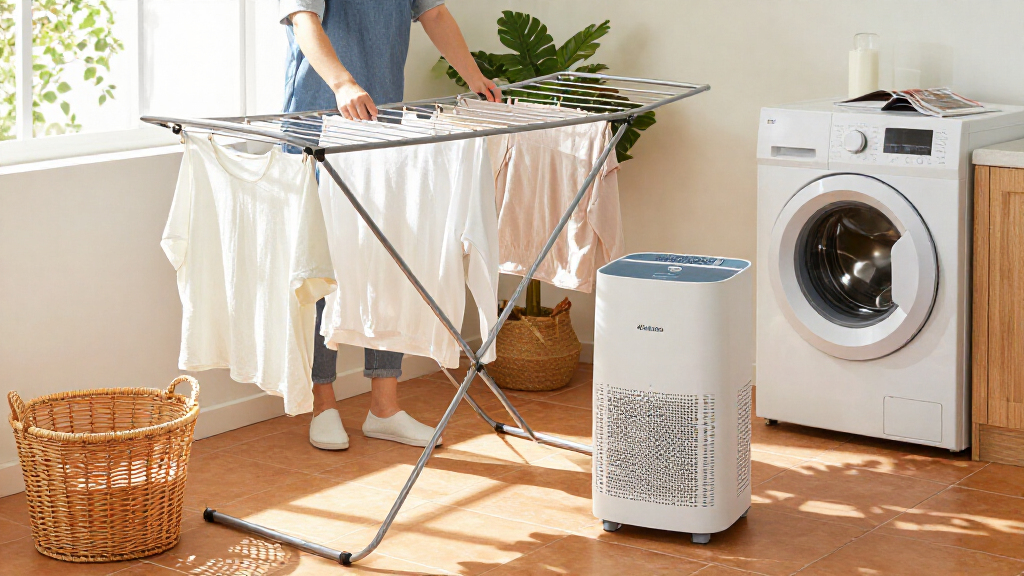
You should place the dehumidifier within 3 to 6 feet of the drying rack for optimal efficiency. If it is too far, the unit will struggle to capture the moist air rising from the wet clothes before it dissipates into the larger room. However, avoid placing it directly underneath the rack to prevent water drips from damaging the machine or creating an electrical hazard. Positioning it slightly to the side or at the end of the rack creates a cross-breeze effect that accelerates drying.Will running a dehumidifier increase my electricity bill significantly?
It depends on the unit’s efficiency and how long you run it. A standard compressor dehumidifier might use 300-700 watts per hour. If you run it for 12 hours to dry a load, that is comparable to running a dishwasher or a small electric heater. Choosing an Energy Star certified model can reduce this cost by 15-20%. To save money, close windows and doors in the drying area to create a controlled microclimate, which allows the unit to reach the target humidity faster and shut off or cycle less frequently.Is it safe to leave a dehumidifier running overnight while sleeping?
Yes, it is generally safe, provided the unit has auto-shutoff features and is placed on a stable, flat surface away from bedding. Modern units include safety mechanisms to prevent overheating. However, noise is the primary concern for bedroom use. If you plan to sleep in the same room, select a model with a dedicated sleep mode or a semiconductor (thermoelectric) unit, which operates at a lower decibel level. Always ensure the air intake and exhaust vents are not blocked by curtains or pillows.Conclusion
For most households drying regular loads, the KNKA 2500 Ft² Max 34 Pints Dehumidifier offers the best balance of power and practicality, making it the best overall pick. If you have limited space or need a quieter option for light loads, the BREEZOME 60 oz Portable Dehumidifier is the best value for small-scale needs. For those with large basements or heavy laundry demands, the 80-Pint Dehumidifier provides the raw extraction power needed for rapid drying, serving as the best premium choice. Beginners should look for the Bedred 95 oz for its simple operation and compact size, while those needing maximum efficiency should prioritize the AEOCKY Energy Star model to keep operating costs low. Choose based on your typical load size and the room where you dry your clothes.
Black Friday Picks

Sonos Era 100 SL Wireless Speakers, Black, Pack of 2
As an affiliate, we earn on qualifying purchases.