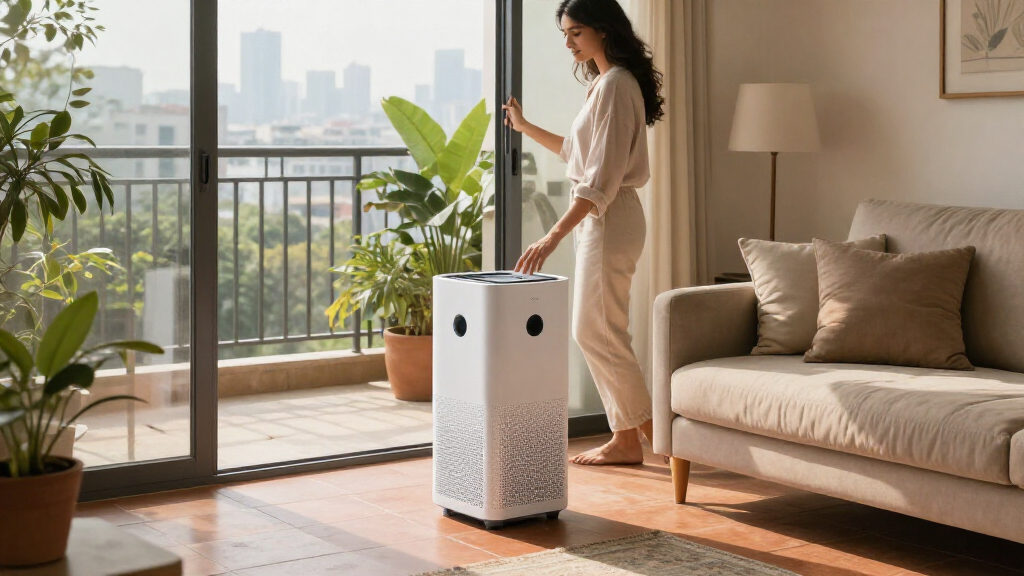
For Delhi homes facing seasonal smog and everyday dust, I’d put the Levoit Core 400S-P first for its balance of room coverage and smart controls. The Coway Mighty AP-1512HH is a strong alternative for buyers who value established, straightforward operation, while the Levoit Vital 100S-P is better suited to smaller rooms and homes with pets. The main tradeoffs are coverage versus noise, smart features versus simple controls, and the convenience of a compact unit versus cleaning a larger area. I also weigh filter replacement needs and whether a purifier’s room-coverage claims match how it will be used at home. Read on for the full comparison and a pick for different room sizes and priorities.

Get cleaning gear delivered free with Prime
- Fast, free delivery on millions of items
- Prime Video, Amazon Music and more included
- Member-only deals all year
Complete the kit



Key Takeaways
- The Levoit Core 400S-P leads the roundup for buyers who want a single, connected purifier with more room coverage than compact options such as the Core 300-P and Blue Pure 511i Max.
- The Coway Mighty AP-1512HH favors straightforward use over the app-led controls found on several Levoit models, making it a sensible alternative for buyers who want less connected-home setup.
- Large-area claims need context. The ECOSELF and MOOKA PR1 list very large coverage figures, but shoppers should compare performance at a useful cleaning rate and check the room conditions behind those claims.
- Pet and placement needs change the shortlist. The Vital 100S-P and Vital 200S-P offer a more relevant form factor for homes with pets than a small personal unit such as the Levoit Core Mini-P.
- Bundles and long-life filter claims alter upkeep, not every other tradeoff. The PuroAir 240 two-pack can cover two locations, while the Shark NeverChange HP152 emphasizes reduced filter replacement; buyers still need to match capacity and ongoing care to their routine.
| Levoit Vital 100S-P Air Purifier for Home and Pets |  | Best for Pet Owners | Model: Vital 100S-P | Filtration: Three-stage system | Maximum coverage: Up to 1,073 sq. ft. at one air change per hour | VIEW LATEST PRICE | See Our Full Breakdown |
| Levoit Core 400S-P Smart Air Purifier for Large Rooms |  | Best for Smart Large-Room Control | Model: Core 400S-P | Maximum coverage: Up to 1,718 sq. ft.; description also states 1,733 sq. ft. | CADR: Smoke: 231 CFM; dust: 240 CFM; pollen: 259 CFM | VIEW LATEST PRICE | See Our Full Breakdown |
| Winix 5510 Smart Air Purifier with True HEPA Filter |  | Best for Verified Room Sizing | Model: 5510 | Maximum coverage: Up to 1,882 sq. ft. at one air change per hour | AHAM-verified area: 392 sq. ft. | VIEW LATEST PRICE | See Our Full Breakdown |
| Levoit Vital 200S-P Smart Air Purifier for Large Rooms, White |  | Best for Large-Room Pet Homes | Model: Vital 200S-P | Maximum coverage: Up to 1,875 sq. ft. | Smoke CADR: 250 CFM | VIEW LATEST PRICE | See Our Full Breakdown |
| KNKA APH4000 Air Purifier for Home, White |  | Best for Frequent Air Refreshes in Mid-Size Rooms | Model: APH4000 | Coverage at 4.8 air refreshes per hour: 350 sq. ft. | Maximum coverage: 1,695 sq. ft. at one air refresh per hour | VIEW LATEST PRICE | See Our Full Breakdown |
| Coway Mighty AP-1512HH(W) Air Purifier, White |  | Best for Automatic, All-Round Filtration | VIEW LATEST PRICE | See Our Full Breakdown | |||
| ECOSELF Air Purifier for Large Rooms up to 2,400 sq. ft. with True HEPA Filter |  | Best for Large Stated Coverage | VIEW LATEST PRICE | See Our Full Breakdown | |||
| Blueair Blue Pure 511i Max Smart Air Purifier |  | Best Compact Smart Pick | VIEW LATEST PRICE | See Our Full Breakdown | |||
| PuroAir 240 HEPA Air Purifier, 2-Pack, Black |  | Best Two-Room Setup | VIEW LATEST PRICE | See Our Full Breakdown | |||
| MOOKA PR1 Air Purifier for Large Rooms, Up to 2,200 Sq Ft, with H13 True HEPA Filter |  | Best for Pet-Focused Cleaning | VIEW LATEST PRICE | See Our Full Breakdown | |||
| Shark NeverChange Air Purifier HP152 |  | Best for Low Filter-Maintenance Needs | Model: HP152 | Coverage: Up to 650 sq. ft. at one air change per hour | Filtration: NeverChange HEPA filter with Anti-Allergen NanoSeal | VIEW LATEST PRICE | See Our Full Breakdown |
| Levoit Core 300-P Air Purifier for Home |  | Best Compact Pick with Published CADR | Model: Core 300-P | CADR: 143 CFM smoke; 153 CFM dust; 167 CFM pollen | Filtration: 3-in-1 filtration | VIEW LATEST PRICE | See Our Full Breakdown |
| MOOKA Air Purifier with HEPA Filter for Large Rooms, White |  | Best Feature-Rich Large-Room Option | Room coverage: Up to 2,200 sq. ft. | Filtration: Three-stage system with HEPA filter, washable pre-filter, and activated carbon | Air-quality monitoring: PM2.5 sensor and display | VIEW LATEST PRICE | See Our Full Breakdown |
| Levoit Core Mini-P Air Purifier with Fragrance Sponge, White |  | Best for Personal-Space Use | Model: Core Mini-P | Power: 7 W | Input: 100–240 V, 50/60 Hz | VIEW LATEST PRICE | See Our Full Breakdown |
| DREO Air Purifier with HEPA Filter, PM2.5 Monitor, Auto and Sleep Modes, 4 Speeds, and Scent Diffuser |  | Best for a Small Room with Verified CADR | Model: DR-HAP008 (Dreo 338) | CADR: 115 CFM | Recommended room coverage: Up to 178 sq. ft. at 4.8 air changes per hour | VIEW LATEST PRICE | See Our Full Breakdown |
| air purifiers for Delhi | Model |
|---|---|
| Levoit Vital 100S-P Air Purifi | Vital 100S-P |
| Levoit Core 400S-P Smart Air P | Core 400S-P |
| Winix 5510 Smart Air Purifier | 5510 |
| Levoit Vital 200S-P Smart Air | Vital 200S-P |
| KNKA APH4000 Air Purifier for | APH4000 |
| Coway Mighty AP-1512HH(W) Air | — |
| ECOSELF Air Purifier for Large | — |
| Blueair Blue Pure 511i Max Sma | — |
| PuroAir 240 HEPA Air Purifier | — |
| MOOKA PR1 Air Purifier for Lar | — |
| Shark NeverChange Air Purifier | HP152 |
| Levoit Core 300-P Air Purifier | Core 300-P |
| MOOKA Air Purifier with HEPA F | — |
| Levoit Core Mini-P Air Purifie | Core Mini-P |
| DREO Air Purifier with HEPA Fi | DR-HAP008 (Dreo 338) |
More Details on Our Top Picks
Levoit Vital 100S-P Air Purifier for Home and Pets
For a Delhi home where pet dander and everyday odors are part of the air-quality problem, the Vital 100S-P brings useful pet-focused features without the footprint of the largest models here. Its washable pre-filter can catch hair and larger debris before they reach the main filters, while the three-stage system targets fine particles and odors. Pet, Auto, and Sleep modes, plus app and voice controls, make it easier to adapt operation to changing routines. Compared with the larger Vital 200S-P, this model has a lower smoke CADR and is a more modest choice for faster cleaning in a large, polluted room. Its stated maximum coverage allows only one air change per hour, so I would size it for a smaller room if frequent air cleaning is the goal. Replacement filters remain an ongoing cost.
Pros:- Washable pre-filter helps catch pet hair and larger debris before it reaches the main filter.
- Three-stage filtration targets fine particles, pet dander, and odors.
- Pet, Auto, and Sleep modes offer useful day-to-night operating choices.
- App and Alexa or Google Assistant controls support remote adjustments and schedules.
Cons:- The 1,073-square-foot maximum coverage figure is based on only one air change per hour.
- At 143 CFM CADR, it is less suited to fast particle removal in a large Delhi room than the Vital 200S-P or Core 400S-P.
- Replacement filters are still required to maintain filtration performance.
Best for: Delhi pet owners who want washable hair pre-filtration, odor support, and app controls in a bedroom or moderate-sized living area.
Not ideal for: People who need rapid air turnover across a large room; its maximum stated coverage is based on one air change per hour, and its 143 CFM CADR is lower than the larger Levoit options here.
- Model:Vital 100S-P
- Filtration:Three-stage system
- Maximum coverage:Up to 1,073 sq. ft. at one air change per hour
- CADR:143 CFM
- Particle filtration:99.97% for particles 0.1–0.3 μm
- Noise:As low as 25 dB
- Power:42 watts
- Controls and modes:VeSync app, buttons, Alexa, Google Assistant; Pet, Auto, Sleep
Our verdict“Choose the Vital 100S-P for pet hair and odor support in a smaller room, but pick the Vital 200S-P for stronger large-room airflow.”
Levoit Core 400S-P Smart Air Purifier for Large Rooms
The Core 400S-P is a strong fit for buyers who want sensor-led operation in a larger Delhi room rather than adjusting fan speed by hand. Its air-quality sensor and Auto mode can respond to changing particle levels, while the listed smoke CADR of 231 CFM gives a more useful comparison for smoke than its broad maximum coverage figure. That CADR is below the Vital 200S-P’s 250 CFM, so the Vital is the stronger pick on listed smoke airflow; the Core 400S-P counters with app and voice control, low sleep-mode noise, and a stated 24-watt draw. The coverage figures in its description differ slightly, and the maximum area should not be read as frequent air turnover. For Delhi pollution, I would prioritize room size and CADR over the headline square-foot figure. Replacement filters are another ongoing requirement.
Pros:- Air-quality sensing and Auto mode can adjust fan operation as conditions change.
- Smoke, dust, and pollen CADR figures give buyers more useful airflow comparisons than coverage alone.
- App and Alexa or Google Assistant controls support remote operation.
- Sleep mode reaches as low as 24 dB, with stated power consumption of 24 watts.
Cons:- The product description gives two different maximum coverage figures: 1,718 and 1,733 square feet.
- Its 231 CFM smoke CADR is lower than the Vital 200S-P’s listed 250 CFM.
- Replacement filters are needed, and the product data recommends authentic Levoit filters.
Best for: Buyers who want app-based monitoring and automatic fan adjustment in a large bedroom or living room and can match the unit to the room using CADR.
Not ideal for: People choosing solely by maximum coverage or seeking the strongest listed smoke CADR; the Vital 200S-P has a higher smoke CADR, and this model’s coverage figures conflict.
- Model:Core 400S-P
- Maximum coverage:Up to 1,718 sq. ft.; description also states 1,733 sq. ft.
- CADR:Smoke: 231 CFM; dust: 240 CFM; pollen: 259 CFM
- Filtration:Three-stage system with activated carbon
- Particle filtration:Captures 99.97% of particles as small as 0.3 microns
- Noise:As low as 24 dB
- Power:24 watts
- Dimensions and weight:10.8 × 10.8 × 20.5 inches; 12.8 lb
- Controls and certifications:VeSync app, Alexa, Google Assistant; ETL, Energy Star, and FCC certified
Our verdict“Pick the Core 400S-P if sensor-led app control matters most, but compare its CADR with the Vital 200S-P before sizing it for a polluted large room.”
Winix 5510 Smart Air Purifier with True HEPA Filter
The Winix 5510 stands out for buyers who want a more grounded room-size reference: its AHAM-verified area is 392 sq. ft., even though the headline coverage reaches 1,882 square feet at just one air change per hour. That distinction matters in Delhi, where a larger room may need more frequent cleaning than a once-hourly refresh provides. Its washable pre-filter, True HEPA filter, and carbon filter cover hair, fine particles, and household odors, while app support and sensor-driven Auto mode simplify daily use. Compared with the Levoit Core 400S-P, the Winix offers a more explicit AHAM area figure and a four-stage system, but its largest advertised area is not a like-for-like measure of rapid cleaning. The low-speed noise is quiet, though performance at higher fan speeds may be more noticeable. PlasmaWave’s added pollutant-reduction benefit is not guaranteed by the supplied product information.
Pros:- AHAM-verified area of 392 square feet provides a clearer sizing reference than the one-air-change maximum.
- Washable pre-filter, True HEPA filter, and carbon filter address different particle and odor needs.
- Smart sensors, app support, and Auto mode reduce the need for frequent manual adjustments.
- Sleep mode reaches 23.5 dB on the lowest speed and responds to room light.
Cons:- The 1,882-square-foot coverage figure is based on only one air change per hour.
- The product data describes PlasmaWave’s pollutant-reduction benefit as potential rather than guaranteed.
- The supplied specifications do not list CADR values, making direct airflow comparisons with the Levoit models harder.
Best for: Delhi households that want an AHAM-verified room-size reference, washable pre-filtration, and automatic operation for a room around the stated verified area.
Not ideal for: Buyers who need strong, frequent air turnover across a very large space based on the 1,882-square-foot headline, or who want a guaranteed benefit from PlasmaWave.
- Model:5510
- Maximum coverage:Up to 1,882 sq. ft. at one air change per hour
- AHAM-verified area:392 sq. ft.
- Filtration:Four-stage system with washable mesh pre-filter, True HEPA filter, and carbon filter
- Particle capture:99.99% of airborne particles as small as 0.01 microns
- Noise:23.5 dB on the lowest speed
- Controls:Winix Smart App, Auto mode, and Sleep mode
- Certifications:AHAM Verified and UL Certified
Our verdict“Choose the Winix 5510 if AHAM-based room sizing and washable pre-filtration matter more than a very large headline coverage figure.”
Levoit Vital 200S-P Smart Air Purifier for Large Rooms, White
Among the large-room options here, the Vital 200S-P is the clearest match for homes where pet hair and dander sit alongside Delhi dust and smoke. Its U-shaped air inlet is designed to draw in hair and airborne debris, while listed smoke, dust, and pollen CADRs make its airflow easier to judge than a maximum-area claim alone. The smoke CADR is 250 CFM, ahead of the Core 400S-P’s 231 CFM, giving the Vital an advantage on that listed measure. It also offers an air-quality monitor and sleep mode, though the supplied data gives fewer operating details than the Core 400S-P’s app and voice-control specifications. Filter choices can suit different needs, but that flexibility means buyers must select the right replacement type. Its 1,875-square-foot maximum should not be mistaken for rapid cleaning throughout that entire area.
Pros:- Listed smoke CADR of 250 CFM is higher than the Core 400S-P’s 231 CFM.
- U-shaped inlet is designed to help capture pet hair as well as airborne particles.
- Smoke, dust, and pollen CADR figures help with room-size comparisons.
- Includes an air-quality monitor, sleep mode, and multiple replacement-filter options.
Cons:- The 1,875-square-foot maximum coverage figure is not accompanied by a stated air-change rate in the supplied data.
- Buyers must select from replacement filter options based on their needs.
- The supplied specs do not state noise, wattage, or detailed control methods.
Best for: Delhi households with pets that need a higher-CADR purifier for a large room and want app-based smart control and air-quality monitoring.
Not ideal for: Buyers who want the simplest filter-replacement choice or are sizing solely by the 1,875-square-foot maximum instead of matching CADR to the room.
- Model:Vital 200S-P
- Maximum coverage:Up to 1,875 sq. ft.
- Smoke CADR:250 CFM
- Dust CADR:254 CFM
- Pollen CADR:289 CFM
- Air inlet:Traditional and U-shaped
- Features:Smart control, air-quality monitor, and sleep mode
- Color:White
Our verdict“Choose the Vital 200S-P for a large Delhi room where pet hair and higher listed smoke CADR matter more than a simple filter-selection process.”
KNKA APH4000 Air Purifier for Home, White
The KNKA APH4000 is the most transparent option here about the gap between a broad maximum-coverage claim and more frequent cleaning: it lists 350 square feet at 4.8 air refreshes per hour, alongside 1,695 square feet at only one refresh per hour. For Delhi pollution, that smaller figure is the more useful starting point if you want repeated air turnover. Dual three-stage filters add washable pre-filters, high-efficiency media, and activated carbon, while PET, Auto, ECO, and Sleep modes offer practical operating choices. Its 226 CFM smoke/dust/PM2.5 CADR is below the Vital 200S-P’s 250 CFM smoke CADR, so it is not the stronger airflow pick for a large room. The AQI display helps show changing conditions, but filters are recommended for replacement every three to six months, adding maintenance work and cost.
Pros:- Lists 350 square feet at 4.8 air refreshes per hour, a more actionable sizing figure for frequent cleaning.
- Dual three-stage filters combine washable pre-filters, high-efficiency filters, and activated carbon.
- Real-time AQI display and color-coded lights provide visible air-quality feedback.
- PET, ECO, Auto, and Sleep modes cover different operating preferences.
Cons:- Its 226 CFM smoke/dust/PM2.5 CADR is below the Vital 200S-P’s listed 250 CFM smoke CADR.
- The 1,695-square-foot maximum provides only one air refresh per hour.
- Filter replacement is recommended every three to six months.
Best for: Delhi households wanting a clear frequent-refresh room-size figure, dual filters, and real-time AQI monitoring in a mid-sized room.
Not ideal for: People seeking fast cleaning across a very large room or minimal filter upkeep; the 1,695-square-foot figure is only one refresh per hour and filters are recommended every three to six months.
- Model:APH4000
- Coverage at 4.8 air refreshes per hour:350 sq. ft.
- Maximum coverage:1,695 sq. ft. at one air refresh per hour
- CADR:Smoke/dust/PM2.5: 226 CFM (384 m³/h); pollen: 244 CFM (415 m³/h)
- Filtration:Dual three-stage filters with washable pre-filters, high-efficiency filters, and activated carbon
- Modes and speeds:PET, ECO, Auto, Sleep; four fan speeds
- Sleep-mode noise:22–24 dB
- Air-quality monitoring:Real-time AQI display with color-coded lights
- Recommended filter replacement:Every 3–6 months
Our verdict“Choose the KNKA APH4000 when frequent-refresh sizing and AQI feedback matter more than maximum large-room airflow or infrequent filter changes.”
Coway Mighty AP-1512HH(W) Air Purifier, White
For Delhi homes where pollution levels can shift through the day, the Coway Mighty AP-1512HH(W) pairs a live air-quality monitor with automatic fan adjustment, so it can respond without constant manual changes. Its four-stage filtration combines a washable pre-filter, deodorization filter, bipolar device and HEPA filter; the stated particle capture is 99.97% of 0.3-micron particles. That gives it a broader filtration approach than the PuroAir 240, whose listed system has three layers and comes as a two-unit pack. Coway also offers Eco mode and a sleep-light-off option for bedrooms. The tradeoff is that its large stated coverage is specified as one air change per hour, not a guarantee of rapid cleaning in every room. Regular pre-filter cleaning and eventual filter replacement add upkeep.
Pros:- Four-stage filtration includes particle, odor and washable pre-filter stages.
- Air-quality monitoring can adjust operation automatically.
- Eco mode and a sleep-light-off option suit different routines.
- Three-year warranty is longer than the one-year-plus support listed for the ECOSELF.
Cons:- The 1,748-square-foot coverage figure is based on one air change per hour, which may be too slow for buyers seeking faster turnover.
- The washable pre-filter needs cleaning, and other filters require replacement.
- Actual coverage and filtration performance can vary with room conditions and use.
Best for: Households wanting automatic air-quality response and a multi-stage filter setup for a shared living space.
Not ideal for: Buyers who need a clearly specified fast cleaning rate for a particular room size or want to avoid routine filter maintenance.
Our verdict“Choose the Coway Mighty if you want a feature-rich, automatically adjusting purifier and can keep up with filter care.”
ECOSELF Air Purifier for Large Rooms up to 2,400 sq. ft. with True HEPA Filter
The ECOSELF makes its case with a 2,400-square-foot stated coverage area and an air-purification rate of twice per hour, a useful distinction for buyers comparing big-room claims. Its PM2.5 display and infrared sensor feed an automatic mode that can change fan speed as readings shift. Against the Blueair Blue Pure 511i Max, which is better suited to smaller rooms, ECOSELF is positioned for a much broader space; Blueair’s listed details, however, give a more specific cleaning-time example. ECOSELF also lists a 22 dB sleep mode, lock controls and a timer, though its aromatherapy feature is secondary to filtration for Delhi’s particulate pollution. The main caveat is limited independent performance detail in the supplied information, alongside a recommendation to use the brand’s replacement filters.
Pros:- Largest stated coverage in this group at up to 2,400 square feet.
- Lists air purification twice per hour rather than only an hourly coverage figure.
- PM2.5 display and automatic fan adjustment support responsive operation.
- Sleep mode, timer and lock controls add useful household settings.
Cons:- No independent performance details are provided in the product information.
- The manufacturer recommends ECOSELF replacement filters.
- Aromatherapy does not add particle-removal capacity for Delhi pollution.
Best for: Buyers furnishing a large open-plan room who want a PM2.5 display, automatic fan control and a stated twice-per-hour cleaning rate.
Not ideal for: Shoppers who prioritize independently detailed performance evidence, or who want flexibility to use replacement filters from multiple brands.
Our verdict“Pick ECOSELF for a large room when its stated coverage and sensor-led controls matter more than independently documented performance.”
Blueair Blue Pure 511i Max Smart Air Purifier
For a bedroom or compact apartment room, the Blueair Blue Pure 511i Max puts quiet operation and connected controls ahead of broad-room capacity. Its HEPASilent system is listed to capture 99.97% of airborne particles down to 0.1 microns, and it can run as quietly as 19 dB. Sensors, automatic fan adjustment and app control make it easier to monitor air without keeping the purifier beside you. Compared with the ECOSELF, Blueair has a smaller-room role, but its supplied data gives a concrete cleaning example: 237 square feet in about 12.5 minutes. The 1,138-square-foot-per-hour figure should not be mistaken for fast cleaning across that entire area at once. Its compact footprint is useful, but it is not the choice for a large Delhi living room, and replacement filters remain an ongoing cost.
Pros:- HEPASilent filtration is specified for particles down to 0.1 microns.
- As-low-as 19 dB operation is suited to bedrooms.
- Air-quality sensors, automatic adjustment and app control enable remote monitoring.
- 360-degree air intake supports a compact placement.
Cons:- Its small-room fit makes it less suitable as the sole purifier for a large living area.
- The hourly coverage figure does not describe rapid cleaning of the full stated area.
- Replacement filters are required.
Best for: Apartment residents or light sleepers seeking app control and quiet particle filtration for a bedroom or smaller room.
Not ideal for: Households trying to clean a large shared space with one unit or buyers who prefer not to manage recurring filter replacements.
Our verdict“Choose the Blueair for quiet, app-connected cleaning in a smaller room, not as a whole-home solution.”
PuroAir 240 HEPA Air Purifier, 2-Pack, Black
The PuroAir 240 two-pack is the practical pick here for someone who wants a purifier in two separate rooms rather than one oversized unit. Each purifier uses a pre-filter, HEPA filter and activated carbon, with stated capture of up to 99.9% of listed pollutants including smoke, dust, pollen, pet dander and VOCs. A particle sensor can raise power when it detects pollution, while sleep mode suits overnight use. Compared with the Coway Mighty, the PuroAir has fewer filtration stages and a lower stated coverage figure per unit, but the two-unit format lets buyers place cleaning where it is needed. Its coverage is specified as up to 1,000 square feet in one hour, so it is a less compelling fit for rapid cleaning in a large room. Filter replacement timing and costs are not specified in the supplied details.
Pros:- Two units can serve separate rooms rather than concentrating capacity in one location.
- Three-layer filtration includes activated carbon for odors and VOCs.
- Particle sensing can trigger higher fan power when pollution is detected.
- Sleep mode and a two-year warranty are listed.
Cons:- Each unit is rated for up to 1,000 square feet in one hour, which may be slow for large-room needs.
- The stated pollutant capture is up to 99.9%, below the 99.97% figures listed for several alternatives.
- Replacement filter costs and intervals are not specified.
Best for: Households that want separate purifier units for two bedrooms or a bedroom and home office.
Not ideal for: Buyers who need fast turnover in one large room or want clearly stated filter replacement intervals and costs.
Our verdict“Choose the PuroAir two-pack when coverage across two rooms matters more than high-speed cleaning in one large space.”
MOOKA PR1 Air Purifier for Large Rooms, Up to 2,200 Sq Ft, with H13 True HEPA Filter
The MOOKA PR1 stands out for households balancing Delhi’s outdoor particulates with indoor pet hair and dander. Its washable pre-filter can catch larger debris before it reaches the four-stage filtration system, while a dedicated Pet mode gives owners a straightforward way to increase cleaning when animals are active. A PM2.5 display and Auto mode add pollution monitoring; six listed fan settings offer more manual control than the simpler two-mode setup on the Coway Mighty. MOOKA’s 2,200-square-foot coverage is a broad claim, but the supplied details do not state the air-change rate behind it, so buyers should match it cautiously to room size. Sleep mode is rated as low as 26 dB, and the purifier also has a child lock. Expect to clean the sensor periodically and replace filters every three to six months.
Pros:- Pet mode and washable pre-filter support homes with shedding animals.
- PM2.5 display and Auto mode provide sensor-based operation.
- Six fan settings offer more manual tuning than the Coway Mighty’s listed Auto and Eco modes.
- Child lock and filter reminder add practical household controls.
Cons:- Replacement filters are recommended every three to six months.
- The air-quality sensor may need regular cleaning to maintain accuracy.
- The 2,200-square-foot coverage figure is not paired with an air-change rate in the supplied details.
Best for: Pet owners who want a washable first-stage filter, a dedicated Pet mode and PM2.5 monitoring in a larger room.
Not ideal for: Buyers seeking low-maintenance ownership or a clearly specified air-change rate for validating large-room performance.
Our verdict“Choose the MOOKA PR1 if pet-focused controls and a washable pre-filter outweigh frequent filter care and an unspecified air-change rate.”
Shark NeverChange Air Purifier HP152
For Delhi buyers who want to reduce routine filter upkeep, the Shark NeverChange HP152 stands apart from the Levoit Core 300-P, which has a recommended filter replacement interval of 6 to 8 months. Its long-lasting HEPA filter is paired with washable debris screens, so larger particles can be removed from the screens rather than left to load the main filter as quickly. CleanSense IQ also gives a live indication of changing air quality, a useful cue when outdoor pollution enters through open doors or windows. The tradeoff is its coverage claim: 650 sq. ft. at one air change per hour is not a strong cleaning rate for a heavily polluted Delhi day. I’d choose it for a bedroom or moderate-use room, not as a high-turnover purifier for a large shared space. The odor cartridge releases scent, which may not suit fragrance-sensitive households.
Pros:- Long-lasting HEPA filter may reduce the frequency of main-filter replacement.
- Washable debris screens help catch larger particles before they reach the HEPA filter.
- CleanSense IQ displays air-quality changes in real time.
- Quiet operation and dimmable lights suit bedroom use.
Cons:- The 650-square-foot coverage figure is based on just one air change per hour.
- The odor-neutralizer cartridge releases a scent that may bother fragrance-sensitive users.
Best for: Households seeking a bedroom or moderate-sized-room purifier with washable pre-filter screens, live air-quality feedback, and less frequent main-filter replacement.
Not ideal for: Buyers needing rapid particle removal across a large, heavily polluted room, or anyone sensitive to scented odor-neutralizer cartridges.
- Model:HP152
- Coverage:Up to 650 sq. ft. at one air change per hour
- Filtration:NeverChange HEPA filter with Anti-Allergen NanoSeal
- Particle capture:99.98% of particles from 0.1 to 0.2 microns, based on IEST-RP-CC007
- Air-quality monitoring:CleanSense IQ real-time display
- Included components:Washable Debris Defense filter, NeverChange HEPA filter, and Odor Neutralizer cartridge
- Additional features:Ultra-quiet performance, dimmable lights, and Eco mode
- Color:Charcoal
Our verdict“Choose the HP152 for quieter, lower-maintenance bedroom purification, but pick a model with a stronger stated cleaning rate for a large Delhi living area.”
Levoit Core 300-P Air Purifier for Home
The Levoit Core 300-P is a straightforward choice for a smaller room when you want published particle-cleaning figures rather than a long list of automatic features. Its 143 CFM smoke CADR gives Delhi shoppers a useful basis for comparing smoke performance, while its 24 dB Sleep Mode is suited to overnight use. It is more compact than the MOOKA large-room model, but its advertised 1,073-square-foot coverage should not be read as fast cleaning at that size: the supplied data gives the coverage area without an air-change rate. Unlike the DREO, the Core 300-P has no Auto Mode or PM2.5 display, so you’ll need to choose fan speed yourself. One practical caution for Delhi shoppers: this model is specified for 120V US use, so check electrical compatibility before buying. Filter replacement is also recommended every 6 to 8 months.
Pros:- Published smoke, dust, and pollen CADR figures make performance comparisons easier.
- Sleep Mode operates at 24 dB for quieter overnight use.
- Touch controls, timer settings, and a filter-change indicator keep operation simple.
- AHAM Verified, with listed CADR ratings.
Cons:- No Auto Mode, smart connectivity, or built-in air-quality display.
- Specified for 120V use in the United States, so voltage compatibility needs checking.
- Recommended filter replacement every 6 to 8 months adds recurring upkeep.
Best for: Buyers who want a compact purifier with published smoke, dust, and pollen CADR figures for a bedroom or home office, and who are comfortable setting fan speed manually.
Not ideal for: Delhi buyers seeking an automatic PM2.5 response or plug-and-play local voltage compatibility; this model is specified for 120V US use.
- Model:Core 300-P
- CADR:143 CFM smoke; 153 CFM dust; 167 CFM pollen
- Filtration:3-in-1 filtration
- Filtration efficiency:99.97% for airborne particles measuring 0.1–0.3 microns
- Coverage area:Up to 1,073 sq. ft.
- Sleep Mode noise:24 dB
- Power:56 watts
- Dimensions and weight:8.7 × 8.7 × 14.2 inches; 7.9 pounds
- Voltage:120V; specified for use in the United States
Our verdict“Pick the Core 300-P for a compact room and clearly stated CADR, provided its 120V specification works for your setup and manual controls suit you.”
MOOKA Air Purifier with HEPA Filter for Large Rooms, White
The MOOKA’s appeal is its combination of automatic controls and broad stated coverage: it has a PM2.5 display, Auto mode, four fan speeds, a child lock, and a washable pre-filter. That makes it more hands-off than the Levoit Core 300-P, which requires manual fan-speed changes and lacks an air-quality display. Its listed coverage reaches 2,200 sq. ft., but the product data does not state the air-change rate behind that figure. For Delhi’s high-pollution periods, I would not treat the area claim alone as proof of fast room cleaning; compare it with models that state coverage at a specified air-change rate. Sleep noise as low as 20 dB is attractive for bedrooms, while the washable pre-filter can help limit debris reaching the main filter. The tradeoffs are separately purchased replacement filters and an aromatherapy pad that uses oil, which may not suit everyone.
Pros:- PM2.5 display and Auto mode provide air-quality feedback and automatic fan adjustment.
- Washable pre-filter helps catch larger debris before it reaches the main filter.
- Sleep mode is rated as low as 20 dB.
- Child lock, four fan speeds, and timer settings offer useful household controls.
Cons:- The 2,200-square-foot coverage claim is not paired with a stated air-change rate.
- Replacement filters must be purchased separately.
- Aromatherapy requires essential oil, which is not included.
Best for: Households wanting a large-room purifier with a PM2.5 display, automatic fan adjustment, child lock, and washable pre-filter.
Not ideal for: Buyers who need a clearly stated high air-change rate for a large Delhi room, or who prefer a purifier without aromatherapy features or separate filter purchases.
- Room coverage:Up to 2,200 sq. ft.
- Filtration:Three-stage system with HEPA filter, washable pre-filter, and activated carbon
- Air-quality monitoring:PM2.5 sensor and display
- Fan speeds:4
- Sleep mode noise:As low as 20 dB
- Timer settings:2, 4, 6, or 8 hours
- Maximum-speed energy use:0.63 kWh per 24 hours
- Additional features:Auto mode, aromatherapy pad, and child lock
- Certifications:CARB, ETL, and DOE
Our verdict“Choose the MOOKA for automatic controls and a washable pre-filter, but verify that its unstated air-change rate fits your room and pollution needs.”
Levoit Core Mini-P Air Purifier with Fragrance Sponge, White
The Levoit Core Mini-P is the smallest, simplest fit in this group: its 6.5-inch footprint and 7-watt draw suit a desk, bedside table, or other personal area better than a shared living room. It has pre- and main filters for particles such as lint, hair, and pet dander, plus a fragrance sponge for users who want to add scent. Compared with the Levoit Core 300-P, it is easier to place in tight spaces but offers no published CADR or room-coverage figure in the supplied product data. That matters in Delhi, where a small purifier should not be mistaken for a room-scale answer to seasonal particulate pollution. Sleep mode and an auto-off display help keep it unobtrusive overnight. I’d treat this as a supplementary personal-space unit, not a substitute for a purifier sized to the whole room.
Pros:- Compact 6.5 × 6.5-inch footprint fits tight desks and bedside spaces.
- Low 7-watt power rating suits extended personal-area use.
- Pre-filter and main filter target lint, hair, pet dander, smoke particles, and other airborne pollutants.
- Sleep mode and auto-off display reduce light and operating distractions.
Cons:- No room-coverage or CADR figure is provided, making room-size suitability hard to judge.
- Its compact design is not a supported choice for whole-room purification.
- Essential oil use must be limited to 2–3 drops to avoid overflow and possible damage to plastic parts.
Best for: People wanting a small, low-power purifier for a desk, bedside table, or compact personal area, especially where space is limited.
Not ideal for: Households seeking a primary purifier for a bedroom or living room, since the supplied data gives no room-coverage or CADR figure.
- Model:Core Mini-P
- Power:7 W
- Input:100–240 V, 50/60 Hz
- Noise level:27–45 dB
- Dimensions:6.5 × 6.5 × 10.4 inches
- Filter features:Pre-filter and main filter
- Additional features:Sleep mode, auto-off display, and aromatherapy sponge
- Essential oil guidance:Use 2–3 drops only
- Color:White
Our verdict“Buy the Core Mini-P for a desk or bedside spot, not as your main purifier for a Delhi room where coverage and cleaning rate matter.”
DREO Air Purifier with HEPA Filter, PM2.5 Monitor, Auto and Sleep Modes, 4 Speeds, and Scent Diffuser
The DREO is the most clearly sized choice here for a small Delhi room: it lists 115 CFM CADR and specifies coverage of 178 sq. ft. at 4.8 air changes per hour. That air-change context makes the figure more useful for frequent cleaning than the MOOKA’s larger coverage claim, which does not state an air-change rate. A real-time PM2.5 sensor and Auto mode can adjust fan operation as air quality changes, so it asks less of you than the manual-control Levoit Core 300-P. It also has a three-layer filter with activated carbon to help with household odors. The main limitation is scale: its stated high-rate coverage is room-specific, not a whole-home solution. The product data also gives no noise figure, so I can’t judge how quiet Sleep mode is compared with the Core 300-P’s stated 24 dB.
Pros:- AHAM Verified with a listed 115 CFM CADR.
- States coverage at 4.8 air changes per hour, giving a clearer high-rate room-size reference.
- Real-time PM2.5 monitoring and Auto mode adjust operation as air quality changes.
- Three-in-one filtration includes an activated carbon layer for household odors.
Cons:- Coverage at 4.8 air changes per hour is limited to 178 sq. ft.
- No specific noise level is provided, making bedroom sound comparisons difficult.
- Its stated high-rate coverage is much smaller than the MOOKA’s broad area claim.
Best for: Buyers furnishing a small bedroom or home office who want AHAM Verified performance, a stated high-air-change room size, and automatic PM2.5-based operation.
Not ideal for: Anyone seeking one purifier for a large living area or who needs a published noise level before choosing a bedroom unit.
- Model:DR-HAP008 (Dreo 338)
- CADR:115 CFM
- Recommended room coverage:Up to 178 sq. ft. at 4.8 air changes per hour
- Coverage at one air change per hour:Up to 856 sq. ft.
- Filter:3-in-1 pre-filter, high-efficiency filter, and activated carbon layer
- Modes:Auto, Turbo, Sleep, and Normal
- Fan speeds:4
- Air-quality monitoring:Real-time PM2.5 sensor; AQI display range 1–999
- Certification:AHAM Verified and ENERGY STAR certified
Our verdict“Choose the DREO for a small room where a stated high air-change rate and automatic PM2.5 response matter more than broad coverage.”
How We Picked
I compared these 15 models on the factors that matter in a Delhi home: usable room coverage, filtration approach, airflow and cleaning-rate information where available, noise and sleep settings, controls, footprint, and likely upkeep. I treated oversized coverage claims cautiously, since a figure on its own does not tell a buyer how quickly a purifier can clean a room or how it will perform with doors open, frequent dust, and changing outdoor pollution.
The order reflects practical fit rather than the longest feature list. Models with a useful balance of coverage, controls, and everyday usability rank ahead of options that are more specialized, more dependent on broad coverage claims, or intended for a single small space. I also considered whether a model’s design suits pets, separate rooms, or buyers who want simpler operation. Filter availability and replacement requirements remain part of the decision, since a purifier that is hard to maintain may be a poor match even when its headline features look appealing.
Factors to Consider When Choosing Best Air Purifiers For Delhi
For Delhi, choosing a purifier is less about chasing the largest number on the box and more about matching cleaning capacity, placement, and maintenance to your actual home. I’d settle those practical details before choosing between app controls, extra modes, or a compact design.
Match Coverage to the Room You Actually Use
Start with the room where people spend the most time, rather than adding together the area of the whole flat. A purifier in a bedroom or living room can only clean air that reaches it, so open doors and connected spaces make coverage harder to judge. Compare the advertised area with the air-cleaning rate and the conditions used for that figure when those details are provided. A large maximum-area claim may describe a slower cleaning cycle than a smaller room rating. For bedrooms, a unit sized for the room at a useful cleaning rate can be a better choice than an oversized machine that stays on a louder setting. If pollution varies sharply by season, leave some capacity headroom rather than buying exactly to the room’s listed dimensions.
Check What the Filter Does—and What It Does Not
HEPA-style filtration is aimed at airborne particles, including dust and fine particulate matter, while activated carbon is used to reduce some odors and gases. Those are different jobs, and a purifier with a particle filter does not automatically provide strong odor control. Delhi households near traffic, cooking fumes, or construction dust may value both particle filtration and a meaningful carbon layer. Filter labels alone do not tell the whole story: look for clear information about filter construction, replacement availability, and the manufacturer’s maintenance instructions. Avoid treating an ionizer or a scent feature as a substitute for particle filtration. If you are sensitive to fragrances, skip scent functions or keep them unused.
Plan for Filter Upkeep Before Choosing a Model
Frequent dust and heavy seasonal use can make maintenance a regular task, not an occasional one. Check whether the pre-filter can be cleaned, how the main filter is replaced, and whether compatible replacements are easy to source where you live. A washable or long-life component can reduce some routine work, but it does not mean the entire filtration system never needs care. Compare the maker’s replacement guidance with your expected daily run time and household conditions. A lower-maintenance design can suit busy buyers, while a model with accessible filters may be easier for someone willing to check and clean it often. Keep the purifier’s air inlets clear; placing it tight against curtains or furniture can hinder airflow.
Weigh Noise Against the Cleaning Speed You Need
Air purifiers often sound different across fan settings, so a quiet sleep mode may move less air than a higher setting. If you plan to run a unit overnight, check noise information and controls for dimming lights or scheduling, not just the presence of a sleep label. A common mistake is choosing a small purifier for a bedroom and then running it at full speed to compensate for limited capacity. Another is buying a high-capacity unit without considering whether its sound will disrupt work or sleep. Auto mode can adjust airflow when sensors detect changes, but sensor readings reflect air near the machine rather than every corner of a room. Use placement and a suitable fan setting together.
Decide Whether Smart Controls Add Real Value
App access, air-quality displays, and scheduling help buyers who want remote control or regular run times. They add less for someone who prefers a physical button and a stable fan setting. Before paying extra for connected features, check which functions remain available on the purifier itself if Wi-Fi is unavailable. A built-in particle monitor can guide adjustments, though it cannot measure every pollutant or certify that the whole home is clean. In a rental or a multi-room home, portability and simple controls may matter more than app integration. Pick smart features to solve a routine problem, such as changing settings from another room, rather than as a substitute for suitable capacity.
Choose One Strong Unit or Several Smaller Ones
A single purifier is easiest to manage when one room is the clear priority. Separate units can make more sense when bedrooms are used at the same time or when doors usually stay closed. A two-pack may provide flexibility across rooms, but buyers should compare each unit’s capacity separately rather than assuming the pair acts like one larger machine. Small personal purifiers are useful for a desk or bedside area, yet they are not a substitute for cleaning a living room. Also factor in the space needed around each unit, access to power, and the work of maintaining multiple filters. The right layout depends on where people spend time and whether air can circulate between rooms.
Frequently Asked Questions
Should I buy one large purifier for my flat or separate units for bedrooms?
I’d base this on room use and whether doors stay open, not on total flat area alone. One larger unit is simpler when most time is spent in a single living space. Separate units can make more sense when bedrooms are occupied at the same time or rooms are usually closed off. Compare each model’s room rating and cleaning rate for the room it will serve; two smaller units do not automatically equal one higher-capacity unit. Also account for the extra filter checks and floor space that come with multiple machines.
Are the biggest advertised room-coverage figures the best choice for Delhi pollution?
Not by themselves. Coverage claims can be based on different air-change assumptions, so compare the cleaning rate and the room size used for the claim where that information is available. A purifier may be listed for a very large area but clean that space more slowly than a buyer expects. For a bedroom or living room, a credible capacity match at a useful fan setting is more informative than a headline maximum. I’d also check noise at that setting, since a unit that is too loud to run may not deliver the routine use you want.
Do I need an air purifier with an app or a PM2.5 monitor?
No; these features are useful only if they suit how you manage the purifier. An app can help with scheduling or remote changes, while a particle monitor can show changes near the machine. Neither feature replaces a suitable filter, enough airflow, or sensible placement. If you prefer simple operation, a model with clear physical controls may be easier to live with. Buyers who choose a connected model should check which settings remain usable without Wi-Fi and avoid treating a single sensor reading as a measure of every room.
How should I compare filter replacement needs before buying?
Check the manufacturer’s replacement guidance, the kind of pre-filter care required, and whether replacement filters are readily available to you. The stated filter life is not a guarantee of identical performance in every home; dust, run time, and usage patterns can affect upkeep. A washable pre-filter can reduce some maintenance but does not remove the need to care for the main filter. Long-life claims are worth comparing with the full cleaning system and its instructions. I’d choose a model whose upkeep routine feels realistic for year-round use rather than relying on a single lifespan figure.
Can a compact purifier like the Core Mini-P clean a bedroom during Delhi’s smog season?
A compact unit can suit a small personal area, but buyers should not assume it can handle a full bedroom without checking its stated coverage and cleaning rate. If the room is larger or the purifier must run quietly overnight, limited airflow may force a tradeoff between noise and cleaning speed. For a main bedroom, compare a compact model with a unit designed for that room size and check the filter and sleep-mode details. A small purifier can still be useful at a desk or bedside, but it should not be treated as a whole-home solution. Room size and intended placement decide whether it is enough.
Conclusion
My best overall pick is the Levoit Core 400S-P for buyers seeking a balance of room coverage and connected controls. For best value in practical flexibility, I’d look at the PuroAir 240 two-pack if two separate rooms need coverage, while recognizing that each unit must be matched to its own space. The best premium-style choice for shoppers prioritizing longer filter-replacement intervals is the Shark NeverChange HP152, provided its capacity and upkeep guidance fit their home. Beginners who want a less app-centered route can start with the Coway Mighty AP-1512HH. For specific needs, the Vital 100S-P is a sensible smaller-room and pet-home option, while the Core Mini-P belongs in a personal space rather than a large room. Choose by room, run-time habits, and maintenance comfort—not by the biggest coverage number alone.