
The best water heaters in this roundup serve different needs: the Ranein 8.5 GPM natural gas tankless model is my best overall pick for households seeking strong on-demand flow, while the GE 18-gallon electric tank is a simpler fit for limited hot-water demand. The Westinghouse offers another high-capacity gas option, and the portable propane model suits off-grid or outdoor use. Your choice comes down to fuel and installation access, how many fixtures need hot water at once, and whether you value continuous heating or stored hot water. Small electric tankless units can fit a point-of-use job, but they are not a direct substitute for a whole-home system. Read on for the full comparison and guidance on matching a heater to your setup.

Get cleaning gear delivered free — and shop member deals
- Fast, free delivery on millions of items
- Access to Prime Big Deal Days deals on October 6–7
- Prime Video, Amazon Music and more included
Complete the kit


Key Takeaways
- Ranein leads for whole-home gas tankless flow: its stated 8.5 GPM and 190,000 BTU capacity top the listed indoor gas models, though actual flow depends on incoming water temperature and installation.
- Westinghouse is the closest high-capacity alternative: its 7.9 GPM and 180,000 BTU figures are slightly lower than Ranein‘s, making sizing and service support more useful deciding factors than a small spec gap.
- APUS and CAMPLUX target midrange gas demand: their lower listed flow capacities may suit smaller households or fewer simultaneous draws better than the highest-output choices.
- The electric options solve different problems: GE’s 18-gallon tank stores a modest reserve, while the 3,000-watt tankless unit is best treated as a limited point-of-use option.
- The portable propane model fills a niche: its 18-liter designation and digital display suit mobile or outdoor use, but it does not replace a permanently installed indoor household heater.
| Ranein Indoor Natural Gas Tankless Water Heater, 8.5 GPM, 190,000 BTU |  | Best for High-Demand Homes | Fuel: Natural gas | Flow rate: 8.5 GPM | Heat output: 190,000 BTU | VIEW LATEST PRICE | See Our Full Breakdown |
| APUS Natural Gas Tankless Water Heater, 140,000 BTU, 6.8 GPM, Indoor |  | Best for App-Based Control | Fuel: Natural gas | Heat output: 140,000 BTU | Maximum flow rate: 6.8 GPM | VIEW LATEST PRICE | See Our Full Breakdown |
| 18L Portable Propane Tankless Water Heater with Digital Display |  | Best for Camping and RV Use | Fuel type: Propane | Capacity: 18 L | Maximum heating output: 115,425 BTU/hour | VIEW LATEST PRICE | See Our Full Breakdown |
| Westinghouse Indoor Natural Gas Tankless Water Heater, 7.9 GPM, 180,000 BTU |  | Best for Stable Temperature Control | Fuel type: Natural gas | Installation: Indoor | Maximum flow rate: 7.9 GPM | VIEW LATEST PRICE | See Our Full Breakdown |
| 110V 3000W Electric Tankless Water Heater with Digital Display | 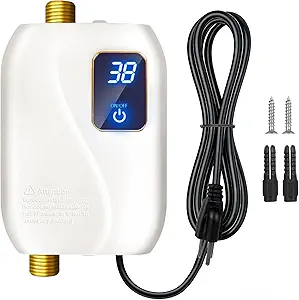 | Best for Point-of-Use Sinks | Voltage: 110V | Power: 3,000W | Temperature rise: 82°F at 0.3 GPM; 131°F at 0.5 GPM | VIEW LATEST PRICE | See Our Full Breakdown |
| CAMPLUX Indoor Natural Gas Tankless Water Heater, Up to 7.6 GPM |  | Best for High-Demand Natural Gas Use | Fuel type: Natural gas | Flow rate: 6.86 GPM listed; up to 7.6 GPM advertised | Maximum input: 199,000 BTU | VIEW LATEST PRICE | See Our Full Breakdown |
| GE Appliances 18-Gallon Electric Water Heater with Adjustable Thermostat |  | Best Compact Electric Tank | Capacity: 18 gallons | Power supply: 120 V | Water connections: 3/4-inch NPT | VIEW LATEST PRICE | See Our Full Breakdown |
More Details on Our Top Picks
Ranein Indoor Natural Gas Tankless Water Heater, 8.5 GPM, 190,000 BTU
The Ranein is the strongest fit here for households that regularly draw hot water from several outlets at once. Its 8.5 GPM flow rate and 190,000 BTU output exceed the Westinghouse’s 7.9 GPM and 180,000 BTU, giving it more stated capacity for overlapping showers and taps. A wall-mounted body keeps floor space free, while the LED display and adjustable-speed blower add operating control. That capacity comes with a firm location limit: the manufacturer does not recommend installation above 2,000 feet, which rules it out for many higher-elevation homes. Cold-weather owners also need to drain remaining water during extended downtime. I’d choose it over the APUS when simultaneous demand matters more than app control or a built-in booster pump.
Pros:- Highest stated flow rate in this group at 8.5 GPM
- 190,000 BTU output suits heavier simultaneous demand
- Wall-mounted design frees floor space
- LED display and adjustable-speed blower provide operating controls
Cons:- Manufacturer does not recommend use above 2,000 feet
- Remaining water must be drained during extended cold-weather non-use
- Two-year warranty is shorter than some buyers may prefer for a major appliance
Best for: Households at or below 2,000 feet that often run several hot-water outlets at once
Not ideal for: Homes above 2,000 feet or owners who want app-based remote controls
- Fuel:Natural gas
- Flow rate:8.5 GPM
- Heat output:190,000 BTU
- Maximum temperature:155 °F
- Dimensions:15.08 × 24.25 × 8.07 in
- Weight:42 lb
- Mounting:Wall mount
- Elevation guidance:Not recommended above 2,000 ft
Our verdict“Choose the Ranein for high simultaneous demand if your home is within its elevation guidance and you can manage winter drainage.”
APUS Natural Gas Tankless Water Heater, 140,000 BTU, 6.8 GPM, Indoor
The APUS trades the higher output of the Ranein and Westinghouse for a more connected, lower-capacity setup. Its Tuya app control lets owners adjust temperature remotely, and the built-in booster pump supports flow up to 6.8 GPM. That makes it a better match for a smaller household or a home where control and hot-water wait time matter more than running many outlets at once. The stated temperature range of 95°F to 140°F allows more adjustment than the Westinghouse specs provided here, while freeze and overheat protection add useful safeguards. The manufacturer’s circulation and ECO savings claims are not independently established by the supplied product data, so I would not choose it on those promises alone. It also needs full drainage during extended freezing conditions or non-use.
Pros:- Tuya app provides remote temperature control and monitoring
- Built-in booster pump supports flow up to 6.8 GPM
- Temperature can be set from 95°F to 140°F
- Includes freeze and overheat protection
Cons:- Lower stated flow and heat output than the Ranein and Westinghouse
- Must be fully drained during extended freezing conditions or non-use
- Circulation and energy-savings claims are manufacturer-provided
Best for: Owners of smaller homes who want remote temperature adjustment and a built-in booster pump
Not ideal for: Large households needing higher simultaneous flow, or owners unable to drain the unit before freezing weather
- Fuel:Natural gas
- Heat output:140,000 BTU
- Maximum flow rate:6.8 GPM
- Temperature range:95°F–140°F
- Energy factor (UEF):0.81
- Heat exchanger:Oxygen-free copper
- Connectivity:Wi-Fi; Tuya app
- Dimensions:7.09 × 21.26 × 13.58 in
Our verdict“Pick the APUS when app control and moderate household demand matter more than the greater capacity of the Ranein or Westinghouse.”
18L Portable Propane Tankless Water Heater with Digital Display
This portable propane unit serves a different job from the indoor gas heaters in this roundup: it brings hot water to outdoor washing, camping, or RV setups rather than supplying a whole home. Its 4.76 GPM maximum flow and one-button shower head suit portable cleanup, while the digital display makes the adjustable temperature easier to monitor. Six listed protections cover conditions such as dry combustion, flame failure, and high water pressure. By comparison, the Ranein and Westinghouse offer substantially higher stated flow for fixed home plumbing, but they are not portable outdoor options. This model depends on a propane supply and is designed for outdoor use, so it is a poor substitute for an indoor household heater. Its listed temperature range tops out at 113°F, another limit for buyers seeking hotter water.
Pros:- Portable format suits camping, RV use, and outdoor washing
- Provides up to 4.76 GPM of continuous hot water
- One-button shower head is designed to reduce water waste
- Six listed safety protections cover multiple operating faults
Cons:- Requires a propane supply
- Outdoor design limits installation options
- 113°F maximum temperature is below the Ranein’s stated 155°F maximum
Best for: Campers, RV owners, and outdoor users who need portable hot water for washing
Not ideal for: Homeowners seeking a permanent indoor water heater or water hotter than its 113°F stated maximum
- Fuel type:Propane
- Capacity:18 L
- Maximum heating output:115,425 BTU/hour
- Maximum flow rate:4.76 GPM
- Temperature range:17°F–113°F
- Display:Digital
- Safety protections:Overheat, dry combustion, antifreeze, low-flow ignition lockout, flame failure, and high water pressure relief
Our verdict“Choose this portable unit for outdoor washing and RV trips, not as a replacement for a fixed indoor household heater.”
Westinghouse Indoor Natural Gas Tankless Water Heater, 7.9 GPM, 180,000 BTU
The Westinghouse is the balanced indoor pick for households that value steady delivery and remote controls as much as raw capacity. It provides 7.9 GPM at 180,000 BTU, just below the Ranein’s 8.5 GPM and 190,000 BTU, while listing temperature stability within ±1°F. That tighter stated control can help reduce swings when water demand changes. Built-in Wi-Fi supports app and voice control, and the 0.53 GPM activation threshold gives it an advantage where occasional low-flow draws matter; the APUS also offers app control, but its maximum flow is lower at 6.8 GPM. The Westinghouse requires natural gas, 120V power, and 3/4-inch NPT plumbing. Its warranty is split, with two years for the unit and five for the heat exchanger.
Pros:- Maintains stated temperature stability within ±1°F
- 7.9 GPM capacity is close to the higher-output Ranein
- Wi-Fi app and voice controls include fault alerts
- Low-flow activation starts at 0.53 GPM
Cons:- Requires natural gas, 120V AC power, and 3/4-inch NPT plumbing
- Unit warranty is two years, while heat exchanger coverage is five years
- Flow rate is lower than the Ranein’s stated 8.5 GPM
Best for: Households wanting a fixed indoor gas heater with remote controls and tightly stated temperature stability
Not ideal for: Buyers without natural gas, 120V power, or compatible 3/4-inch NPT plumbing
- Fuel type:Natural gas
- Installation:Indoor
- Maximum flow rate:7.9 GPM
- Heating capacity:180,000 BTU
- Temperature stability:±1°F
- Minimum activation flow:0.53 GPM
- Connectivity:Built-in Wi-Fi; app and voice control
- Warranty:2 years for the unit; 5 years for the heat exchanger
Our verdict“Choose the Westinghouse if stable temperatures and connected controls matter more than the Ranein’s modestly higher stated capacity.”
110V 3000W Electric Tankless Water Heater with Digital Display
This compact electric model is a point-of-use choice for a sink, kitchenette, or compatible RV setup, not a whole-home heater. Its 3,000W output is far below the gas-fired Ranein and Westinghouse, and the product data explicitly says it is not suitable for showers. That tradeoff can make sense when the goal is local hot water without a storage tank or a longer plumbing run. The LED display shows operating status, and listed leakage, dry-boil, and overheating protections address key operating risks. The stated temperature rise varies with flow—82°F at 0.3 GPM and 131°F at 0.5 GPM—so buyers should match expectations to the outlet’s demand. Installation is vertical only and calls for a circuit over 32A, which may require electrical work.
Pros:- Compact wall-mounted design suits point-of-use installation
- On-demand heating avoids tank preheating
- LED display shows operating status
- Includes leakage, dry-boil, and overheating protections
Cons:- Not suitable for showers or whole-home demand
- Requires a circuit over 32A and vertical-only installation
- Temperature rise depends on a low flow rate
Best for: People adding on-demand hot water at a sink or kitchenette with suitable high-amperage wiring
Not ideal for: Households needing shower or whole-home hot water, or spaces without a circuit over 32A
- Voltage:110V
- Power:3,000W
- Temperature rise:82°F at 0.3 GPM; 131°F at 0.5 GPM
- Thermal efficiency:Up to 98%
- Connections:1/2-inch NPT
- Installation:Vertical only; wall-mounted
- Recommended circuit:Over 32A
- Shower suitability:Not suitable
Our verdict“Choose this electric unit for a sink where compact point-of-use heating fits the wiring and demand.”
CAMPLUX Indoor Natural Gas Tankless Water Heater, Up to 7.6 GPM
The CAMPLUX pairs a listed 6.86 GPM flow rate with a 199,000 BTU maximum input, making it a strong fit for homes that want tankless hot water across several fixtures. The listed flow rate is below the advertised 7.6 GPM, so I would compare it by the lower figure when planning simultaneous showers and taps. The Ranein Indoor Natural Gas Tankless Water Heater lists 8.5 GPM, giving it a higher stated flow rate, while this CAMPLUX offers a compact wall-mounted format and freeze protection. That protection does not remove cold-weather upkeep: the unit needs winterization below 20°F and annual descaling. Its CSA certification and multiple safety protections add useful reassurance, but ongoing maintenance makes it less hands-off than a tank heater.
Pros:- Provides on-demand hot water without tank preheating
- Compact wall-mounted design
- Freeze protection and multiple safety protections
- CSA certified
Cons:- Listed 6.86 GPM flow rate is lower than the advertised 7.6 GPM
- Requires annual descaling
- Winterization is required below 20°F
Best for: Households with natural gas service that want a wall-mounted tankless unit and can keep up with annual descaling and cold-weather winterization
Not ideal for: Buyers who need a guaranteed high simultaneous flow rate or want to avoid seasonal maintenance
- Fuel type:Natural gas
- Flow rate:6.86 GPM listed; up to 7.6 GPM advertised
- Maximum input:199,000 BTU
- Heat output:170,000 BTU/hour
- Power:120 V, 58 W
- Maximum temperature:149°F
- Connections:3/4-inch NPT
- Mounting and weight:Wall mount; 37.5 lb
- Certification and care:CSA certified; annual descaling; winterization required below 20°F
Our verdict“Choose the CAMPLUX if you want a compact natural gas tankless heater with substantial stated output and are prepared for regular maintenance.”
GE Appliances 18-Gallon Electric Water Heater with Adjustable Thermostat
This GE is a practical choice when a small space needs a modest reserve of hot water rather than the continuous output of a tankless unit. Its 18-gallon tank can serve one hookup or a small home, and the adjustable thermostat lets owners set the temperature to suit their needs. It can also work as an inline booster, giving it a second use that the CAMPLUX tankless heater does not offer. That flexibility comes with a capacity ceiling: a busy household may draw down the tank during overlapping showers or other heavy use. A 120-volt supply is convenient where compatible, but the buyer also needs 3/4-inch NPT plumbing. I would choose this for a compact installation, not as a substitute for a larger household heater.
Pros:- Compact 18-gallon capacity suits limited spaces
- Can operate on its own or as an inline booster
- Adjustable thermostat gives control over the set temperature
- Stainless steel heating element resists rust and corrosion
Cons:- 18-gallon capacity may run short for larger households
- Requires a compatible 120-volt supply
- Requires 3/4-inch NPT plumbing connections
Best for: Apartment residents, condo owners, or small households needing hot water at one hookup or a compact inline booster
Not ideal for: Larger households with frequent overlapping showers or high simultaneous hot-water demand
- Capacity:18 gallons
- Power supply:120 V
- Water connections:3/4-inch NPT
- Thermostat:Adjustable
- Heating element:Stainless steel
- Anode rod:Included
- Installation use:Standalone heater or inline booster
Our verdict“Choose the GE if you need a compact electric tank for a small household or a booster, and do not need a large hot-water reserve.”
How We Picked
I ranked these seven options by how clearly their stated design and capacity match a practical buyer need. For the indoor gas tankless models, I compared listed flow and BTU output as clues to potential simultaneous hot-water demand, while treating those figures as dependent on climate, incoming water temperature, and installation. I also weighed format and fuel: a small storage tank, a low-wattage electric tankless unit, and a portable propane heater each serve a different role from a whole-home gas system.
The Ranein ranks first for its strongest listed combination of flow and heating input among the indoor gas models. Westinghouse follows as a similar high-output alternative; APUS and CAMPLUX sit below them on stated capacity and make more sense where demand is lower. The GE tank ranks for straightforward stored-water use, the portable propane unit for mobile use, and the 3,000-watt electric tankless option for narrow point-of-use needs. Installation requirements, service availability, verified certifications, warranty terms, and local code compliance can change which model is the soundest choice, so buyers should confirm these details before purchase.
Factors to Consider When Choosing Best Water Heaters
Start with the conditions in your home or use case, then compare heater formats. The product specifications help narrow the field, but plumbing, fuel access, climate, and usage patterns often determine whether a model will work well.
Size for Simultaneous Demand, Not Household Size Alone
List the fixtures likely to run together, such as a shower and dishwasher, and estimate their combined flow. Tankless capacity is affected by the temperature rise required, so a unit’s advertised GPM does not guarantee that flow at your local winter inlet temperature. A home with cold incoming water may need more heating capacity to deliver the same shower performance. Avoid sizing only by the number of people in the house; schedules and overlapping use matter just as much. If demand regularly exceeds a unit’s output, users may see reduced flow or temperature changes. A qualified installer can help match capacity to local conditions.
Check Fuel, Venting, and Electrical Service Before Choosing
A natural gas heater needs an adequate gas supply and a compatible venting route, while propane models require a suitable propane source and setup. Electric tankless equipment can draw substantial power; the listed 3,000-watt unit is a limited-capacity appliance, and larger whole-home electric systems commonly require substantial electrical service. Confirm the home’s breaker capacity, wiring, gas line, and vent configuration before buying. Installation changes can outweigh the convenience of a compact unit. Ask an installer to check the model’s manual and local code requirements, including combustion air and vent clearances where relevant. This step can rule out an otherwise appealing option early.
Choose Between Stored Hot Water and On-Demand Heating
A storage tank keeps a reserve ready, which can make its delivery feel familiar and simple, but the amount available at once is limited by tank capacity and recovery. Tankless heaters warm water as it flows, so they can provide sustained use within their capacity but may need time to activate and can struggle with several simultaneous draws. A small tank can work for a modest demand point or limited-use setting, yet may run out during back-to-back use. Do not compare tank gallons directly with tankless GPM; they describe different aspects of performance. Think about peak use and recovery between draws before deciding which format suits your routine.
Match the Heater to Its Location and Use
Indoor whole-home heaters, point-of-use units, and portable heaters have different installation and operating assumptions. A portable propane model can serve outdoor washing or mobile use, but it needs the conditions and connections specified by its manufacturer and is not automatically suitable for indoor use. A small electric unit may make sense near one sink where only a modest amount of hot water is needed. Check dimensions, access for maintenance, drainage needs, and the manufacturer’s placement rules. For outdoor or seasonal use, consider storage and freeze protection. Buying for the intended location prevents a mismatch that raw capacity figures cannot reveal.
Compare Maintenance Access, Warranty, and Local Support
Water quality affects scale buildup, especially in tankless heat exchangers, so ask whether the model calls for periodic flushing or filtration. A heater that is difficult to access can make routine service more involved. Before choosing a lesser-known brand, confirm that replacement parts, warranty service, and qualified technicians are available in your area. Read warranty terms for coverage conditions, including installation requirements and maintenance records. Check certifications and the exact model documentation rather than relying on a product title alone. These details can matter more over time than a small difference in stated flow.
Frequently Asked Questions
Can an 8.5 GPM tankless heater run two showers at once?
Possibly, but the listed maximum alone cannot answer that reliably. The water heater must raise incoming water to the desired temperature while supplying the combined flow of both showers. Cold winter inlet water can reduce the flow available at a given temperature rise. Check each shower’s flow rate, local winter water temperature, and the heater’s performance chart before relying on simultaneous use. An installer can size the system and confirm whether the home’s gas supply supports its rated output.
Is a 3,000-watt electric tankless heater suitable for a whole house?
That wattage points to a limited application rather than typical whole-home service. Electric tankless heaters need enough power to raise water temperature at the desired flow, and 3,000 watts generally cannot deliver high flow with a large temperature rise. It may suit a single low-demand outlet, depending on local water temperature and the product’s specifications. Check the required voltage, circuit, flow chart, and intended-use statement in the manual. For multiple bathrooms or whole-home use, compare systems sized for that electrical load instead.
Should I choose the GE 18-gallon tank or a tankless heater for a small household?
Choose based on when and how much hot water you use, not household size alone. The GE tank stores a modest amount for short or low-demand use, but repeated draws can use up its reserve before it recovers. A tankless heater avoids a fixed storage volume, yet must be sized for the required temperature rise and may need more complex fuel or electrical work. For one sink or occasional use, a small tank or point-of-use unit may be simpler. For regular showers, check the tank’s recovery and capacity against your routine before deciding.
Can I install a portable propane water heater inside my home?
Do not assume that a portable propane heater is suitable for indoor installation. Use it only in the locations and configurations allowed by its manufacturer, and follow its ventilation, exhaust, water, and fuel instructions. Portable equipment may be designed for outdoor or mobile use and may not have the venting and safety features required for permanent indoor service. Check the manual and local rules before use. If you need an indoor household heater, select a model specifically listed for that installation type and have it installed to code.
What should I verify before buying a high-output natural gas tankless model?
Confirm that the gas line and meter can supply the heater’s required input, since a high BTU rating can exceed what an existing setup supports. Check vent materials, route, clearances, combustion air, condensate handling if applicable, and electrical requirements in the installation manual. Also compare the unit’s flow chart at your expected temperature rise rather than relying on its maximum GPM headline. Confirm local technician and parts availability, warranty conditions, and required maintenance. An installer can assess these items before the purchase locks you into a particular model.
Conclusion
For the strongest listed whole-home gas tankless capacity, my best overall choice is the Ranein 8.5 GPM model, provided its gas and venting requirements fit your home. The APUS is my best value by role for buyers whose demand fits its lower stated capacity; compare installation and warranty details before choosing it. Westinghouse is my premium-leaning pick for buyers who want another high-output indoor gas option and can verify service support. The GE tank is the best beginner-friendly format for modest hot-water needs where a familiar storage system makes sense. Choose the portable propane heater for mobile or outdoor use, and the 3,000-watt electric tankless unit only for a suitable low-demand point-of-use job. Match the model to your plumbing, fuel, climate, and real peak demand before making the final choice.
Fall Picks
fall essentials
As an affiliate, we earn on qualifying purchases.