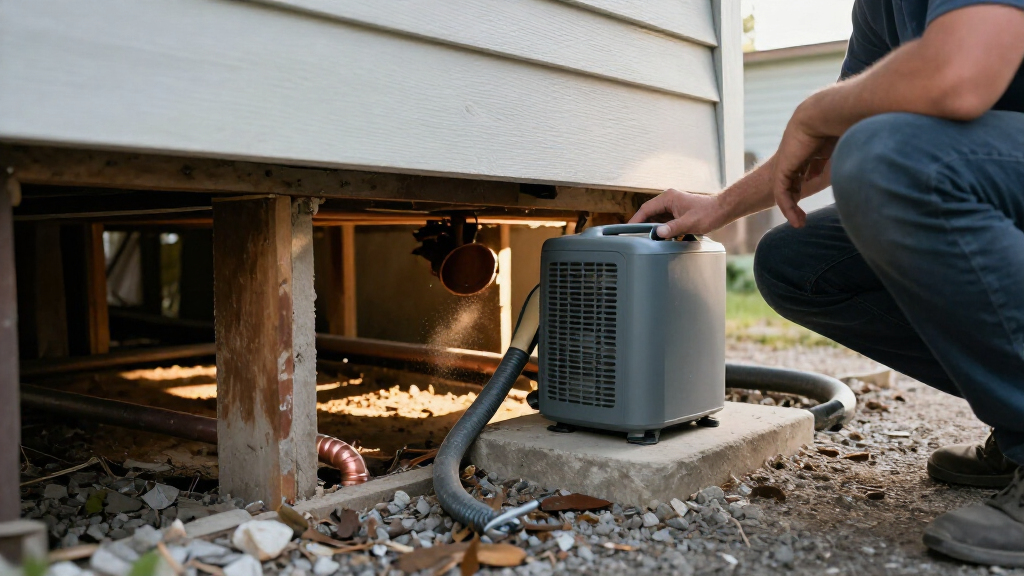
The best crawl space dehumidifier overall in this roundup is the AlorAir Sentinel HD55, a balanced choice for buyers who want substantial capacity without jumping straight to the largest units. For larger or persistently damp spaces, the Moiswell M145 and Airzentti 155 Pint stand out for their high stated capacity, while the Waykar 70-Pint is a more approachable option for smaller spaces. The main tradeoffs are capacity versus operating demands, built-in pumping versus gravity drainage, and a lower initial outlay versus features such as energy certification. The right fit depends on the crawl space’s moisture load, layout, and access for maintenance—not just its square footage. Read on for the full breakdown and a guide to choosing among all 15 models.

Get cleaning gear delivered free with Prime
- Fast, free delivery on millions of items
- Prime Video, Amazon Music and more included
- Member-only deals all year
Complete the kit


Key Takeaways
- Capacity spans a wide range: this lineup runs from 70-pint models to units advertised at 155 pints, so matching capacity to moisture conditions matters more than picking the biggest number.
- Drainage changes installation flexibility: several models include a pump, while others rely on a drain hose; the right setup depends on whether water can flow to a suitable outlet by gravity.
- The 70-pint group serves a different job: models such as the AlorAir Helios MP35, ALORAIR HS35, and Waykar are better starting points for more modest loads than the 145- or 155-pint options.
- High stated capacity is not the whole comparison: placement, drainage route, service access, and the manufacturer’s operating conditions all affect whether a large-capacity unit is a practical fit.
- Model names and capacities can overlap: the lineup includes M145-branded units listed at different capacities and several similar CADPXS options, so buyers should verify the exact model, specifications, and included drainage parts before ordering.
| Airecoler Stellar SP10 70 Pints Commercial Dehumidifier with Built-in Pump |  | Best for Easy Remote Monitoring | Moisture removal: 70 pints/day | Coverage area: 1,000 sq. ft. | Pump lift: 16.4 ft | VIEW LATEST PRICE | See Our Full Breakdown |
| Moiswell M145 155-Pint Commercial Dehumidifier for Crawl Spaces and Basements |  | Best for Very Large Crawl Spaces | Moisture removal: 155 pints/day maximum; 70 pints/day AHAM | Coverage area: Up to 6,000 sq. ft. | Airflow: 265 CFM | VIEW LATEST PRICE | See Our Full Breakdown |
| Airecoler GT-X5 125 Pints Commercial Dehumidifier for Crawl Space & Basement |  | Best Compact High-Capacity Pick | Moisture removal: 125 pints/day maximum; 60 pints/day AHAM | Coverage area: Up to 6,000 sq. ft. | Airflow: 265 CFM | VIEW LATEST PRICE | See Our Full Breakdown |
| AlorAir Helios MP35 70-Pint Crawl Space/Commercial Dehumidifier with Pump |  | Best for High-Lift Pump Drainage | Moisture removal: 70 pints/day; 8.75 gallons/day | Coverage area: 1,000 sq. ft. | Pump lift: 19.6 ft | VIEW LATEST PRICE | See Our Full Breakdown |
| Aegis HP110 120-Pint Commercial Dehumidifier with Pump for Crawl Space |  | Best for Large Spaces Needing Pumped Drainage | Moisture removal: 120 pints/day maximum; 53 pints/day AHAM | Coverage area: Up to 4,500 sq. ft. | Pump drain hose: 16.4 ft | VIEW LATEST PRICE | See Our Full Breakdown |
| CADPXS 80 Pints Crawl Space/Commercial Dehumidifier with Pump & Drain Hose |  | Best for Flexible Drainage | Capacity: 80 pints per day | Stated coverage: Up to 1,200 sq ft | Drain options: Built-in pump with 19.6 ft hose; gravity drain with 6.56 ft hose | VIEW LATEST PRICE | See Our Full Breakdown |
| AlorAir Sentinel HD55 113-Pint Crawlspace Dehumidifier |  | Best for Rugged Continuous Operation | Maximum capacity: 113 pints per day | AHAM capacity: 53 pints per day | Stated coverage: Up to 1,200 sq ft | VIEW LATEST PRICE | See Our Full Breakdown |
| Airzentti 155 Pint Commercial Dehumidifier with Pump and Drain, Energy Star Certified |  | Best for Very Large Crawl Spaces | Capacity: 155 pints per day | Stated coverage: Up to 7,500 sq ft | Airflow: 220 CFM | VIEW LATEST PRICE | See Our Full Breakdown |
| Onebei M145 120-Pint Commercial Dehumidifier for Crawl Spaces and Basements |  | Best for Low-Clearance Spaces | Capacity: 120 pints per day | Stated coverage: Up to 6,000 sq ft | Airflow: 265 CFM | VIEW LATEST PRICE | See Our Full Breakdown |
| ALORAIR 70 PPD Dehumidifier with Pump for Crawl Space and Basement |  | Best for Quiet, Pumped Drainage | Maximum capacity: 70 pints per day | AHAM capacity: 35 pints per day | Stated coverage: Up to 1,000 sq ft | VIEW LATEST PRICE | See Our Full Breakdown |
| ALORAIR Sentinel HS35 Crawlspace Dehumidifier (70 Pints) |  | Best Compact Crawl Space Pick | Capacity: 35 pints/day AHAM; 70 pints/day at saturation | Coverage: 1,000 sq. ft. | Airflow: 115 CFM | VIEW LATEST PRICE | See Our Full Breakdown |
| CADPXS 145-Pint Crawl Space Dehumidifier with Drain Hose (ETL Certified) |  | Best for Large Crawl Spaces | Capacity: 60 pints/day AHAM; up to 145 pints/day maximum | Coverage: Up to 1,800 sq. ft. | Airflow: 176 CFM | VIEW LATEST PRICE | See Our Full Breakdown |
| Waykar 70-Pint Energy Star Crawl Space Dehumidifier with Pump and Drain Hoses |  | Best for Flexible Drainage | Capacity: 70 pints/day | Recommended area: Up to 5,000 sq. ft. | Airflow: 158.82 CFM | VIEW LATEST PRICE | See Our Full Breakdown |
| CADPXS 125-Pint Commercial Crawl Space Dehumidifier |  | Best for Mid-Size Commercial Spaces | Coverage: 1,500 sq. ft. | Drainage: Gravity drainage with 6.56 ft hose | Airflow: 147 CFM | VIEW LATEST PRICE | See Our Full Breakdown |
| Airecoler 155-Pint Commercial Dehumidifier for Crawl Spaces and Basements |  | Best High-Capacity Pick | Capacity: 155 pints/day; 73.3 L/day | Coverage: 1,000–6,500 sq. ft. | Airflow: 300 CFM | VIEW LATEST PRICE | See Our Full Breakdown |
| crawl space dehumidifier | Dimensions | Airflow | Weight | Power |
|---|---|---|---|---|
| Airecoler Stellar SP10 70 Pint | 15.51 × 13.15 × 12.28 in. | 206 CFM | 40.8 lb | 450 W, 120 V |
| Moiswell M145 155-Pint Commerc | 22.5 × 14 × 14.7 in. | 265 CFM | 63 lb | 860 W |
| Airecoler GT-X5 125 Pints Comm | 19.2 × 12.2 × 13.4 in. | 265 CFM | 50 lb | 830 W, 115 V |
| AlorAir Helios MP35 70-Pint Cr | 16.1 × 11.8 × 13.1 in. | 126 CFM | — | 323 W, 115 V |
| Aegis HP110 120-Pint Commercia | 14 × 21.8 × 14.9 in. | 180 CFM | 63.2 lb | 680 W, 115 V |
| CADPXS 80 Pints Crawl Space/Co | 15.6 × 12 × 12.6 inches | — | 37 lb | 310 watts |
| AlorAir Sentinel HD55 113-Pint | 19.2 × 12.2 × 13.3 inches | 120 CFM | 41.7 lb | 460 W |
| Airzentti 155 Pint Commercial | 24.3 × 14.2 × 15 inches | 220 CFM | 59 lb | 860 watts |
| Onebei M145 120-Pint Commercia | 19.3 × 12.2 × 13.3 inches | 265 CFM | 41 lb | 308 watts |
| ALORAIR 70 PPD Dehumidifier wi | 15.2 × 11.2 × 11.4 inches | — | 38.2 lb | 331 W |
| ALORAIR Sentinel HS35 Crawlspa | 15.35 × 11.2 × 11.4 in | 115 CFM | 37.8 lb | — |
| CADPXS 145-Pint Crawl Space De | 20.9 × 13.5 × 14.5 in | 176 CFM | 51 lb | 506.8 W |
| Waykar 70-Pint Energy Star Cra | 15.79 × 13.58 × 13.15 in | 158.82 CFM | — | — |
| CADPXS 125-Pint Commercial Cra | 12.5 × 18.67 × 13.39 in | 147 CFM | 49.1 lb | 453 W |
| Airecoler 155-Pint Commercial | 14.3 × 24.3 × 15.1 in | 300 CFM | 65 lb | — |
More Details on Our Top Picks
Airecoler Stellar SP10 70 Pints Commercial Dehumidifier with Built-in Pump
The Stellar SP10 is a strong fit when the challenge is not extreme moisture volume but placing a dehumidifier where its controls are hard to reach. Its detachable wired control panel lets you check and adjust settings outside the crawl space, a practical advantage over the AlorAir Helios MP35, whose remote control is an optional accessory. The built-in pump lifts water 16.4 feet, so drainage can run upward to a suitable outlet rather than relying only on gravity.
At 70 pints per day and 206 CFM, it is sized for moderate spaces, not the largest wet crawl spaces in this group. The compact metal housing and ENERGY STAR certification help make it a considered continuous-use choice, but its 40.8-pound weight still makes initial placement a two-handed job. Choose a larger-capacity model such as the Moiswell M145 if the area needs more moisture-removal headroom.
Pros:- Detachable wired control panel can be positioned for easier monitoring outside the crawl space.
- Built-in pump supports drainage with a vertical lift of up to 16.4 feet.
- ENERGY STAR certified and rated at 450 watts.
- Compact metal housing is suited to low-clearance installations.
Cons:- The 70-pint daily capacity is below the Moiswell M145 and other large-area options.
- At 40.8 pounds, placement in a confined crawl space can take effort.
- Control panel connection is wired rather than wireless.
Best for: Owners of moderate-size crawl spaces who want pump drainage and an accessible wired control panel without choosing a high-capacity unit.
Not ideal for: Buyers with very large or persistently saturated crawl spaces, or anyone who needs wireless control or a lightweight unit for frequent repositioning.
- Moisture removal:70 pints/day
- Coverage area:1,000 sq. ft.
- Pump lift:16.4 ft
- Airflow:206 CFM
- Power:450 W, 120 V
- Dimensions:15.51 × 13.15 × 12.28 in.
- Weight:40.8 lb
- Warranty:5-year limited
Our verdict“Choose the Stellar SP10 for a moderate-size crawl space where accessible wired controls and pumped drainage matter more than maximum capacity.”
Moiswell M145 155-Pint Commercial Dehumidifier for Crawl Spaces and Basements
For a large crawl space where moisture load is the main concern, the M145 brings the highest stated maximum capacity in this five-product selection: 155 pints per day, with a listed AHAM capacity of 70 pints per day. That makes it a more heavy-duty choice than the Airecoler Stellar SP10, whose 70-pint rating and 1,000-square-foot coverage suit a smaller job. Moiswell lists coverage up to 6,000 square feet, and the horizontal form is designed to fit beneath low-clearance floors.
Auto-defrost and auto-restart reduce the need for frequent attention, while continuous gravity drainage avoids bucket emptying. The tradeoff is that this model has no built-in pump in the supplied details, so the drain must be positioned to flow downhill. At 63 pounds, it is also less convenient to maneuver than the GT-X5. Its capacity suits broad, wet areas, but buyers should check access, outlet placement, and drainage route before installation.
Pros:- High stated maximum capacity of 155 pints per day, with 70 pints per day listed at AHAM conditions.
- Coverage is listed up to 6,000 square feet.
- Horizontal design is intended for low-clearance crawl spaces.
- Auto-defrost, auto-restart, and continuous drainage support less hands-on operation.
Cons:- Continuous drainage is gravity-based; no built-in pump is listed.
- At 63 pounds, installation and repositioning may require help.
- Its large capacity and 860-watt draw may be more than a smaller or less damp space needs.
Best for: Owners managing a large crawl space with a gravity-drain route and a substantial, ongoing moisture load.
Not ideal for: Buyers who need pumped drainage to lift water, have a small crawl space, or expect to move the unit often.
- Moisture removal:155 pints/day maximum; 70 pints/day AHAM
- Coverage area:Up to 6,000 sq. ft.
- Airflow:265 CFM
- Drainage:Continuous gravity drainage
- Power:860 W
- Dimensions:22.5 × 14 × 14.7 in.
- Weight:63 lb
- Warranty:5-year limited: 2 years on unit, 3 years on parts
Our verdict“Pick the M145 for a large, moisture-heavy crawl space when gravity drainage works and capacity takes priority over easy handling.”
Airecoler GT-X5 125 Pints Commercial Dehumidifier for Crawl Space & Basement
The GT-X5 targets buyers who want more moisture-removal capacity than a 70-pint unit without moving up to the M145’s larger body. Its 19.2 × 12.2 × 13.4-inch footprint is notably compact for a commercial model listed at up to 125 pints per day, making it easier to fit around ducts and low-clearance access than the larger Moiswell M145. Airecoler lists an AHAM capacity of 60 pints per day, so buyers should distinguish that figure from the higher maximum rating when matching the unit to their conditions.
The R32 system, auto timer, auto-defrost, and continuous mode support ongoing operation, and the included drain hose removes the need for bucket emptying when a suitable gravity route is available. Unlike the pump-equipped Stellar SP10, the GT-X5 has no listed condensate pump, so it cannot lift water to a higher drain. Its 50-pound weight and standard 115-volt requirement also deserve a placement check before purchase.
Pros:- Compact dimensions relative to its listed 125-pint maximum capacity.
- R32 system, auto timer, auto-defrost, and continuous mode support automated operation.
- Includes a drain hose for continuous drainage.
- Five-year total warranty, with separate coverage periods for the unit and dehumidification system.
Cons:- No built-in pump is listed, so drainage depends on a suitable gravity route.
- The 60-pint AHAM rating is well below the 125-pint maximum figure.
- At 50 pounds, it may be difficult to move through a tight access opening.
Best for: Owners of larger crawl spaces with restricted installation room who can provide a downhill drain route and standard 115-volt power.
Not ideal for: Buyers who need water pumped vertically, want a lighter unit, or are sizing strictly by the maximum capacity figure without checking AHAM conditions.
- Moisture removal:125 pints/day maximum; 60 pints/day AHAM
- Coverage area:Up to 6,000 sq. ft.
- Airflow:265 CFM
- Power:830 W, 115 V
- Drainage:Continuous mode; drain hose included
- Dimensions:19.2 × 12.2 × 13.4 in.
- Weight:50 lb
- Warranty:5 years total: 2 years full unit, 3 years dehumidification system
Our verdict“Choose the GT-X5 when crawl-space clearance is tight but you want more capacity than the SP10 and can use gravity drainage.”
AlorAir Helios MP35 70-Pint Crawl Space/Commercial Dehumidifier with Pump
The Helios MP35 is the standout here when the drain sits well above the dehumidifier. Its built-in pump lifts condensate up to 19.6 feet, exceeding the 16.4-foot pump lift listed for the Airecoler Stellar SP10. The corrosion-resistant casing and automatic defrost and GPP modes also suit a damp, hard-to-reach installation where routine visits are inconvenient. With a listed 70-pint daily capacity and 1,000-square-foot coverage, it belongs in the same smaller-space class as the SP10 rather than competing with the high-capacity Moiswell M145.
The Helios uses just 323 watts according to the supplied specifications, though its 126 CFM airflow is lower than the SP10’s 206 CFM. That difference may matter when air circulation across a broader area is a priority. The pump setup also requires the gravity drain cap to be sealed tightly, and vibration may be an issue without the recommended hanging kit. The remote and hanging kit are optional, not included.
Pros:- Built-in pump lifts water up to 19.6 feet for flexible drainage routing.
- Corrosion-resistant casing is suited to damp crawl-space conditions.
- Automatic operation includes defrost and power-outage recovery.
- Listed power use is 323 watts.
Cons:- The 70-pint capacity and 1,000-square-foot coverage are limited compared with the M145 and GT-X5.
- Remote control and hanging kit are optional accessories.
- Pump use depends on a tightly sealed gravity drain cap, and vibration may occur without the recommended hanging kit.
Best for: Owners of moderate-size crawl spaces whose drain point is high and who want a corrosion-resistant unit with automatic operation.
Not ideal for: Buyers who want accessories included, need higher airflow or capacity, or cannot secure the drain cap and installation properly.
- Moisture removal:70 pints/day; 8.75 gallons/day
- Coverage area:1,000 sq. ft.
- Pump lift:19.6 ft
- Airflow:126 CFM
- Power:323 W, 115 V
- Dimensions:16.1 × 11.8 × 13.1 in.
- Casing:Corrosion-resistant
- Warranty:6-year limited; first 2 years full coverage
Our verdict“Choose the Helios MP35 when a high vertical drain lift and corrosion-resistant housing matter more than high airflow or maximum capacity.”
Aegis HP110 120-Pint Commercial Dehumidifier with Pump for Crawl Space
The Aegis HP110 combines substantial stated capacity with a built-in pump, a useful pairing for larger crawl spaces where a gravity drain is not practical. It is rated for 120 pints per day maximum and up to 4,500 square feet, while the listed AHAM capacity is 53 pints per day. That makes it a middle ground between the 70-pint Airecoler Stellar SP10 and the higher-capacity Moiswell M145, with the added benefit of a 16.4-foot pump hose for automatic water removal.
Its smart control panel offers a cycle timer, auto defrost, auto restart, and adjustable humidity control, so it can manage routine operation without constant access. The tradeoff is physical fit: at 21.8 inches wide and 63.2 pounds, it is less convenient to maneuver through tight crawl-space openings than the compact GT-X5. The listed 180 CFM airflow is also lower than the 265 CFM figures for the M145 and GT-X5. Check access dimensions and drainage routing before choosing it.
Pros:- 120-pint maximum capacity and listed coverage up to 4,500 square feet.
- Built-in pump and 16.4-foot drain hose support automatic water removal.
- Controls include adjustable humidity, cycle timer, auto defrost, and auto restart.
- ENERGY STAR certified with a stated IEF of 2.01 L/kWh.
Cons:- At 63.2 pounds and 21.8 inches wide, it can be awkward to install in tight access areas.
- The 53-pint AHAM rating is substantially lower than the 120-pint maximum figure.
- Its 180 CFM airflow is below the 265 CFM listed for the M145 and GT-X5.
Best for: Owners of larger crawl spaces who need a built-in pump, automatic controls, and a unit rated above the 70-pint class.
Not ideal for: Buyers with narrow crawl-space access, limited room for a wide 63-pound unit, or a need for higher airflow than 180 CFM.
- Moisture removal:120 pints/day maximum; 53 pints/day AHAM
- Coverage area:Up to 4,500 sq. ft.
- Pump drain hose:16.4 ft
- Airflow:180 CFM
- Power:680 W, 115 V
- Energy efficiency:ENERGY STAR certified; IEF 2.01 L/kWh
- Dimensions:14 × 21.8 × 14.9 in.
- Weight:63.2 lb
Our verdict“Pick the HP110 for a large crawl space that needs pumped drainage and automatic controls, provided its size fits the access route.”
CADPXS 80 Pints Crawl Space/Commercial Dehumidifier with Pump & Drain Hose
The CADPXS is a practical fit for crawl spaces where the drain location is awkward: its built-in pump lifts water up to 19.6 feet, while gravity drainage offers a simpler alternative when a floor drain sits nearby. Its 80-pint daily capacity and stated coverage up to 1,200 square feet suit moderate moisture loads, though it has less headroom than the Onebei M145’s 120-pint capacity or the larger Airzentti. At 37 pounds, this unit is lighter than those two high-capacity choices, and its compact dimensions can help in a restricted access area. A washable filter, automatic restart, timer, and automatic defrost support ongoing operation. The tradeoff is that the remote is separate, and the included hoses may not reach every installation point.
Pros:- Built-in pump supports vertical drainage up to 19.6 feet
- Gravity-drain option provides flexibility when a drain is close by
- Compact 15.6-by-12-by-12.6-inch body fits tighter installation areas
- Automatic restart, defrost, timer, and washable filter support ongoing use
Cons:- 80-pint capacity is below the Onebei M145 and Airzentti options for larger moisture loads
- Remote control is sold separately
- Included hose lengths may not suit distant drains without added hose
Best for: Homeowners with a moderate-size crawl space and a drain point that requires pumped vertical lift
Not ideal for: Owners managing very large spaces or severe moisture loads who need more capacity than 80 pints per day
- Capacity:80 pints per day
- Stated coverage:Up to 1,200 sq ft
- Drain options:Built-in pump with 19.6 ft hose; gravity drain with 6.56 ft hose
- Power:310 watts
- Voltage:115 volts
- Dimensions:15.6 × 12 × 12.6 inches
- Weight:37 lb
- Warranty:5-year limited
Our verdict“Choose the CADPXS for a moderate crawl space where flexible pump or gravity drainage matters more than maximum capacity.”
AlorAir Sentinel HD55 113-Pint Crawlspace Dehumidifier
The Sentinel HD55 favors a durable, straightforward installation over a built-in pump: continuous drainage and a rugged metal housing suit crawl spaces where the unit can stay in place and a drain hose can be routed downhill. Its stated maximum is 113 pints per day, while the listed AHAM capacity is 53 pints per day; that distinction gives buyers a more grounded comparison than looking at the maximum figure alone. The Airzentti offers higher listed capacity and a pump for vertical drainage, but it is also larger and heavier. The HD55 weighs 41.7 pounds and has automatic defrost for colder conditions. It lacks an internal tank, so drainage setup is part of installation, and its filter may need to be purchased separately. The six-year limited warranty is a notable support feature, with full coverage specified for the first two years.
Pros:- 113-pint maximum capacity with a separately stated 53-pint AHAM rating
- Continuous drainage avoids routine tank emptying
- Metal housing and automatic defrost suit demanding crawl-space conditions
- Six-year limited warranty, with full coverage for the first two years
Cons:- No built-in pump, so the drain hose needs a suitable gravity route
- At 41.7 pounds, moving it into a crawl space can be difficult
- MERV-1 filter may need to be purchased separately
Best for: Owners of larger crawl spaces who can route a permanent gravity drain and want metal construction for continuous operation
Not ideal for: Buyers who need pumped drainage to a higher outlet or want a simple, easily repositioned unit
- Maximum capacity:113 pints per day
- AHAM capacity:53 pints per day
- Stated coverage:Up to 1,200 sq ft
- Airflow:120 CFM
- Power:460 W
- Voltage:115 V AC
- Dimensions:19.2 × 12.2 × 13.3 inches
- Weight:41.7 lb
- Warranty:6-year limited; first 2 years full coverage
Our verdict“Pick the Sentinel HD55 when you want a rugged, continuously draining unit and can provide a gravity-drain route.”
Airzentti 155 Pint Commercial Dehumidifier with Pump and Drain, Energy Star Certified
For a crawl space that needs substantially more moisture removal, the Airzentti brings 155 pints per day of stated capacity and coverage listed up to 7,500 square feet. That makes it a different class of choice from the CADPXS 80-pint model, which is smaller and better suited to moderate loads. The built-in pump can send condensate up to 16.4 feet, helpful when a drain is not at floor level, and Energy Star and TUV certifications are listed. Its 220 CFM airflow also supports larger areas, but the machine weighs 59 pounds and draws 860 watts, so placement and continuous operating costs deserve attention. Compared with the Onebei M145, it offers more listed capacity and coverage, but is far heavier and physically broader. This is a high-capacity solution, not the easiest one to install in a tight crawl space.
Pros:- 155-pint daily capacity and stated coverage up to 7,500 sq ft
- Built-in pump lifts condensate up to 16.4 feet
- Energy Star and TUV certifications are listed
- Auto-defrost and timer support unattended operation
Cons:- At 59 pounds, it is difficult to maneuver into confined crawl spaces
- 860-watt power draw may add to electricity use during continuous operation
- Wider body requires more installation room than the CADPXS or ALORAIR 70 PPD
Best for: Owners of very large or persistently damp crawl spaces who need high capacity and pumped drainage
Not ideal for: Buyers with a small crawl space, limited access, or a priority on low power draw and easy repositioning
- Capacity:155 pints per day
- Stated coverage:Up to 7,500 sq ft
- Airflow:220 CFM
- Pump lift:16.4 ft
- Power:860 watts
- Dimensions:24.3 × 14.2 × 15 inches
- Weight:59 lb
- Certifications:Energy Star, TUV
Our verdict“Choose the Airzentti when a very large, wet space calls for high capacity and a pump, and the heavy, high-draw unit will fit the installation.”
Onebei M145 120-Pint Commercial Dehumidifier for Crawl Spaces and Basements
The Onebei M145’s horizontal, low-profile design is its clearest advantage: at 13.3 inches tall, it can suit crawl spaces where upright equipment is hard to place. It offers 120 pints per day of listed capacity and coverage up to 6,000 square feet, putting it between the CADPXS 80-pint unit and the Airzentti 155-pint model on stated capacity. Its 265 CFM airflow, continuous drain, auto-restart, and auto-defrost make it suited to longer unattended runs. Unlike the CADPXS and Airzentti, the supplied product details do not list a built-in pump, so buyers should confirm that a gravity drain can work for their layout. At 41 pounds, it is no lightweight, and its compact profile does not make it effortless to move. The key appeal is fitting useful capacity into a low space.
Pros:- Low 13.3-inch height and horizontal layout suit restricted headroom
- 120-pint daily capacity with stated coverage up to 6,000 sq ft
- 265 CFM airflow supports circulation through a larger area
- Auto-restart, auto-defrost, timer, and adjustable humidity control are listed
Cons:- No built-in pump is listed, limiting fit where gravity drainage is unavailable
- At 41 pounds, it is cumbersome to move through tight access points
- The high stated coverage may exceed what a small crawl space needs
Best for: Homeowners with a low-clearance crawl space who need more capacity than a compact 80-pint unit
Not ideal for: Installations where condensate must be pumped uphill or where equipment needs frequent repositioning
- Capacity:120 pints per day
- Stated coverage:Up to 6,000 sq ft
- Airflow:265 CFM
- Dimensions:19.3 × 12.2 × 13.3 inches
- Weight:41 lb
- Power:308 watts
- Drainage:Continuous drain
- Controls and protection:24-hour timer, adjustable humidity control, auto-defrost, auto-restart
Our verdict“Choose the Onebei M145 when low clearance is the main constraint and you have a workable continuous-drain route.”
ALORAIR 70 PPD Dehumidifier with Pump for Crawl Space and Basement
The ALORAIR 70 PPD is a smaller-capacity alternative for crawl spaces where quiet operation and pumped drainage matter more than maximum extraction. Its built-in pump lifts water up to 19.6 feet, a longer stated lift than the Airzentti’s 16.4 feet, while its 70-pint maximum capacity and 1,000-square-foot coverage are below the CADPXS 80-pint model’s stated capacity and area. The listed AHAM capacity is 35 pints per day, so buyers should distinguish that figure from the 70-pint maximum when sizing for damp conditions. Operation below 50 dB may be welcome near occupied rooms, and automatic defrost supports colder crawl spaces. At 38.2 pounds, it remains a substantial unit to carry into a confined area. Its MERV-1 filter is listed as capturing 95% of airborne pollutants, but that does not compensate for its lower capacity in larger spaces.
Pros:- Built-in pump lifts condensate up to 19.6 feet
- Quiet operation is specified below 50 dB
- Automatic defrost supports operation in low-temperature settings
- Six-year limited warranty, with first two years of full coverage
Cons:- 70-pint maximum capacity is lower than the Onebei M145 and Airzentti
- Listed AHAM capacity is 35 pints per day, well below the maximum figure
- At 38.2 pounds, it can be awkward to carry through a crawl-space access opening
Best for: Homeowners with a crawl space up to the stated 1,000-square-foot coverage who need quiet operation and pumped drainage
Not ideal for: Owners with large or heavily damp spaces who need higher capacity than 70 pints per day
- Maximum capacity:70 pints per day
- AHAM capacity:35 pints per day
- Stated coverage:Up to 1,000 sq ft
- Pump lift:19.6 ft
- Noise:Below 50 dB
- Power:331 W
- Dimensions:15.2 × 11.2 × 11.4 inches
- Weight:38.2 lb
- Warranty:6-year limited; first 2 years full coverage
Our verdict“Pick the ALORAIR 70 PPD for a moderate crawl space where quiet running and a long pump lift outweigh the need for higher capacity.”
ALORAIR Sentinel HS35 Crawlspace Dehumidifier (70 Pints)
The Sentinel HS35 suits buyers who need a crawl-space-oriented unit without the footprint of the largest commercial models. Its listed coverage is 1,000 sq. ft., and gravity drainage avoids the routine of emptying a tank when a suitable drain is nearby. Auto-defrost adds useful protection in cooler crawl spaces, while the washable MERV-1 filter keeps basic upkeep straightforward. Compared with the CADPXS 125-Pint, the HS35 is smaller and lighter, but it is also aimed at less demanding areas. Its capacity figures need context: the 70-pint rating is at saturation, while its AHAM rating is 35 pints per day. The tradeoff is simple manual humidity control rather than a digital display, and at 37.8 pounds it may still take two hands to position.
Pros:- Compact dimensions make it easier to fit in tighter crawl-space access areas than larger commercial units.
- Gravity drainage supports continuous operation without frequent tank emptying.
- Auto-defrost is useful where crawl-space temperatures run low.
- Washable MERV-1 filter reduces the need to replace the basic filter routinely.
Cons:- The 70-pint figure is at saturation; the listed AHAM capacity is 35 pints per day.
- Manual humidity knobs provide less precise adjustment than LCD controls.
- At 37.8 pounds, positioning or installation can still be awkward for one person.
Best for: Owners of crawl spaces or basements around 1,000 sq. ft. who want gravity drainage, low-temperature defrost, and a relatively compact unit.
Not ideal for: Buyers with very large or persistently wet spaces who need the higher standard capacity of a larger commercial model, or those who want digital humidity controls.
- Capacity:35 pints/day AHAM; 70 pints/day at saturation
- Coverage:1,000 sq. ft.
- Airflow:115 CFM
- Noise:Less than 50 dB
- Drainage:Continuous gravity drainage
- Dimensions:15.35 × 11.2 × 11.4 in
- Weight:37.8 lb
- Filter and certification:Washable MERV-1; ETL listed
- Warranty:6-year limited
Our verdict“Choose the Sentinel HS35 for a compact, straightforward crawl-space unit sized around 1,000 sq. ft., not for the most demanding moisture loads.”
CADPXS 145-Pint Crawl Space Dehumidifier with Drain Hose (ETL Certified)
For a large crawl space where capacity matters more than easy relocation, the CADPXS 145-Pint offers a stronger scale than the Sentinel HS35 or CADPXS 125-Pint. Its stated coverage reaches 1,800 sq. ft., with 60 pints per day at AHAM conditions and a maximum rating of 145 pints. LCD controls, a timer, and memory start make it easier to set a schedule and resume operation after an outage than the HS35’s manual knobs. The metal enclosure and floor-or-ceiling mounting options also give installers more placement choices. The main constraint is drainage: its included hose relies on gravity, so the drain must sit appropriately below the unit. At 51 pounds, it is not a casual move, and the listed package does not include a pump for uphill or remote drainage.
Pros:- Higher stated capacity and coverage than the 1,000-sq.-ft. Sentinel HS35.
- LCD controls, timer, and memory start support scheduled, repeatable operation.
- Gravity-drain hose avoids regular manual water removal.
- Floor or ceiling mounting options allow more installation flexibility.
Cons:- Gravity drainage limits placement when the drain is not lower than the unit.
- No built-in pump is listed for uphill or distant drainage.
- The 51-pound weight makes solo repositioning difficult.
Best for: Owners or installers managing large crawl spaces up to 1,800 sq. ft. with a nearby gravity drain and a need for programmable controls.
Not ideal for: Buyers whose drain is above the unit, who need a built-in pump, or who expect to move the dehumidifier frequently.
- Capacity:60 pints/day AHAM; up to 145 pints/day maximum
- Coverage:Up to 1,800 sq. ft.
- Airflow:176 CFM
- Drain hose:6.56 ft, gravity drainage
- Power:506.8 W
- Voltage:115 V
- Dimensions:20.9 × 13.5 × 14.5 in
- Weight:51 lb
- Warranty:5-year limited
Our verdict“Pick this CADPXS when a large crawl space needs substantial capacity and digital scheduling, provided gravity drainage fits the installation.”
Waykar 70-Pint Energy Star Crawl Space Dehumidifier with Pump and Drain Hoses
The Waykar 70-Pint is the most adaptable choice here when the crawl-space drain is not directly beneath the unit. Its built-in pump can lift water vertically up to 16.4 feet, while a separate gravity hose offers a simpler route when a floor drain is available. That flexibility is a meaningful advantage over the gravity-only CADPXS 145-Pint and the Airecoler 155-Pint. The unit also has adjustable humidity controls, a digital display, automatic restart, and a washable filter, giving it a broader control set than the Sentinel HS35. Its stated coverage of 5,000 sq. ft. is unusually expansive for a 70-pint model, so buyers should match capacity to actual moisture conditions rather than rely on area alone. The single operating speed limits airflow tuning, and the remote control is sold separately.
Pros:- Built-in pump lifts condensate up to 16.4 ft, unlike the gravity-only CADPXS and Airecoler models in this group.
- Includes both pump and gravity drainage hoses for different installation layouts.
- Digital display and adjustable humidity range allow more control than the Sentinel HS35’s manual knobs.
- Automatic restart and washable filter support ongoing operation and routine maintenance.
Cons:- One operating speed limits airflow adjustment.
- Remote control is sold separately.
- The stated 5,000-sq.-ft. coverage should not replace checking moisture load and conditions against its 70-pint capacity.
Best for: Crawl-space owners who need pumped drainage to a higher outlet, want a gravity-drain backup option, and value adjustable digital controls.
Not ideal for: Buyers who need multiple fan speeds, included remote operation, or want to choose a unit solely on the unusually broad stated coverage figure.
- Capacity:70 pints/day
- Recommended area:Up to 5,000 sq. ft.
- Airflow:158.82 CFM
- Pump drainage:16.4 ft hose; pumps vertically up to 16.4 ft
- Gravity drainage:6.6 ft hose
- Humidity range:10%–90% RH
- Power and voltage:265 W; 110 V
- Dimensions:15.79 × 13.58 × 13.15 in
- Warranty:1 year, with 1 additional year after registration; 5-year compressor warranty
Our verdict“Choose the Waykar when drainage flexibility is the priority and its single-speed operation suits the crawl-space setup.”
CADPXS 125-Pint Commercial Crawl Space Dehumidifier
The CADPXS 125-Pint fills the gap between the smaller Sentinel HS35 and the larger 145-pint CADPXS: it is listed for areas up to 1,500 sq. ft. and pairs continuous gravity drainage with a timer, automatic restart, and defrost. Those functions suit a crawl space where the unit can stay installed and run with little day-to-day attention. Its 453-watt draw and 147 CFM airflow are specified, helping buyers compare operating demands with the larger CADPXS 145-Pint, which has more airflow and greater stated coverage. Capacity figures vary by conditions here: the listing gives 37 pints per day at DOE conditions and 60 at AHAM conditions, alongside a 125-pint headline figure. It has no internal reservoir or pump, and optional remote and hanging kits add installation considerations.
Pros:- Listed 1,500-sq.-ft. coverage places it between the Sentinel HS35 and CADPXS 145-Pint.
- Gravity drainage supports continuous use without emptying a tank.
- Automatic defrost and restart help maintain operation through cooler periods and power interruptions.
- Includes a MERV-1 filter and 24-hour timer.
Cons:- No internal reservoir or pump; installation depends on a suitable gravity-drain route.
- Remote control and hanging kits are optional accessories.
- The 125-pint headline rating differs from the listed 37-pint DOE and 60-pint AHAM capacities.
Best for: Owners of mid-size crawl spaces up to 1,500 sq. ft. who have a lower drain nearby and prefer timer-based continuous operation.
Not ideal for: Buyers needing pumped drainage, a water reservoir, included remote operation, or capacity suited to a larger area than its listed coverage.
- Coverage:1,500 sq. ft.
- Drainage:Gravity drainage with 6.56 ft hose
- Airflow:147 CFM
- Power:453 W
- Dimensions:12.5 × 18.67 × 13.39 in
- Weight:49.1 lb
- Filter and certification:MERV-1; cETL
- Warranty:5-year limited
Our verdict“This CADPXS fits mid-size crawl spaces with a gravity drain, but buyers should compare its condition-specific capacity ratings before sizing it for a wet area.”
Airecoler 155-Pint Commercial Dehumidifier for Crawl Spaces and Basements
When a large crawl space needs substantial moisture removal, the Airecoler 155-Pint brings the highest stated capacity in this five-product group, along with 300 CFM airflow and listed coverage reaching 6,500 sq. ft. Its ENERGY STAR certification and stated IEF of 2.01 L/kWh offer useful efficiency context for a unit intended to run continuously. A detachable control panel allows operation from a more accessible location, while power-recovery memory can resume settings after an outage. Compared with the Waykar 70-Pint, this is built for a much larger moisture load, but it gives up pumped drainage: the included 6.56-foot hose depends on gravity. The 65-pound metal body is also the heaviest option in this batch, and a single fan speed leaves little room to tailor airflow to a particular installation.
Pros:- Highest stated capacity in this batch at 155 pints per day.
- 300 CFM airflow and coverage listed up to 6,500 sq. ft. suit larger enclosed areas.
- ENERGY STAR certified with a stated IEF of 2.01 L/kWh.
- Detachable control panel and power-recovery memory aid operation after installation.
Cons:- Gravity drainage only; no built-in pump is listed for uphill drainage.
- At 65 pounds, it is difficult to move through tight crawl-space access.
- Single-speed operation limits airflow adjustment.
Best for: Owners of large crawl spaces or basements with heavy moisture loads, a suitable gravity drain, and room for a substantial fixed installation.
Not ideal for: Buyers with elevated or remote drainage, tight access, frequent relocation needs, or a preference for multiple fan speeds.
- Capacity:155 pints/day; 73.3 L/day
- Coverage:1,000–6,500 sq. ft.
- Airflow:300 CFM
- Efficiency:ENERGY STAR certified; IEF 2.01 L/kWh
- Drainage:Continuous gravity drainage; 6.56 ft hose
- Power and voltage:860 W; 120 V
- Dimensions:14.3 × 24.3 × 15.1 in
- Weight:65 lb
- Warranty:5-year limited: 2 years full unit replacement, 3 years parts
Our verdict“Choose the Airecoler for a large, moisture-heavy space with a gravity drain and fixed placement, not for flexible drainage or easy relocation.”
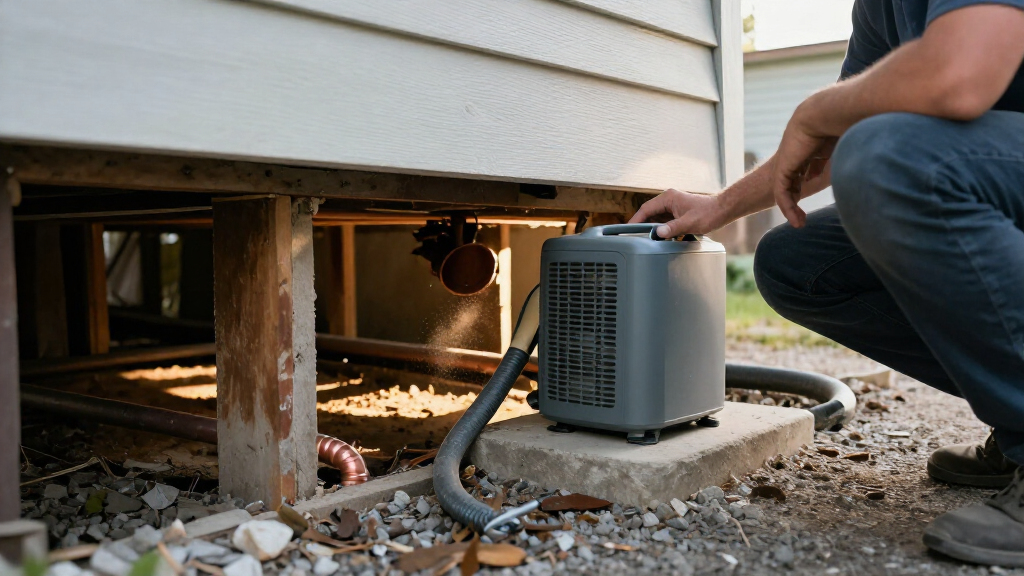
How We Picked
I compared the 15 listed models by the factors that shape crawl-space ownership: stated moisture-removal capacity, drainage method, crawl-space suitability, available efficiency or certification claims, and the practical demands of installation and upkeep. Capacity matters, but a pump can be more useful than extra pints when the unit sits below the drain outlet; conversely, a gravity hose can be simpler when a dependable downhill route is available. I also treated product names and listed specifications carefully, since several entries share a brand or model label while showing different capacities.
The ranking favors balanced utility over capacity alone. The AlorAir Sentinel HD55 leads as a middle-ground pick between modest 70-pint units and the largest advertised machines; higher-capacity models follow for buyers with larger or heavier moisture loads, while smaller and more focused options suit limited spaces or simpler installations. Energy Star or ETL claims are useful comparison points, but they do not by themselves establish operating cost, noise, durability, or real-world removal rates. Since the supplied product list does not provide consistent room conditions, energy data, or warranty terms, I do not treat those details as verified performance guarantees.
Factors to Consider When Choosing Best Crawl Space Dehumidifiers
Before choosing a unit, I would start with the crawl space itself rather than the product’s headline capacity. These broader decisions can prevent a mismatch that no feature list can fix: an undersized machine may run constantly, while an oversized one can add installation and operating demands without solving drainage or air-leak problems.
Match Capacity to Moisture Load, Not Just Floor Area
Square footage is only a starting point because two crawl spaces of equal size can have very different moisture loads. Soil exposure, standing water, climate, air leakage, and the condition of the vapor barrier all affect how hard a dehumidifier must work. A 70-pint model may suit a relatively controlled space, while persistent dampness can call for a higher-capacity unit such as one of the 120- to 155-pint models here. Do not treat a larger rating as an automatic upgrade: check the manufacturer’s stated test conditions and confirm that the model is intended for the expected temperature range. If water enters through a leak or poor drainage, fix that source rather than asking the dehumidifier to handle it indefinitely. When conditions are uncertain, a moisture assessment can help avoid buying by guesswork.
Choose a Drainage Plan Before You Choose a Pump
A built-in pump is useful when condensate must travel upward or across a distance to reach an approved drain, but it adds a component that needs power and may need service. A gravity-drain hose can be simpler and quieter when the unit can sit above a drain and the hose can maintain a continuous downward slope. Crawl spaces often have limited clearance, so sketch the route from the unit to the discharge point before buying. Check hose connection size, pump lift limits, and whether the included hose length suits your layout; do not assume those details from the product name. Never route condensate where it can seep back under the home or create a new moisture problem. A good drainage plan can make a lower-capacity model more practical than a larger one with nowhere to send its water.
Check Crawl-Space Conditions and Service Access
Cold temperatures can affect dehumidifier performance, and a unit designed for a basement may not behave the same way in a chilly crawl space. Look for the model’s permitted operating temperature range and any defrost or low-temperature protections in its documentation. Measure access openings, clearance around the unit, and the route needed to carry it into place before choosing a heavy commercial model. Filters, coils, controls, and drain connections need room for inspection even if the unit fits under the floor. Restricted access can turn routine cleaning into a difficult service job, which matters more over time than a small difference in headline capacity. If the crawl space is especially low or hard to reach, favor a design and installation plan that leave the service points accessible.
Compare Efficiency Claims With Actual Operating Needs
Because a crawl-space dehumidifier may run for long periods, energy use can shape ownership cost. An Energy Star label, where verified for the exact model, can provide a useful efficiency signal, but it is not a substitute for checking rated power draw and the conditions behind the rating. Compare units on a consistent basis rather than assuming a higher pint rating means more efficient moisture removal. A machine that is too small for the load may run continuously, while an oversized unit can be unnecessary for a well-sealed, low-moisture space. Humidistat controls and automatic restart can help the unit respond to changing conditions and recover after a power interruption, but buyers should confirm those functions in the specification sheet. If energy use is a priority, compare documented operating data for the exact model and plan to monitor humidity after installation.
Treat Certifications, Warranty, and Support as Separate Checks
Certification labels can help confirm that a product has met a particular safety or efficiency standard, but each label covers a defined scope. Verify that the certification applies to the exact model being sold rather than relying on a similar product name or a listing headline. Then read the warranty terms for coverage length, exclusions, labor, and who handles service, since commercial-style equipment may have different support conditions from household appliances. Ask how replacement filters or other maintenance parts are obtained and whether service can be performed without removing the unit from the crawl space. Keep the model number and purchase documentation together for future claims. These checks can matter more than a small capacity difference when the unit will be difficult to access after installation.
Decide When Paying for More Capacity Makes Sense
Higher-capacity models make the most sense when the crawl space has a substantial moisture load, frequent damp conditions, or an area that a smaller unit is unlikely to manage. They are a weaker fit when moisture is limited, the space is well sealed, or the electrical and drainage setup cannot support a larger commercial machine. Before stepping up from a 70-pint unit to a 145- or 155-pint model, consider whether air sealing, a ground vapor barrier, or water management would address the underlying cause more directly. A larger model may also take more effort to position and maintain, so check its dimensions and service requirements rather than comparing capacity alone. For buyers who are unsure, choose based on documented conditions and a clear return or support policy. Paying for more capacity is justified when it addresses a real load—not simply because the largest number looks safer.
Frequently Asked Questions
Should I choose a 70-pint unit or one rated at 120 pints or more?
Start with the crawl space’s moisture load, temperature, and the manufacturer’s rating conditions rather than choosing by floor area alone. The 70-pint models in this roundup are the more restrained options, while the 120- to 155-pint models are aimed at heavier demands. A larger rating can provide more headroom, but it may bring greater installation and operating requirements. If the space has standing water or a persistent leak, address that source before relying on added capacity. When the load is unclear, ask a qualified moisture-control professional to assess the space and compare exact model specifications.
Do I need a built-in pump for a crawl space dehumidifier?
You need a pump when condensate must be lifted to a drain or moved along a route that cannot maintain a steady downhill slope. If the unit can sit higher than a suitable drain, a gravity hose may be simpler and avoids relying on a pump mechanism. The Airecoler SP10, AlorAir Helios MP35, and several other listed models advertise pumps, while other models emphasize a drain hose; check the exact model’s setup instructions before deciding. Confirm pump lift limits and hose routing details rather than assuming a pump will reach any outlet. The drainage path should carry water away from the foundation and prevent it from returning to the crawl space.
Can a basement dehumidifier model work in a crawl space?
Some products in this lineup are described for both crawl spaces and basements, but that wording alone does not confirm suitability for every crawl-space condition. Temperature range, clearance, drainage, and access for filter and coil maintenance can differ substantially under a home. Check the manual for operating-temperature limits and required installation clearances, especially if the crawl space gets cold. Also measure the access opening and placement area before ordering a bulky commercial unit. A model that fits the stated application but cannot be serviced safely or drained correctly may be a poor practical choice.
Is an Energy Star or ETL claim enough to decide between these models?
No. A label can help with a specific efficiency or safety comparison, but it does not tell you whether the capacity, drainage setup, or operating range fits your crawl space. Verify the certification for the exact model and check the documentation for power use, temperature limits, and installation requirements. The listed lineup includes an Energy Star-described 120-pint unit and an Energy Star-certified Airzentti model, as well as a CADPXS model described as ETL certified; confirm those claims with current product documents. Warranty and service access still deserve separate checks. Use certification as one part of the decision, not a substitute for fit.
What should I fix before installing a crawl space dehumidifier?
Look for plumbing leaks, roof or foundation water entry, poor exterior drainage, exposed soil, and gaps that let humid outside air enter. A dehumidifier can remove moisture from the air, but it is not a repair for water intrusion or a replacement for sound crawl-space moisture control. If water collects on the ground, resolve the drainage problem before choosing a machine to run against it. A ground vapor barrier and appropriate air sealing may reduce the load and let a smaller unit work more effectively. After repairs, monitor humidity and follow the chosen model’s setup and maintenance instructions.
Conclusion
For a balanced recommendation, I would start with the AlorAir Sentinel HD55 as the best overall pick in this lineup, while confirming its current specifications and fit for the crawl space. The Waykar 70-Pint is my best for beginners choice for buyers seeking a more approachable-capacity option, provided its drainage and operating range match the site. For best value, compare the CADPXS 80-pint model against the 70-pint options using the exact included parts, warranty, and verified specifications rather than the capacity label alone. For best premium and heavy-moisture needs, the Moiswell M145 or Airzentti 155 Pint offers a higher-capacity direction; choose between them only after checking their documentation, drainage arrangement, and operating demands. For specific layouts that need pumped condensate, focus on pump lift and hose routing in models such as the Airecoler SP10 or AlorAir Helios MP35. Match the machine to the moisture source and drain plan first, then use capacity and features to settle the final choice.
Fall Picks

eufy Security Essential 7-Piece Alarm System
As an affiliate, we earn on qualifying purchases.